Auction-Based Self-Custodial Bitcoin Staking: A PoX-6 Deep Dive
PoX-6 is the next upgrade to Bitcoin staking on Stacks. It replaces today's managed allocation of self-custodial staking capacity with an open auction: any participant who sources STX can bid for capacity, and the market, rather than a whitelist, decides who stakes BTC on the Bitcoin L1 and earns BTC. In 2027, the open auction will let anyone stake BTC in the self-custodial path.
Everything here is in research and development, not a commitment from core engineers. Scope can change, and the final design is set through the community SIP (Stacks Improvement Proposal) process before activation. The Genesis Bond (230 BTC) and Bond 2 (505 BTC) are the production data the research draws on.
What changes in PoX-6
During the bootstrap phase, self-custodial Bitcoin staking is whitelisted for anchor participants, and each bonding period's capacity is allocated to the participants that grow the Bitcoin economy on Stacks (with the Stacks Endowment setting the rate and sizing the period). That let institutions run the product firsthand at small scale: 735 BTC staked across two bonds, with UTXO Management, Sypher Capital, 21Shares and HashKey among the first in.
PoX-6 removes the allocation step. Capacity is sold at auction instead of assigned, so bids rather than a review decide who stakes self-custodially. The whitelist and the application process belong to the bootstrap phase and are not in the design under study.
Two more properties are built in. Each position's STX-to-BTC ratio locks at a fixed Bitcoin block height, so its terms are deterministic and anyone reading the chain can verify them. And pooling moves to the protocol level, covered below.
How the auction would work
The design follows the model of US Treasury auctions. Institutions bid competitively for staking capacity, the auction clears at a single rate, and individuals who do not bid directly take part at the clearing rate through pooled products from wallets and exchanges. A bidder sources STX, bids for capacity in a bonding period, and if the bid clears, locks that STX beside the BTC they stake for the term.
Three parts of the design are not in question. Bidders compete for capacity, meaning the STX that has to be paired with each staked BTC for it to earn. Results publish at a fixed Bitcoin block height, so anyone can verify a position's ratio and term from the moment it opens. And the BTC never moves: it stays timelocked on Bitcoin under the participant's custody, as in the Genesis Bond today.
How the clearing rate is determined, whether a reserve applies, and what happens to unfilled capacity are open questions for the SIP process.
Where does the yield come from?
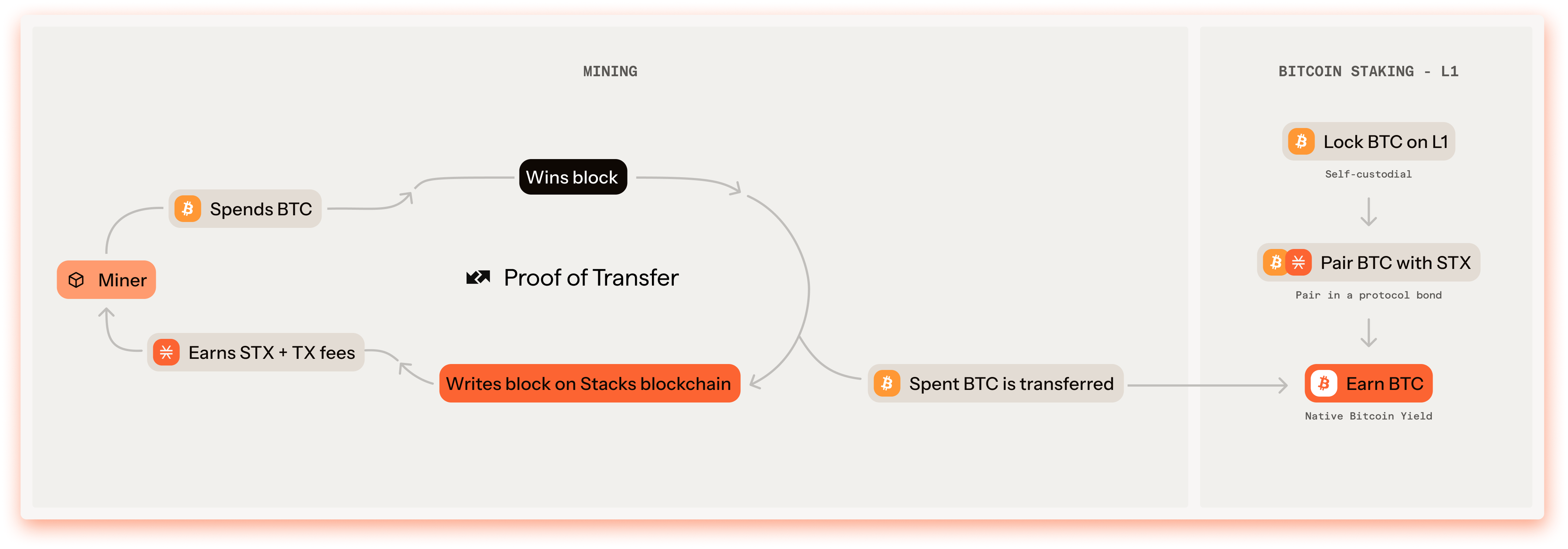
The yield comes from Stacks miners, who commit BTC through Proof of Transfer (PoX), the consensus mechanism Stacks has run in production since January 2021. That BTC is distributed to participants, and PoX has paid out over 4,200 BTC since launch. PoX-6 changes how the capacity to receive that BTC is priced and who can hold it, not where it comes from.
Protocol-level pooling
The second focus of the research is a standard way for exchanges and custodians to offer Bitcoin staking to their own clients. Today each of the confirmed pools (StackingDAO, Esbee DAO and Xverse) runs its own integration. Under PoX-6, pooling becomes a protocol primitive: a venue aggregates client BTC into positions won at auction, with no bespoke integration.
This is how individuals reach the clearing rate: an exchange or wallet bids, or buys capacity at the clearing rate, and passes the position through to its customers. Pooled positions are not self-custodial. Their custody model belongs to the venue, as pooled Bitcoin staking today runs through sBTC and the pool rather than a timelock the participant controls. Which venues offer it, and on what terms, is for those venues to announce.
Staking positions as a building block for Bitcoin capital markets
A position issued at auction has a known term, a known STX-to-BTC ratio and a known BTC reward stream, all published onchain at a fixed block height. That makes it a standardized instrument, which is what capital markets are built from. The designs under study open positions to DeFi primitives on Stacks in four ways, each at the active research stage.
Fractional positions
Positions won at auction are large, because the bidders are institutions and venues. A position can be split so smaller holders own a share of it and its BTC yield, so one position is held by many participants, none of whom needs to bid.
Principal and yield, separated
A position can be divided into a principal component that returns the BTC at maturity and a yield component that receives the BTC rewards over the term, the STRIPS structure the US Treasury uses to separate coupons from principal. One holder locks in a fixed BTC yield; another holds the principal and takes the variable reward.
Early exit and re-entry
Staked BTC is locked for the bond's term. The research includes mechanics for a holder to sell a position before maturity and for a buyer to step into it, so the position is liquid while the BTC stays in the timelock. Further out, the same primitives support fixed-income products institutional desks already use: selling or borrowing against future rewards, and pricing a yield curve across bonding periods of different lengths.
A Bitcoin staking reference rate
Auction results at fixed Bitcoin block heights create a public, verifiable record of what the market paid for capacity in each period. That series lays the foundation for a Bitcoin staking reference rate, a benchmark lenders and structured products can price against, the way SOFR (the Secured Overnight Financing Rate) anchors dollar lending.
These pieces lead to self-custodial Bitcoin lending. In 2027, holders will be able to borrow stablecoins against staked BTC without selling it, while it keeps earning. Longer term, capital anchored in staking positions becomes borrowable while the BTC stays in the holder's custody on the Bitcoin L1.
What PoX-6 means for STX
In an open auction, STX is the asset bidders source to win Bitcoin staking capacity. Every self-custodial, pooled and fractional position needs STX locked beside the BTC for the term, at a current parameter of 5% of the staked BTC value, so demand for Bitcoin yield shows up as demand for STX. Across the first two bonds, staked STX rose from 392M to 493M, and Bond 2 alone required 6.7M STX.
A leasing model under exploration broadens that role. Instead of staking BTC themselves, STX holders could provide capacity to Bitcoin stakers for a share of the BTC yield. With transferable positions, locked STX becomes productive capital: holders earn BTC as capacity providers and can sell or borrow against a position before maturity.
Risks and tradeoffs
An auction replaces a set rate with a market rate. During the bootstrap phase each bond carries a 3% target annual yield, set before it opens and fixed for its term. Under an auction, capacity costs whatever bidders pay, and that can differ from one period to the next. A position is still fixed for its own term once it clears; what moves is the price of entering the next one.
Sourcing STX becomes the bidder's job. A participant who wants self-custodial capacity has to acquire and lock the STX to bid, and a bid that does not clear earns nothing for that period.
Custody differs by path. Self-custodial positions keep BTC timelocked on Bitcoin under the participant's custody, with no slashing, and the BTC unlocks at the end of the term. Pooled positions run through a venue and through sBTC, which is secured by a decentralized signer set requiring 70% consensus; they are not self-custodial, and their risk profile is the venue's and sBTC's.
Fractional, split and transferable positions are new instruments. Their pricing, their liquidity before maturity and their treatment under the rules that apply to a given holder are unknown until they exist.
What changes by path
Self-custodial
The whitelist and application give way to a bid. Capacity is priced by the market, positions are verifiable at a known block height, and the principal-and-yield split and the reference rate are instruments desks already know how to price. Custody is unchanged: BTC timelocked on Bitcoin under the participant's custody, or held by a qualified custodian such as Anchorage Digital on their behalf. Details at stacks.co/institutional-bitcoin-staking.
Pooled
Holders who do not want to bid reach the clearing rate through pooled products from wallets and exchanges, or own a slice of a position through fractionalization. Today's paths are at stacks.co/bitcoinstaking.
STX
STX is what bidders need to win capacity, and leasing lets STX holders earn a share of BTC yield without staking BTC themselves. Transferable positions mean locked STX can be sold or borrowed against before the term ends. More at stacks.co/stx.
Frequently asked questions
When does PoX-6 activate? In 2027, the open auction will let anyone stake BTC in the self-custodial path. The activation height is set through the SIP process; no date is confirmed. PoX-5, the current version, activated at Bitcoin block 960,230 on July 30, 2026.
Is PoX-6 confirmed? No. Every feature here is in research and development, not a commitment from core engineers. The community sets the final design through a SIP before activation.
Do I still need to be whitelisted to stake BTC self-custodially? During the bootstrap phase, yes. PoX-6 is designed to replace the whitelist with an auction open to anyone who sources STX.
Does the auction change where my BTC is held? No. In the self-custodial path, BTC stays timelocked on Bitcoin under your custody. Pooled positions run through a venue and sBTC and are not self-custodial.
Can I sell a position before it matures? Early exit and re-entry mechanics are in research, so a holder could sell a position before maturity while the BTC stays in the timelock. This is not available in the current bonding periods.
What does an STX holder get out of PoX-6? STX is what bidders source to win capacity, so demand for Bitcoin yield is demand for STX. A leasing model under exploration would also let STX holders earn a share of BTC yield by providing capacity to Bitcoin stakers.
Where to start
Bitcoin staking is live now in the bootstrap phase. Anchor participants can apply for self-custodial capacity at stacks.co/institutional-bitcoin-staking; everyone else can compare the paths at stacks.co/bitcoinstaking. The current bonding periods are explained in Genesis Bond: How It Works and Pooled Bitcoin Staking on Stacks: How It Works. The PoX-6 design will be published as a SIP for community review before any activation.
Stacks is where Bitcoin earns.
Get more of Stacks
Get important updates about Stacks technology, projects, events, and more to your inbox.