How Stacks Is Building Bitcoin Capital Markets
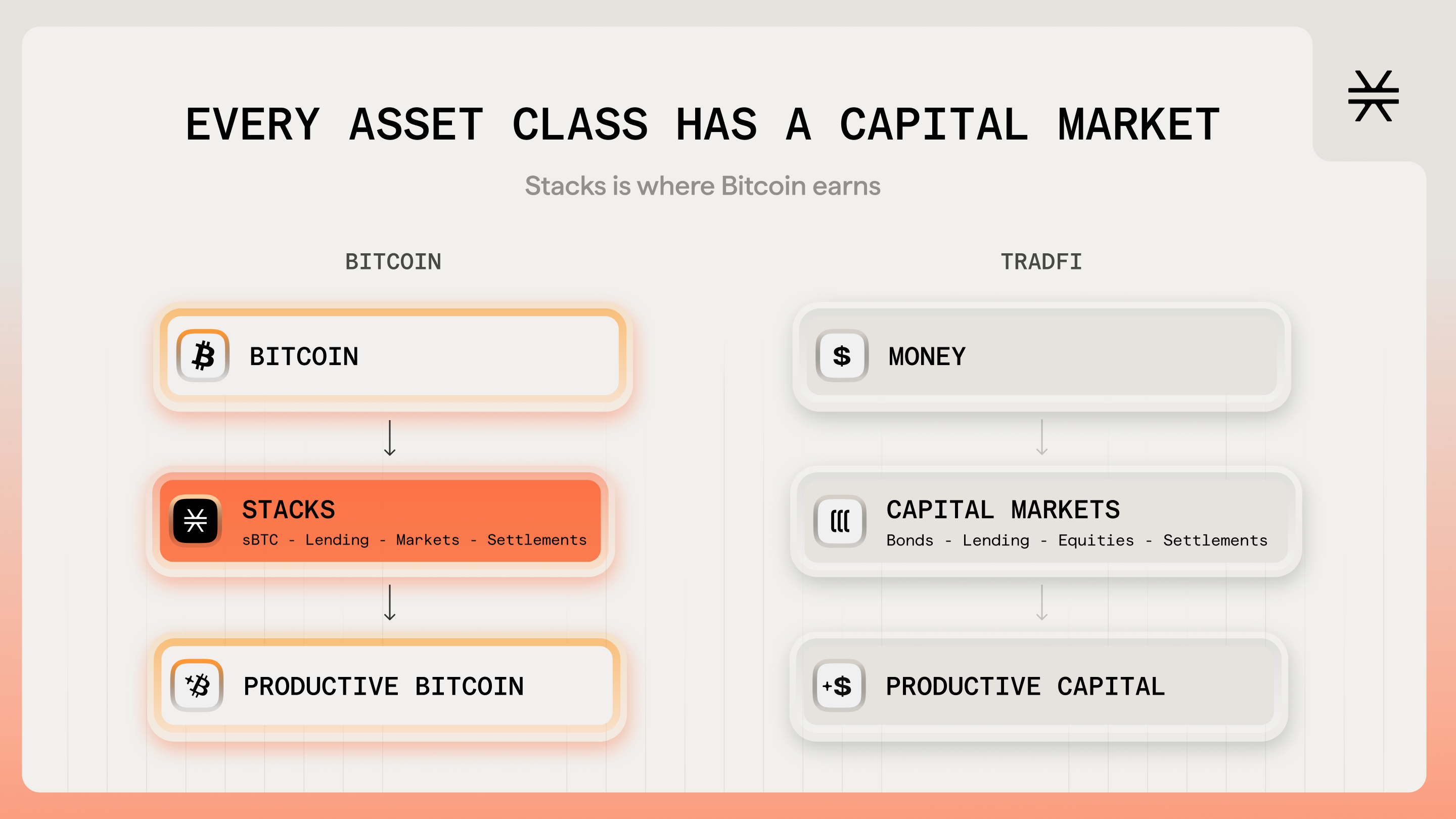
Stacks is building Bitcoin capital markets in sequence. Bitcoin staking, the yield market, is live today. Self-custodial Bitcoin borrowing, the credit market, is planned for 2027. Trading grows throughout, in the apps on Stacks and through a working goal of 100x throughput. Capital earns a return first, can then be borrowed against, and over time is traded at scale.
The first market already has institutional participation. Millions of USD in Bitcoin were staked across the first two Bitcoin staking bonds, with participants including 21Shares, UTXO Management, HashKey Cloud and Sypher Capital.
For background on what capital markets are and why Bitcoin still lacks native ones, read What are Bitcoin Capital Markets?
What's Live on Stacks Today
The yield market is live on Stacks today, along with the assets and apps the credit and trading markets are built on.
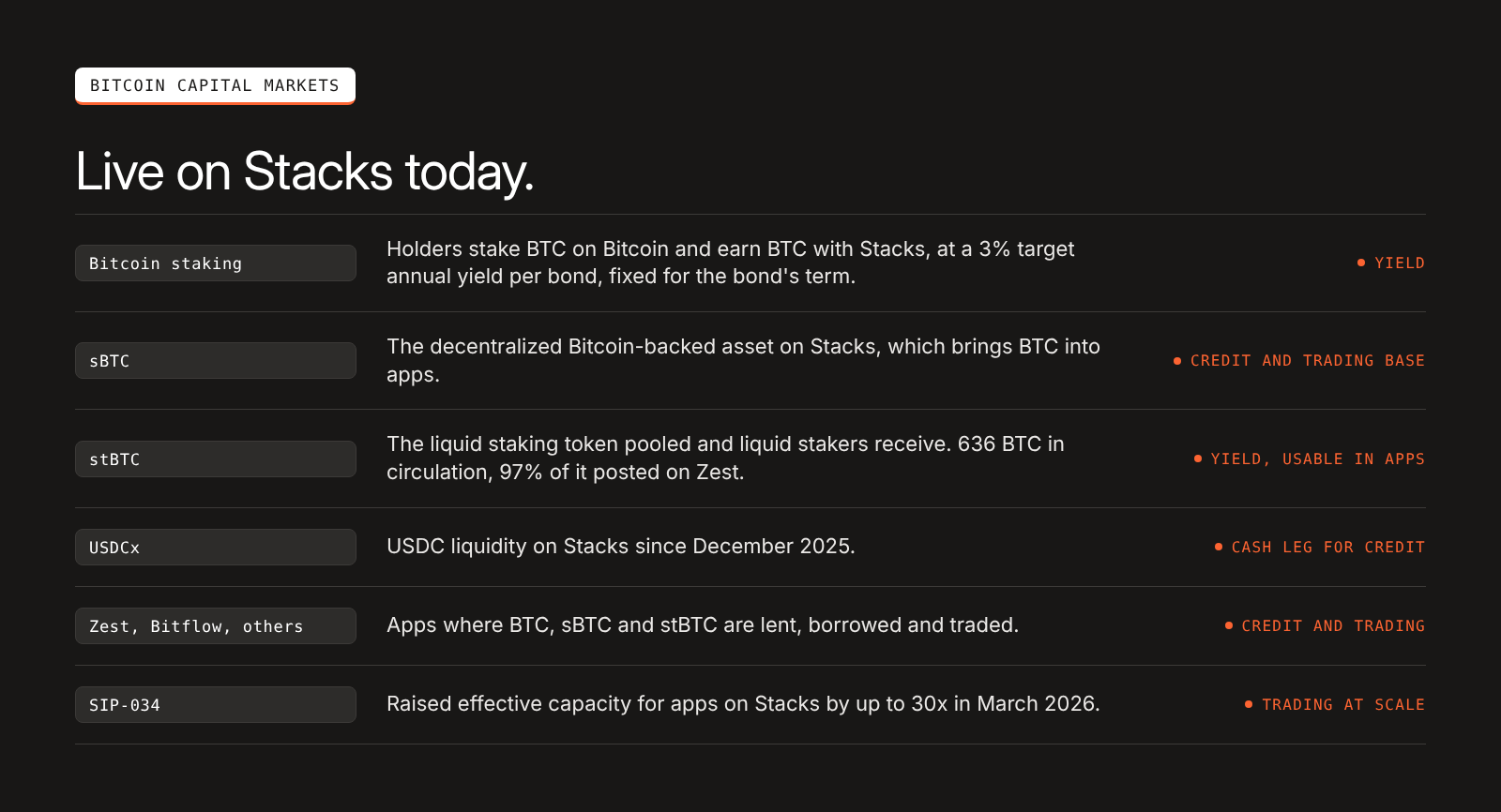
In the self-custodial path, BTC stays timelocked on the Bitcoin L1 under the holder's own custody. Other holders join through pools and liquid staking and receive stBTC so they can keep using their bitcoin across apps on Stacks. Each bond sets its target yield before it opens and holds it for the term, which gives Bitcoin a predictable rate earned in BTC. The next stage turns those bonds into an open market.
Creating an Open Market for Bitcoin Staking
In 2027, the current bonds give way to an open auction for self-custodial staking. The first bonds are a bootstrap phase, sized to learn from real participation before capacity scales.
In the open auction, STX bids determine how much BTC can be staked in each period, so capacity follows demand. Anyone will be able to stake BTC in the self-custodial path, with the BTC remaining on the Bitcoin L1 under the holder's own custody.
The upgrade that introduces the auction is PoX-6, the next version of Proof of Transfer, the mechanism through which Stacks miners pay BTC to stakers. The proposal and implementation are both scheduled for 2027, and the design follows the Bitcoin staking whitepaper.
An open market for staking gives Bitcoin a rate that anyone can access, which is the base the credit market is built on.
Self-Custodial Bitcoin Borrowing
Self-custodial Bitcoin borrowing is the credit market, planned for 2027. Holders will be able to borrow stablecoins against staked BTC without selling it, and the BTC continues to earn for the duration of the loan. The staked BTC stays locked on the Bitcoin L1 under the holder's control; the loan is issued against that position on Stacks. This is the function repo serves for bonds in traditional finance: cash without selling the asset or giving up its yield.
Borrowing against BTC requires deep stablecoin liquidity on Stacks, which is why USDCx is part of the roadmap. The borrowed stablecoins can be deployed in apps on Stacks or directed to uses outside the ecosystem, turning staked Bitcoin into working capital.
Credit markets can only carry real capital when the network beneath them handles volume and volatility reliably, which is the role of the performance roadmap.
Throughput for Trading and Lending at Scale
Stacks is working toward 100x throughput so that trading and lending apps can carry institutional volumes of Bitcoin capital. Clarity WebAssembly (Wasm) and related performance work are the main paths, building on SIP-034, which raised effective capacity for apps on Stacks by up to 30x in March 2026.
Trading needs throughput because deeper markets mean more transactions at lower cost; apps such as Bitflow can quote tighter prices and absorb larger trades when the network processes more per block. Credit needs it more. Lending markets depend on fast, reliable liquidations when collateral prices move, and a network that slows under load exposes lenders at the moment markets are most volatile.
Alongside throughput, sBTC bridge optimization improves how BTC moves into and out of Stacks, and work on fee abstraction is exploring whether users and agents can pay transaction fees in sBTC. Both reduce friction for capital entering Bitcoin capital markets.
What STX Does in Bitcoin Capital Markets
STX is the asset that powers Bitcoin capital markets on Stacks. Every staked BTC requires STX locked alongside it, which ties demand for STX to how much Bitcoin seeks to earn and move on Stacks.
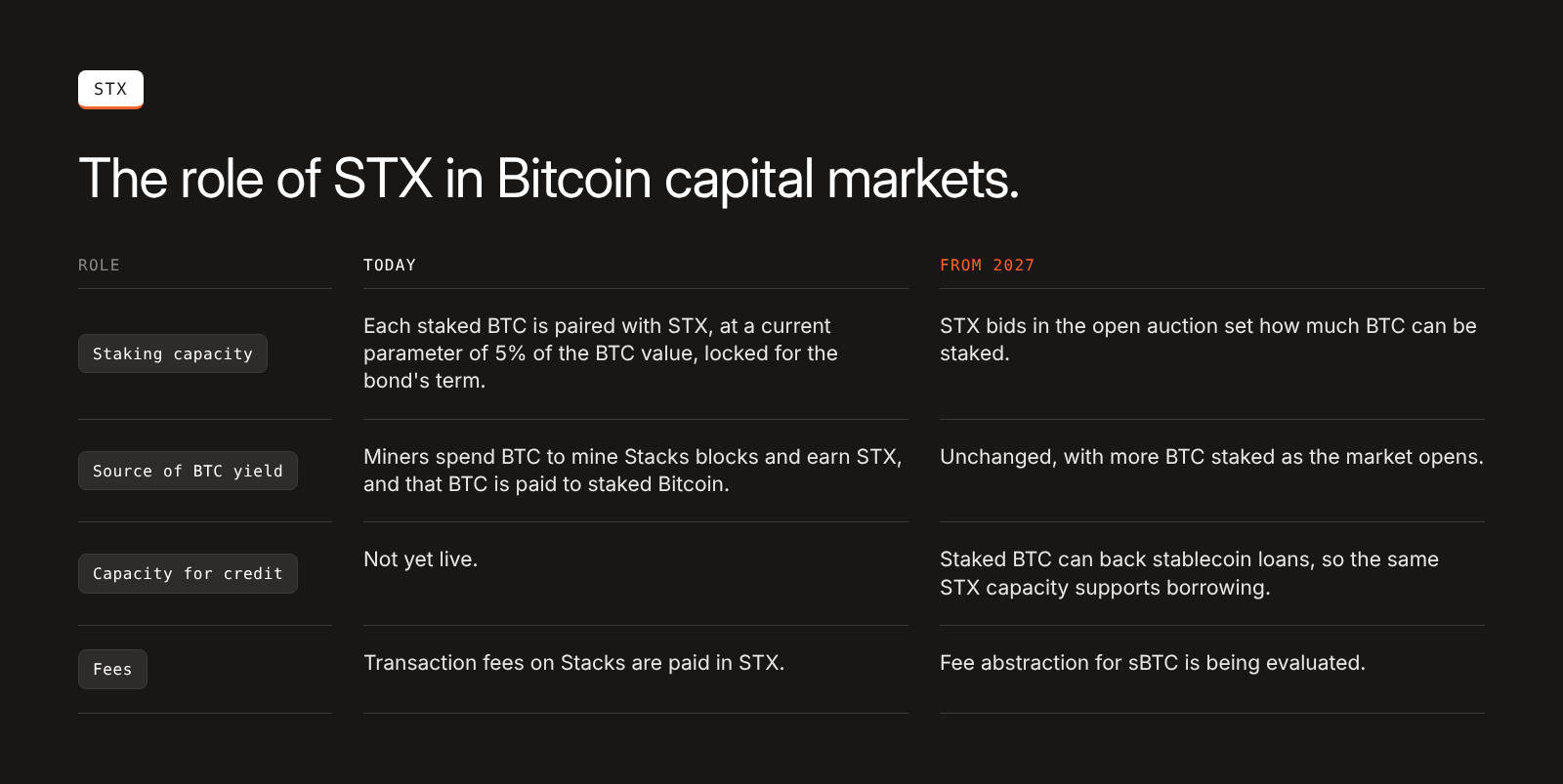
Bitcoin staking, the open auction and self-custodial borrowing all run on the same pairing of BTC with STX. Bitcoin capital markets run on STX, and each new leg adds another use for the same capacity.
Access and Security for Institutional Capital
Institutional capital reaches Bitcoin capital markets through the custodians, exchanges and wallets it already uses, so integrations ship alongside protocol upgrades. Custody partners including Fireblocks and Anchorage supported the first Bitcoin staking bond, STX is listed on Bullish, the NYSE-listed institutional exchange, and BitGo has opened Bitcoin staking support for its institutional clients.
Every transaction on Stacks is secured by 100% of Bitcoin's security budget, and sBTC is backed by a decentralized, institutional-grade signer set that includes operators such as HashKey Cloud. Continued investment in sBTC and core security, including AI-powered testing, is a standing priority.
Compliant Privacy and Post-Quantum Security
Compliant privacy and post-quantum security are the two frontiers that Stacks founder Muneeb Ali has set out alongside Bitcoin capital markets as part of the 2030 vision for Stacks. Both address requirements that large institutions will have before they commit significant Bitcoin capital onchain.
Compliant privacy
Institutions need to keep positions, trading strategies and counterparties confidential, while still meeting their regulatory obligations. Contributors across the Stacks ecosystem are researching compliant privacy for Bitcoin capital markets: ways for institutions to transact with selective privacy, disclosing information to regulators and auditors when required. This work is at the research and development stage, carried out by core contributors, ecosystem teams and grant recipients, and its implementation forms part of the longer-term vision for Stacks.
Post-quantum security
Quantum computing is a long-term consideration for every system that relies on today's cryptography, including Bitcoin and the assets built on it. Stacks contributors are working on post-quantum security, which is at the active research stage. A dedicated quantum roadmap will follow as that work progresses.
Where the Roadmap Leads
Each step extends what a bitcoin holder can do with BTC without selling it. Staked BTC earns BTC today; from 2027 it can back stablecoin loans while it continues to earn; and the apps on Stacks give that capital a productive place to go. Savings that earn and can be borrowed against are what traditional capital markets are built on, and Stacks is bringing the same pairing to Bitcoin.
Stacks is where Bitcoin earns.
Get more of Stacks
Get important updates about Stacks technology, projects, events, and more to your inbox.