.png)
sBTC Rollout: An Overview for Builders
With the primary Testnet launch complete, we are one step closer to fully programmable Bitcoin.
The launch of sBTC is a pivotal milestone toward a decentralized, 1:1 Bitcoin-backed asset to users of DeFi and Web3. sBTC unlocks a programmable Bitcoin layer, allowing users to bridge BTC into productive applications to generate yield, access on-chain lending, and trade on decentralized exchanges.
This post covers the sBTC launch plan, detailing the rollout strategy and what users can expect during each phase of the rollout.
Quick Look: The Launch Phases
Phase 0: Testnet - The testnet phase focused on rigorous testing of sBTC's core functionality, including deposits and signer operations. This phase ensured the protocol met security and performance benchmarks ahead of the mainnet launch. Currently, the sBTC Working Group is actively onboarding signers and developers to strengthen testing efforts and prepare for a seamless transition to mainnet.
Status: Completed (November 22, 2024)
Phase 1: Mainnet - Bitcoin Deposits
Phase 1 introduces the ability for users to deposit BTC and mint sBTC, bridging Bitcoin into DeFi. This mainnet launch will focus on onboarding users and providing early access to builders. By starting with deposits only, the protocol limits its operational complexity and allows for rigorous real-world testing of essential components under controlled conditions.Early depositors will be eligible to participate in the sBTC rewards program, providing incentives for adoption. Details about the rewards program will be shared in an upcoming blog post.
Estimated Launch Date: December 17, 2024
Phase 2: Mainnet - Bitcoin Withdrawals
Phase 2 unlocks sBTC withdrawals, allowing users to redeem sBTC for BTC seamlessly. During this phase, the initial deposit cap will gradually be increased to onboard more users.
Estimated Timeline: March 2025
Phase 3: Open Signer Set + Optimization
In this phase, the sBTC signer set will decentralize beyond the initial 15 community-elected Signers. Expanding the Signer set will be a gradual process with the end goal being a fully decentralized, open, permissionless Signer set over time.
Estimated Timeline: Following Phase 2
Phase 1: Deep Dive
Phase 1 focuses on sBTC’s deposit functionality. This is a mainnet release with a limited deposit cap that will provide an important onboarding period for partners. Users will be able to deposit their BTC for sBTC and will be eligible to receive rewards through the sBTC Rewards Program.
Bitcoin Deposit Cap
A deposit cap of 1,000 BTC will be implemented for this phase in order to do controlled testing while ongoing security efforts continually reinforce the protocol as it scales. This cap will be increased as Phase 1 progresses and transitions to Phase 2.The deposit cap will be filled on a first come, first serve basis which means that deposits will be accepted based on their order on the Bitcoin blockchain, until the cap is reached. Deposits that arrive after the cap is reached will be reclaimable by the user. There will be a minimum deposit of .01 BTC to start.
Rewards: Bitcoin In, Bitcoin Out
Unlike other incentive programs that rely on opaque point systems and offer alternative tokens as rewards, sBTC gives the people what they really want: Bitcoin. Eligible deposits will earn sBTC rewards and can be used in DeFi without staking, locking, or additional token derivatives. This program is designed to keep the user experience simple.
Signers: The Backbone of sBTC
The security and reliability of the sBTC protocol depend on its Signer set, which is responsible for managing Bitcoin custody and facilitating deposit and withdrawal operations.The Stacks community recently approved SIP-028, defining the criteria for selecting signers based on factors such as technical expertise, reliability, performance and decentralization. An initial group of 15 institutional Signers has been chosen for Phase 1 to maintain simplicity and reduce operational risks. This group will expand over time as the protocol matures.As sBTC evolves, the Signer set will transition to a fully decentralized model, further strengthening the protocol's resilience.
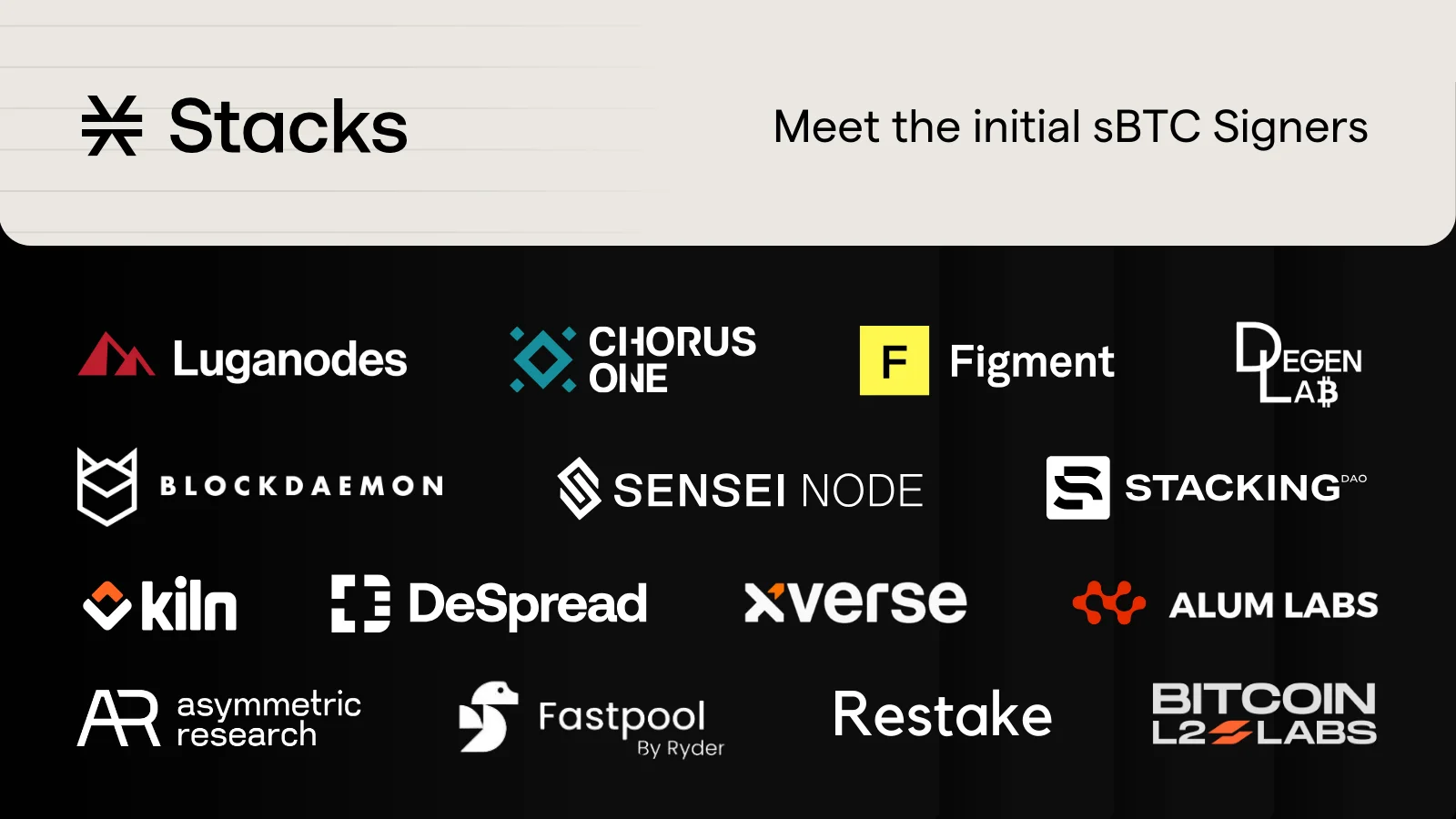
Signers
- ALUM Labs: Institutional-grade infrastructure, reliable STX signer, committed to sBTC launch support. 99% SLA commitment, high responsiveness, flexibility.
- Asymmetric Research: Top validator on various networks (Solana, Aptos), providing critical feedback to Stacks ecosystem. High-performance infrastructure, security expertise.
- Bitcoin L2 Labs: Core development company for sBTC protocol, deep involvement in Stacks and Bitcoin ecosystems. Extensive knowledge of sBTC protocol, long-standing contributions to Stacks and Bitcoin.
- Blockdaemon: Largest node operator, 50+ blockchains supported, active as a signer in Stacks. Technical feedback, operational reliability, broad blockchain experience.
- Chorus One: Supports 60+ networks, Chorus One SDK development, active on Stacks mainnet and testnet. 99.8% uptime guarantee, strong ecosystem contributions.
- Degen Lab: Continuous involvement with the Stacks ecosystem, successfully built a decentralized stacking pool, and contributor to several open-source projects. Long-term commitment to the ecosystem, high responsiveness, strong stacking experience.
- DeSpread: Validator for multiple networks, strong presence in Asia, contributing to Stacks decentralization.Validator experience, significant contributions to decentralization and tool development, Stacks regional partner.
- Fast Pool: Oldest Stacking pool, deep knowledge of Bitcoin and Stacks nodes since 2021. Long operational history, contributions to sBTC code.
- Figment*: Leading institutional staking provider, zero slashing incidents, early supporter of Stacks. Well-established operational track record, zero slashing incidents.
- Kiln: Manages $8.6 billion in staked assets, SOC2 Type 2 certified, track record on Stacks network. Deep expertise in Bitcoin and PoS protocols, proven security standards.
- Luganodes: Institutional staking provider, manages $2 billion in assets, ISO27001, SOC2 Type 2 certified. Trusted by financial institutions, strong focus on compliance and infrastructure security.
- SenseiNode: Top Latin American node operator, 9,500+ validators, focused on decentralizing infrastructure. Extensive validator experience, strong presence in LATAM.
- Stacking DAO: Leading DeFi app and liquid staking protocol, managing 56 million STX, sBTC signer infrastructure. Largest validator network in Stacks, focus on decentralization.
- Restake: Institutional blockchain infrastructure provider, spin-off from one of Europe’s largest bitcoin miners. One of the first signers on Stacks and backer of Stacks ecosystem projects. Strong infrastructure, security practices, active ecosystem contributions.
- Xverse: Long-term Stacks supporter, largest Stacking pool by TVL, integrated into Xverse wallet. Deep integration with Stacks ecosystem, history of operating, strategic sBTC integration.
An alternate sBTC Signer will be elected in place of Figment. Learn more
Security: A Multi-layered Approach
Security is the foundation of this rollout. For Phase 1, partnerships with top-tier security experts have been established to ensure the protocol is fortified at every level:
- Asymmetric Research: Known for their rigorous research and top embedded security researchers, Asymmetric brings security expertise to sBTC to identify and mitigate potential vulnerabilities.
- ImmuneFi: A robust bug bounty program incentivizes ethical hackers to uncover and address potential issues, adding an additional layer of defense. ImmuneFi is the leading crowdsource bounty platform for DeFi.
- 3rd Party Audits: Independent audit reports are in progress for additional security reviews, ensuring the protocol is thoroughly vetted by external experts.
How to Participate: Convert BTC to sBTC
- Visit the sBTC Dashboard: This user-friendly interface will guide you through the deposit process and help you explore sBTC-enabled applications. The dashboard is currently in private beta and will soon be available to the public. Sign up to stay informed here.
- Connect a non-custodial wallet. Use Leather or Xverse wallets, both designed with seamless integrations for Bitcoin and Stacks users.
- Deposit BTC. Follow the instructions to deposit Bitcoin and receive sBTC in return.
- Earn Rewards. Begin earning BTC rewards immediately after your deposit is processed by heading to the rewards website.
- Deploy sBTC in DeFi. Visit one of the featured sBTC applications to swap, lend, or borrow against your sBTC onchain.
**Users must enroll in the program to be eligible to receive rewards.
Unlocking Bitcoin's Full Potential
The phased rollout of sBTC paves the way for Bitcoin to evolve from a store of value to a productive asset. By integrating Bitcoin into DeFi and other use cases, sBTC empowers builders to create innovative applications that leverage the world’s most secure digital asset.
Developing this phased roadmap was a collaborative effort involving builders from all top (TVL) apps on Stacks. As always, the Stacks ecosystem invites users, developers, and stakeholders to actively participate in shaping the future of Bitcoin-backed applications.
Stay tuned for more updates as we move closer to the launch of Phase 1 and beyond.
Get more of Stacks
Get important updates about Stacks technology, projects, events, and more to your inbox.