.avif)
Bitcoin Staking Explained: How It Works on Stacks
.avif)
What Is Bitcoin Staking?
Bitcoin Staking on Stacks enables BTC holders to earn BTC yield without transferring custody of their bitcoin. Participants lock BTC on Bitcoin L1 alongside a corresponding STX position to form a protocol bond. Yield is generated by Stacks mining through Proof of Transfer, a consensus mechanism that has distributed over 4200 BTC to stakers since January 2021.
This is not lending. There is no counterparty borrowing the bitcoin. There is no bridge moving it to another chain. BTC stays on Bitcoin, under the participant's own keys, for the duration of the bonding period.
How It Works
1. Create a Protocol Bond
A protocol bond pairs two assets: BTC and STX.
BTC is locked on Bitcoin L1 using OP_CHECKLOCKTIMEVERIFY, a standard Bitcoin timelock script in production since 2015. The BTC never leaves Bitcoin. It is not bridged, wrapped, or held by a third party. It remains under the participant's own keys, non-spendable until the bonding period concludes.
STX is locked on Stacks at a ratio of approximately 5% of the BTC position value. STX determines the staking capacity that a participant is eligible for.
In a protocol bond, one hundred percent of the yield accrues to the BTC side.The STX-to-BTC ratio is set by the protocol using miners' bids from Proof of Transfer, creating a transparent, market-driven relationship. An initial bootstrap period (PoX-5) uses managed parameters for stability before transitioning to fully market-driven rates in the subsequent phase (PoX-6).
2. Earn BTC Yield
Stacks miners compete for block production by committing BTC approximately every 10 minutes. That BTC flows to stakers through Proof of Transfer. Miners participate because they earn STX block rewards in return.
Protocol bond holders are paid first from the miner BTC pool each reward cycle (approximately every 7 days). The yield distribution follows a waterfall:
Tranche 1: Active Protocol Bonds- Protocol bond holders receive payment first at the yield rate of their bond. The initial target is approximately 3% APY (annualized over a 52,560-block Bitcoin year of 50 weekly cycles), paid in BTC. A 6 month bond covers 24 of those cycles, so it delivers about 1.44% of locked BTC. Realized payout may vary slightly with miner economics.
Tranche 2: STX only stakers - The remaining BTC revenue is split between STX-only stakers and the reserve fund. Yield from STX-only staking varies with miner activity and total participation.
Reserve fund: Excess miner revenue is set aside to buffer future cycles in the event that miner revenues temporarily fall below total yield obligations.
3. Unlock at Maturity
After the bonding period of approximately six months (25,200 Bitcoin blocks, or 24 weekly reward cycles), the BTC timelock expires and the bitcoin is available again. STX unlocks simultaneously. Principal is returned in full. There is no slashing and no protocol-level mechanism that can reduce the participant's BTC or STX positions.
An early exit option is available: participants can withdraw their BTC in full, forfeiting undistributed yield for the remainder of the bonding period. STX remains locked for the full term.
Not Proof of Stake
If this sounds similar to staking on Ethereum, the similarities are largely superficial. Proof of Stake requires validators to post collateral that can be slashed if they misbehave or go offline. That risk scales with position size.
Bitcoin Staking on Stacks has no slashing. Locked BTC cannot be penalized, reduced, or seized by the protocol. Participants earn yield or they do not, but principal is never impaired by a slashing event.
Paths to Participate
Native BTC on L1
The fully self-custodial path. Lock BTC on Bitcoin L1 via timelock and STX in a Stacks wallet. Yield is paid directly to the participant's BTC address. Bitcoin never touches a bridge, wrapper, or custodian. Participants must meet the minimum capital requirements to reserve capacity in a bonding period.
sBTC on Stacks
Uses sBTC, a BTC-backed asset on Stacks, in place of a native L1 timelock in the protocol bond.
Approximately 10% of the capacity for each bonding period is reserved for community participation via pools. For participants who cannot meet the capital requirements to participate independently, pooling options aggregate positions. Pool operators typically take approximately 5% of rewards, with the remainder distributed pro-rata.
STX-only on Stacks
Participants who prefer not to pair a BTC commitment may stake STX alone. STX-only staking has no BTC capacity constraint, no whitelist, and protocol bonding periods. Participants may choose to stake independently or part of a pool. This path is effectively the same participation model as “stacking” from previous PoX versions.
How Does It Compare?
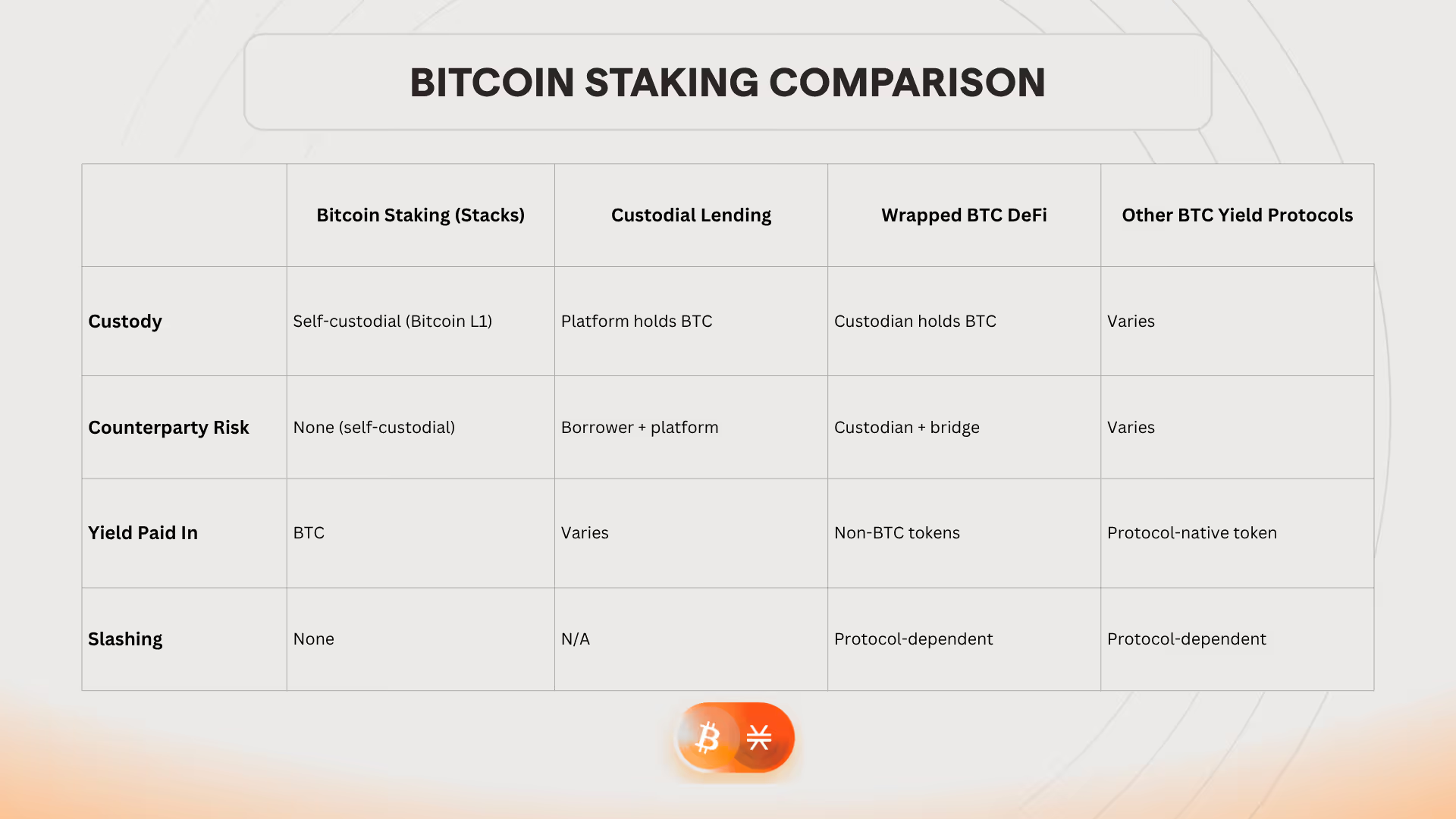
For a detailed comparison with CoreDAO and Babylon, see How Bitcoin Staking Protocols Actually Compare.
What Are the Risks?
No yield mechanism is without risk. The following summarizes the key exposures. Check out The Risk Profile of Bitcoin Staking Explained for a deeper risk analysis.
Liquidity
BTC is illiquid during the bonding period (approximately six months). An early exit mechanism returns BTC but forfeits remaining yield.
Reflexivity
BTC yield depends on miner bids, which depend on STX value, which depends economic activity on Stacks. This circular dependency can amplify both favorable and adverse conditions. The protocol manages this through capacity constraints, the reserve fund and waterfall distribution.
Reward variability
Yields are market-driven, not fixed. Protocol bonds set a target yield for the bonding period. By limiting capacity for each bonding period, the protocol maintains healthy coverage of all active yield obligations. However, in the event of sustained downturns, where miner revenue falls short of active yield obligations and the reserve fund is depleted, yields are compressed starting with STX-only stakers, then protocol bond holders.
STX exposure
Participation requires locking STX worth approximately 5% of the BTC position, introducing exposure to STX price movement for the bonding period.
Smart contract risk
The Stacks-side smart contracts governing yield distribution and auction mechanics are new code. Audits are planned for publication prior to mainnet launch.
How to Get Started
For Institutions
The Stacks team provides support for custody integration, compliance considerations, STX acquisition strategy, and technical implementation.
Contact the institutional team: vip@stacksendowment.co
For Individual Holders
Self-custodial Bitcoin Staking is accessible through the Stacks ecosystem. Participants need BTC, STX, and a compatible wallet.
Read the full Bitcoin Staking Whitepaper.
Read next: Where Does the Yield Come From? | The Risk Profile of Bitcoin Staking Explained
Get more of Stacks
Get important updates about Stacks technology, projects, events, and more to your inbox.

.png)


