.avif)
BTCFi Explained: Bitcoin Lending, Yield, and DeFi Infrastructure in 2026
Kevin Williams, the founder of Sats Ventures, recently shared his thesis on where Bitcoin DeFi is headed:

He's not alone.
Bitcoin has established itself as the hard asset people want to hold for the long term, a hedge against debasement and a bet on a rising asset class. Yet most BTC still sits idle in exchange accounts and cold wallets. Only recently has its use as collateral begun gaining real traction. Until a few years ago, the infrastructure to earn yield on Bitcoin or use it as productive capital simply didn't exist.
That's changing fast. A new category, BTCFi (Bitcoin decentralized finance), is emerging to unlock the trillions of dollars in idle BTC sitting on the sidelines.
Why BTCFi? The Biggest Names in Crypto See Bitcoin DeFi as the Next Frontier
The conviction that Bitcoin must evolve from passive store of value into productive financial infrastructure is no longer a fringe view. It's the consensus forming across investors and builders alike.
a16z Crypto has argued that Bitcoin's limited programmability has left massive amounts of BTC idle, and that enabling its use as collateral could unlock one of the largest untapped pools of on-chain capital. Galaxy Digital's Global Head of Trading, Jason Urban, called it the next evolution in Bitcoin's journey toward becoming a productive financial asset.
Function CEO Thomas Chen put a timeline on it: "By 2026, treating bitcoin as a passive treasury asset may no longer be enough. The new standard will be actively earning yield."
Jacob Phillips, co-founder of Lombard, sees the product layer taking shape: "Novel DeFi strategies will emerge across the risk curve with Bitcoin as a collateral asset, from simple buy-and-hold strategies with yield-bearing Bitcoin assets to basis trades and options strategies."
The signal is clear. Bitcoin's next chapter is about building financial infrastructure on top of the hardest asset in crypto. Here are five BTCFi verticals where that's already happening.
1. Bitcoin Staking: Earning BTC Yield Without Giving Up Custody
Staking is already dominant for ETH and SOL. Around 28% of ETH is staked (~$90B). Roughly 65% of SOL is staked. The thesis is simple: hold an asset you believe in, earn yield on top.
Bitcoin doesn't have native staking, but unlocking it would make BTC dramatically more attractive to institutions and digital asset treasuries. Matt Hougan, Bitwise's CIO, told Cointelegraph: "Everything aligns for Bitcoin staking being a significant market. There's a lot of demand for Bitcoin yield. Even if you're getting a 3% yield, it's attractive compared to other options."
Many current approaches still require bridging, offer thin yield, or pay out in governance tokens rather than BTC. All dealbreakers for serious allocators.
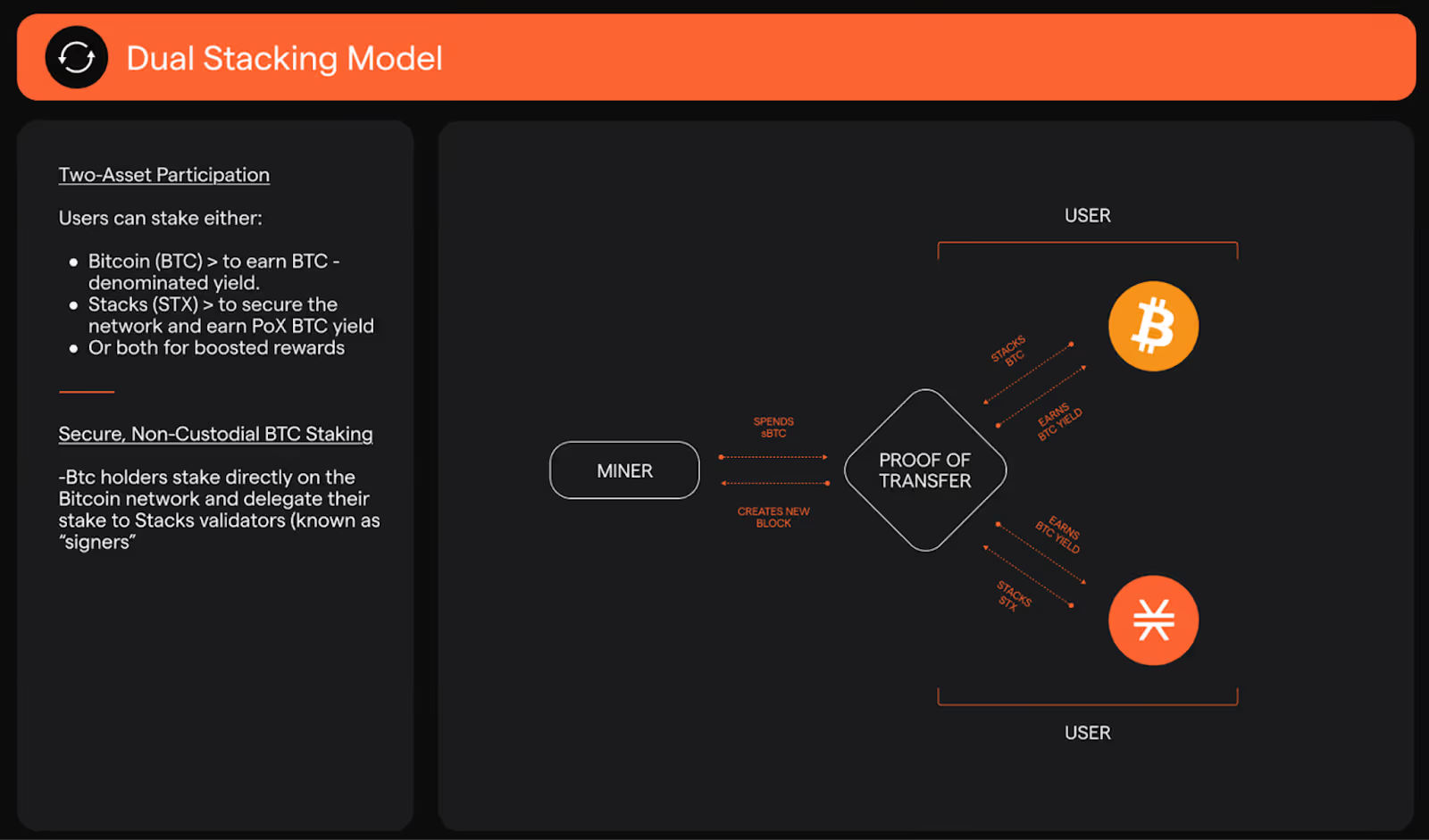
Stacks is building a dual stacking model designed to solve all three problems:
- BTC stays on mainnet in a self-custodial setup. No BTC-backed tokens, no custody trade-offs.
- Institutional-grade custody through Copper, Fireblocks, and Fordefi.
- Rewards paid in native BTC generated sustainably through Proof of Transfer (PoX), where miners bid BTC that gets distributed to stackers.
- Compounding incentive loop stacking STX alongside BTC boosts yield, creating a flywheel between the two assets.
2. Bitcoin-Backed Lending: Over $1 Billion in BTC Loans in 2025
Bitcoin-backed lending (borrowing against BTC without selling it) is booming. The numbers speak for themselves:
- Pantera Capital reports more than $1 billion in BTC-backed loans in 2025, citing Stacks and Zest Protocol among key developments.
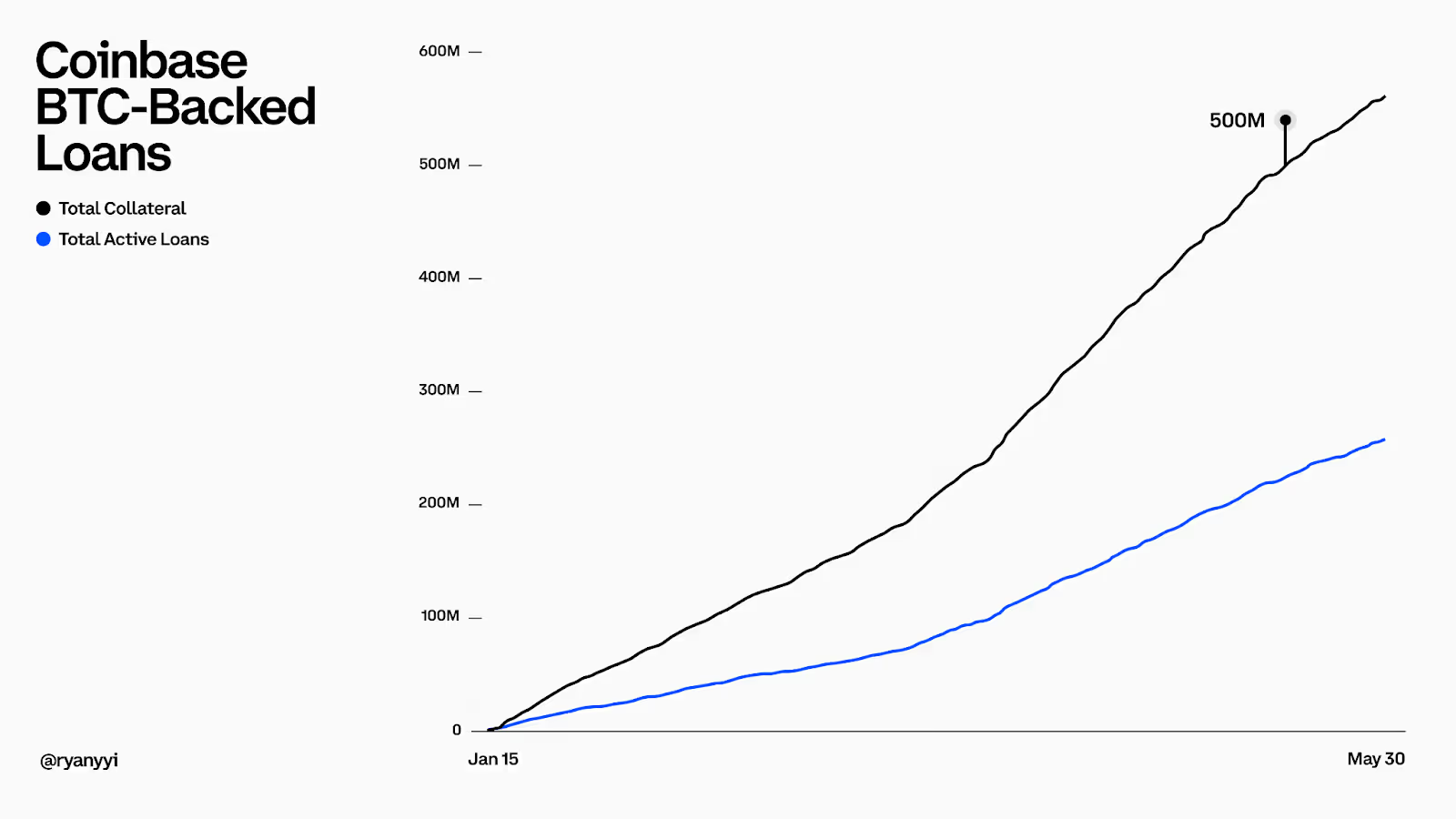
- Coinbase launched BTC-collateralized lending through Morpho, crossing $250M in active loans within five months on $500M in total collateral.
- Cantor Fitzgerald, one of the oldest investment banks on Wall Street, is now providing BTC-backed loans to large holders.
On Stacks, Zest Protocol has attracted over $70M in deposits, including 700+ sBTC. Backed by Binance Labs, Tim Draper, and Stacks co-creator Muneeb Ali, Zest V2 recently launched to scale capital efficiency.
The composability here is already real. You can deposit BTC as collateral on Zest, borrow STX, stack that STX to earn up to 10% APY in BTC rewards, all while boosting the yield on your self-custodial BTC staking position. This kind of looping only works when the infrastructure is natively integrated, which is exactly where Stacks has an edge.
3. Bitcoin Yield Vaults: Automated BTC Strategies Hitting 8% APY
Vaults automate capital allocation into lending markets, yield strategies, and DeFi positions, all non-custodial and fully transparent on-chain.
The category has exploded. Across all crypto, vault assets grew from under $100M in 2024 to $8.8B at their peak in 2025. Matt Hougan, on the Bankless podcast: "Someday we'll be sitting here talking about multiple trillions of dollars in vaults."
a16z's Big Ideas 2026 report highlighted how tools like Morpho Vaults "automatically allocate assets into lending markets with the best risk-adjusted yield," giving every user access to active portfolio management previously reserved for sophisticated funds.
The Bitcoin side is still early. That's the gap Hermetica is filling with hBTC, a one-click Bitcoin yield vault targeting up to 8% APY.
The mechanics: deposit native BTC. Behind the scenes, sBTC is deployed as collateral on Zest (~3.5% APY via dual stacking), USDCx is borrowed against it and converted to USDh, then staked for up to 15% yield from funding rates. All returns compound back to sBTC, redeemable for native BTC at any time. One deposit, one withdrawal. The vault handles the rest.
4. Bitcoin DEXs: On-Chain Trading Infrastructure for BTC DeFi
As lending, staking, and vaults scale, they create hard dependencies on on-chain trading infrastructure. Lending protocols need deep liquidity for liquidations. Vault strategies need reliable BTC to stablecoin swaps. Without a functioning DEX layer, the rest of the BTCFi stack breaks down.
The broader DEX market validates the model. The DEX to CEX spot trading ratio tripled from 6% in 2021 to over 20% by late 2025. DEX perp volume hit $7.35 trillion in 2025, exceeding the cumulative total of the prior four years combined.
Almost none of that growth has happened on Bitcoin. Ethereum and Solana dominate through Uniswap and Jupiter. Most "Bitcoin DEXs" still just trade wrapped BTC on other chains, which defeats the purpose.
Sats Terminal is building a Bitcoin DeFi aggregation protocol that unifies swaps, bridges, loans, and yield into a single interface. Its SatStream algorithm routes orders across Runes, Alkanes, and Spark tokens for optimal execution. Backed by Coinbase Ventures, Draper Associates, and Sats Ventures, Sats Terminal raised $1.7M in pre-seed funding.
Disclosure: Sats Ventures, whose founder's thesis opens this article, is an investor in Sats Terminal.
5. Bitcoin Multisig and Institutional Custody: The Security Layer BTCFi Needs
As Bitcoin DeFi scales, so does the need for institutional-grade custody. No investment committee will approve deploying capital without proper security standards. This is the layer that turns BTCFi from a retail playground into real infrastructure.
The multisig wallet market reached $1.27B in 2024, projected to hit $4.37B by 2033. Institutional wallet usage is growing 51% year over year.
Most multisig tooling has been built for Ethereum. Bitcoin, a $2.2T asset with over $6B in DeFi TVL, has lacked native multisig infrastructure that meets institutional standards.
Stacks' institutional stack is already live: BitGo for custody, Fordefi for SOC 2 Type II compliant execution, Figment for enterprise staking, Asymmetric Research for independent validation.
Asigna is a Bitcoin-native multisig vault with over $1B in assets secured across Bitcoin L1 and L2 multisigs. M-of-N approval structures. Private keys never leave their owners. No single party can unilaterally move funds.
The key differentiator: unlike smart contract based multisig on Ethereum, Asigna is fully native to the Bitcoin layer. No smart contract risk, and no possibility of wallets being frozen regardless of what happens to Asigna itself.
The V2 upgrade introduces embedded apps, a developer SDK, sub accounts, custom dashboards, and governance tools, letting institutions manage shared Bitcoin treasuries and interact with DeFi protocols from a single multisig interface.
BTCFi Is Live. The Question Is How Fast It Scales.
Bitcoin DeFi isn't a hypothetical anymore. The lending markets are live, the yield is real, and the institutional rails are being built. The question is no longer whether Bitcoin becomes productive capital. It's how fast the rest of the market catches up to what's already being built on Stacks.
Frequently Asked Questions
What is BTCFi?
BTCFi (Bitcoin DeFi) refers to the growing ecosystem of decentralized finance protocols built on or around Bitcoin. It includes Bitcoin staking, BTC backed lending, yield vaults, decentralized exchanges, and institutional custody tools, all designed to make BTC a productive, yield bearing asset rather than a passive store of value.
Can you earn yield on Bitcoin?
Yes. Through protocols like Stacks' Proof of Transfer (PoX), BTC holders can earn native Bitcoin rewards by staking. Additional yield comes from BTC-backed lending on platforms like Zest Protocol and automated vault products like Hermetica's hBTC, which target up to 8% APY.
How does Bitcoin staking work?
Bitcoin staking is an emerging concept that differs fundamentally from Ethereum's native staking. Because Bitcoin's design doesn't support native staking, developers are exploring Layer 2 solutions to enable staking rewards.
Stacks is one proposed approach using it's mechanism called Proof of Transfer (PoX). The concept allows users to earn BTC rewards while keeping their Bitcoin on the main chain in self custody. Miners would commit BTC that gets distributed to stakers. However, this functionality is still in development.
What is BTC backed lending?
BTC backed lending lets holders borrow against their Bitcoin without selling it. Platforms like Zest Protocol (on Stacks), Granite (on Stacks), Coinbase (via Morpho), and Cantor Fitzgerald now offer BTC collateralized loans, with over $1 billion originated in 2025.
Is Bitcoin DeFi safe for institutions?
Institutional adoption of BTCFi is accelerating, supported by custody providers like BitGo, SOC 2 Type II compliant platforms like Fordefi, and Bitcoin native multisig solutions like Asigna. Stacks' institutional stack is purpose built for enterprise security and compliance requirements.
Get more of Stacks
Get important updates about Stacks technology, projects, events, and more to your inbox.

.png)


