.avif)
How Bitcoin Staking Protocols Actually Compare: Stacks vs. CoreDAO vs. Babylon
Three protocols currently offer some form of self-custodial BTC staking: Stacks, CoreDAO, and Babylon. All three use Bitcoin's native timelock scripting. All three allow BTC to remain on Bitcoin L1 during staking.
This is a comparison of what each protocol does, the mechanics, the yield assets, and the tradeoffs. The appropriate choice depends on individual priorities.
The Quick Comparison
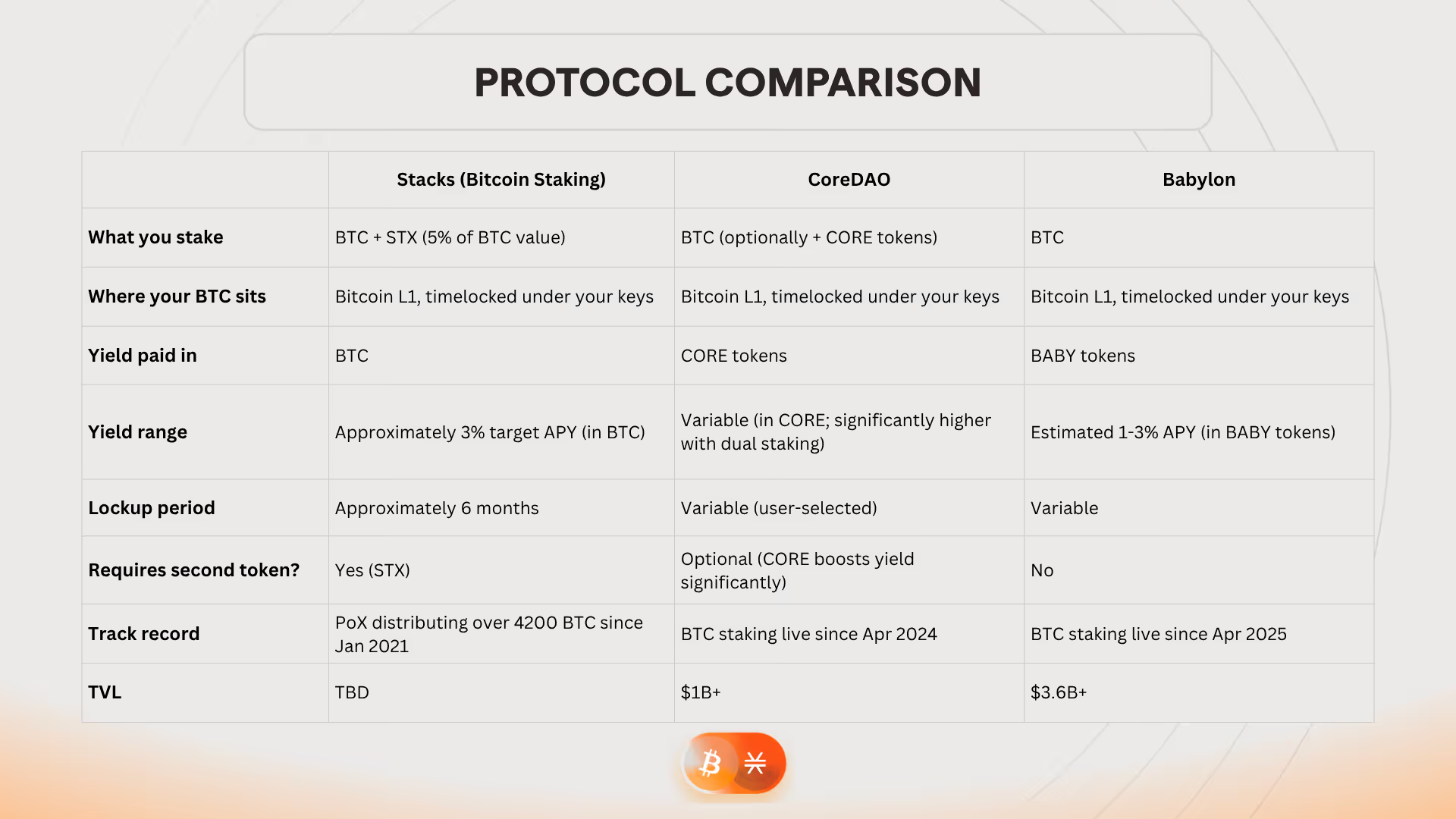
Yield Asset & Yield Source
This is the most consequential distinction between the three protocols. Understanding the yield source is the foundation of any meaningful risk assessment.
Stacks: Yield paid in BTC, sourced from Stacks Miner BTC expenditure
Stacks uses Proof of Transfer. Miners commit BTC approximately every 10 minutes to compete for STX block rewards. The BTC they commit forms the yield pool distributed to stakers. This mechanism has operated continuously since January 2021 with over 4200 BTC distributed to stakers. Yield is denominated and paid in BTC.
With Bitcoin Staking, this yield pool is distributed through a waterfall: protocol bond holders (BTC + STX positions) are are paid first, STX-only stakers are paid next and a reserve fund buffers volatility. Target initial yield is ~3% APY, annualized on a Bitcoin year basis, not directly comparable to CoreDAO's and Babylon's calendar year figures.
CoreDAO: Yield paid in CORE tokens, sourced from CORE protocol emissions
CoreDAO's yield comes from CORE block rewards, tokens distributed over an 81-year emission schedule, along with transaction fees on the Core blockchain. Staking BTC on CoreDAO earns CORE tokens, not BTC. The value of the yield depends on the market price of CORE.
CoreDAO offers a dual staking model in which staking CORE tokens alongside BTC significantly increases yield. Without CORE, BTC-only staking yields are minimal. At the maximum tier (Satoshi, requiring 68,000 CORE per 1 BTC), yields increase substantially. Effective yield depends heavily on the participant's willingness to acquire and hold CORE alongside their BTC position.
Babylon: Yield paid in BABY tokens, sourced from Babylon protocol emissions
Babylon's yield comes from BABY token rewards and network fees. Staking BTC through Babylon earns BABY tokens. The protocol launched its Bitcoin Staking Network in April 2025 and has attracted significant TVL, though much of the initial growth was driven by airdrop expectations rather than recurring yield.
Ongoing yield for Babylon BTC staking is estimated at 1-3% APY in BABY tokens (distinct from BABY token staking, which carries different rates). As with CoreDAO, the realized value of the yield depends on the market price of a separate token.
Yield Denomination
Yield denominated in BTC means the return is in the same asset that was staked. There is no additional token price risk on the yield itself. Total return is original BTC plus additional BTC.
Yield denominated in CORE or BABY means the return depends on two variables: the token emission rate and the token's market price. A 50% decline in the reward token reduces the effective yield by the same proportion, regardless of the nominal token quantity received. This is not necessarily disqualifying, as both tokens could also appreciate, but it is a fundamentally different risk profile that should be modeled accordingly.
Self-Custody: Same Mechanism, Different Depth
All three protocols use Bitcoin's CLTV (CheckLockTimeVerify) to timelock BTC on L1. In all three cases, BTC remains on Bitcoin under the holder's keys during the staking period. This is a meaningful improvement over custodial yield products.
However, "self-custody" encompasses a range of implementations:
Stacks
BTC remains on L1 via timelock. STX is locked in a Stacks smart contract. Yield (in BTC) is distributed through the Proof of Transfer mechanism. The complete flow, from miner commitment to staker distribution, settles on Bitcoin.
CoreDAO
BTC remains on L1 via timelock. Relayers bridge staking information between Bitcoin and the Core blockchain. Yield (in CORE) is distributed on the Core chain. BTC custody is self-custodial, but the yield mechanism depends on cross-chain coordination through relayers.
Babylon
BTC remains on L1 via timelock. The Babylon protocol coordinates staking between Bitcoin and the Babylon chain. Yield (in BABY) is distributed on the Babylon network. A vulnerability in Babylon's BLS vote extension was disclosed in December 2025 (rated "High" severity) that could have allowed malicious validators to disrupt block production. It was patched in version 4.2.0 and no user funds were affected.
Lockup and Flexibility
Stacks: approximately 6 months, early exit available
Protocol bonds lock BTC for approximately six months (25,200 Bitcoin blocks). An early exit option returns BTC but forfeits remaining yield; STX remains locked.
CoreDAO: User-selected lockup
Participants choose their own lockup period when creating the timelock transaction. Shorter lockups are available but may earn less. This offers more flexibility than Stacks' fixed term.
Babylon: Variable
Lockup periods are variable. Some platforms offering Babylon staking (such as Kraken) have added their own terms. The protocol itself is relatively flexible on unbonding.
The Second Token Question
Both Stacks and CoreDAO involve pairing a second token with BTC. On Stacks, STX is required (5% of BTC position value) to create a protocol bond. On CoreDAO, CORE is optional but has a significant impact on yield. Babylon does not require a second token.
- Stacks: STX exposure is mandatory at 5% of the total position. STX does not earn yield; it is the participant's commitment to the protocol. In exchange, the participant receives senior tranche priority on BTC yield.
- CoreDAO: CORE is technically optional, but BTC-only staking yields are minimal in practice. Meaningful yield requires substantial CORE holdings, with the highest tier (Satoshi) requiring 68,000 CORE per 1 BTC staked.
- Babylon: No second token is required to stake. However, yield is paid in BABY, which means participants accumulate a token position regardless.
Track Record
Stacks: Proof of Transfer has operated continuously since January 2021, over five years. The underlying consensus mechanism is established; the yield structuring layer is new.
CoreDAO: Self-custodial BTC staking launched April 2024. Approximately two years of operation. The Core blockchain has been running since January 2023.
Babylon: Bitcoin Staking Network launched April 2025. Approximately one year of operation. Has attracted the largest TVL among the three, though much of the initial growth was driven by airdrop activity.
Who Should Use What
Stacks if:
- The participant wants yield denominated and paid in BTC rather than a separate token
- Structured yield protection (priority tranche, reserve fund, managed capacity) is important
- The participant is comfortable with an approximately six-month lockup and a 5% STX position
CoreDAO if:
- Flexible lockup periods are a priority and the participant is willing to hold significant CORE positions alongside BTC
- The participant is comfortable earning yield in CORE tokens and prefers a platform that is already live
Babylon if:
- The participant prefers to stake BTC without acquiring a second token and is comfortable earning yield in BABY tokens
- The participant is comfortable with a newer protocol (one year of operation) and values participation in the largest TVL network
Summary
All three protocols represent a meaningful improvement over custodial BTC yield products. Bitcoin remains on L1 under the holder's own keys in all three cases.
The differences are in what the yield is denominated in (BTC versus CORE versus BABY), how yield is protected (waterfall structure versus flat distribution), what is required to participate (STX, CORE, or nothing), and how long the mechanism has been in operation.
For participants who prioritize BTC-denominated yield with structured protection and are comfortable with a small STX position, Stacks is designed for that use case. For those who want flexibility and are comfortable with CORE exposure, CoreDAO provides that. For those who prefer simplicity and no second token requirement, Babylon is the most straightforward entry point.
The right choice depends on what the participant values most. The whitepapers and onchain data for all three protocols are publicly available for independent evaluation.
Read the full Bitcoin Staking Whitepaper.
Read next: How to Earn Yield Without Giving Up Custody | From BitBonds to Protocol Bonds
Get more of Stacks
Get important updates about Stacks technology, projects, events, and more to your inbox.

.png)


