.avif)
Proof of Transfer (PoX): Understand How Bitcoin Yield Works on Stacks
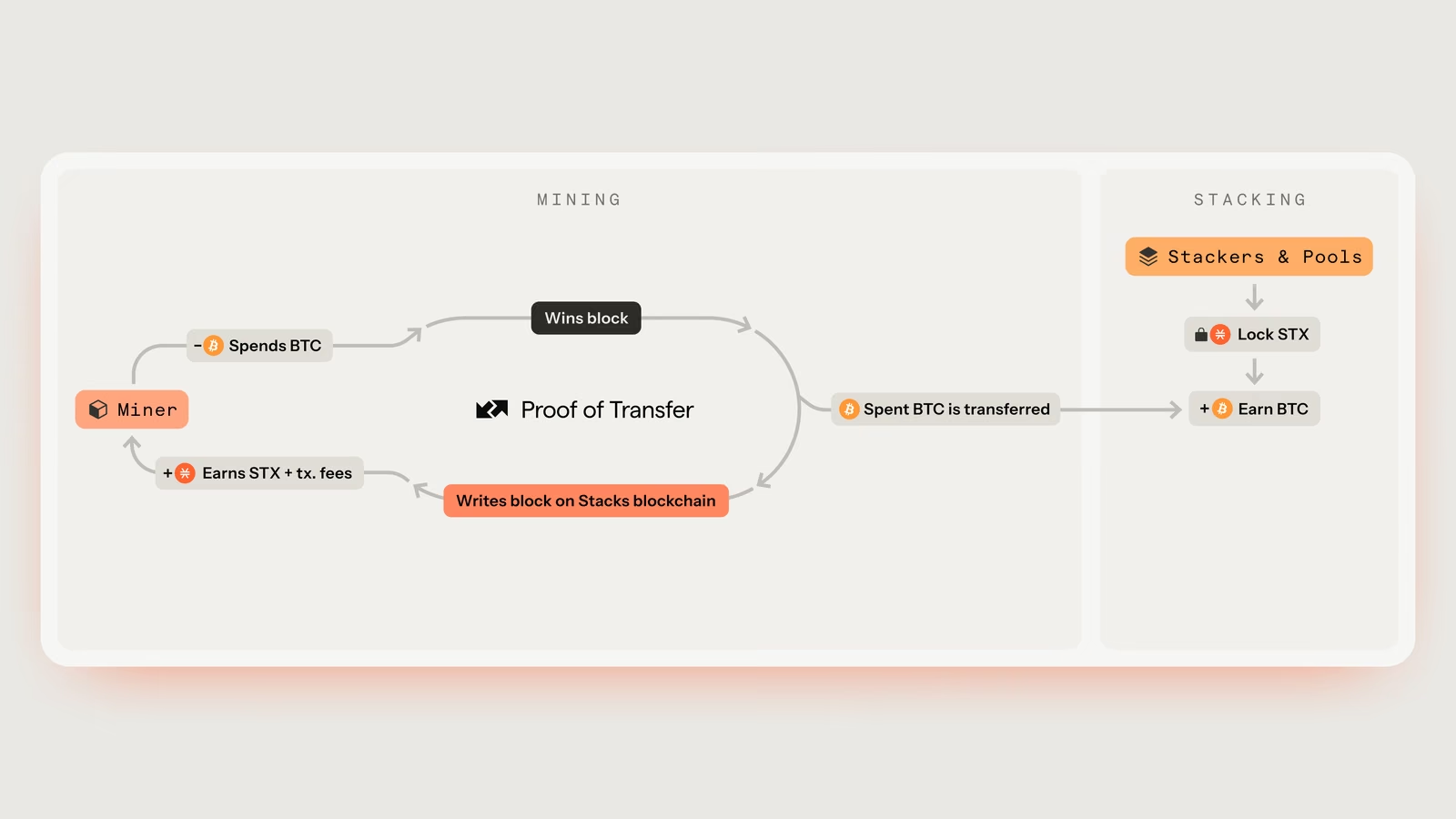
Proof of Transfer (PoX) is the consensus mechanism of the Stacks blockchain that enables participants to earn native BTC yield by locking STX tokens - without giving up custody, relying on intermediaries, or modifying the Bitcoin protocol. It is the first consensus mechanism to recycle Bitcoin's Proof of Work energy to secure a separate programmable blockchain.
PoX generates yield at the protocol level. Miners transfer real BTC to earn the right to produce Stacks blocks, and that BTC flows directly to STX stacking participants. Every transaction in this process is recorded on Bitcoin L1 and can be independently verified by anyone.
What Is Proof of Transfer?
Proof of Transfer is a consensus algorithm designed to extend Bitcoin's security to a new blockchain without requiring changes to Bitcoin itself. Where Proof of Work burns energy and Proof of Stake locks a network's native token, Proof of Transfer redirects an existing cryptocurrency - Bitcoin - to secure a new chain.
The concept was introduced by Muneeb Ali and others as an evolution of Proof of Burn. Rather than permanently destroying cryptocurrency to demonstrate commitment, PoX transfers it to productive use: compensating network participants who lock STX tokens to support consensus.
The result is a programmable blockchain - Stacks - that inherits Bitcoin's security properties while enabling smart contracts, DeFi applications, and Bitcoin-native yield.
How Does Stacks Mining Work?
Stacks mining does not require specialized hardware or high energy consumption. Any participant with BTC can compete to produce blocks.
Step 1: Miners commit BTC. To compete for the next Stacks block, a miner submits a BTC transaction on Bitcoin L1. This is a direct transfer - not a gas fee, not a token burn.
Step 2: The protocol selects a winner. A cryptographic sortition function, seeded by Bitcoin transaction data, selects the winning miner. The probability of selection is proportional to the BTC committed relative to all competing miners. This inherits Bitcoin's own unpredictability as an entropy source.
Step 3: The winner produces a Stacks block. The selected miner writes the next Stacks block and earns newly minted STX tokens plus transaction fees.
Step 4: The block is anchored to Bitcoin. A hash of the Stacks block is written into the corresponding Bitcoin transaction, creating a permanent, immutable record on Bitcoin L1.
Because every block commitment is a Bitcoin transaction, the complete history of Stacks block production is embedded in Bitcoin's blockchain. Anyone can verify the canonical Stacks chain by reading the Bitcoin chain.
How Does STX Stacking Work?
STX stacking is the process of locking STX tokens to support network consensus and earn BTC rewards. It is the other half of the Proof of Transfer mechanism.
Locking STX. Participants commit STX tokens for a defined stacking cycle (approximately two weeks). During this period, tokens remain in the stacker's own wallet - they are not transferred to a third party or custodian.
Earning BTC. The BTC that miners commit to produce blocks is distributed proportionally to stackers based on the amount of STX locked. Rewards are sent as native BTC to a Bitcoin address the stacker controls.
Cycle boundaries. At the end of each cycle, participants can re-commit for the next cycle or withdraw their STX. There is no penalty for not re-stacking.
This is a structural distinction from Proof of Stake systems: stackers earn BTC - not the network's native token. The yield comes from real economic activity (miners spending BTC to produce blocks), not from token emissions or inflation.
Who Are Signers?
Following the Nakamoto upgrade, stackers also serve as Signers - participants who validate and co-sign Stacks blocks. Signers play a critical role in finalizing blocks and ensuring the network operates correctly. The Signer role is integrated into the stacking process: by stacking STX, participants automatically become eligible to serve as Signers.
What Is the Nakamoto Upgrade?
The Nakamoto upgrade, activated in late 2024, was the most significant enhancement to the Stacks protocol since launch. It strengthened PoX security and introduced several capabilities critical to institutional adoption.
100% Bitcoin finality. Before Nakamoto, miners could theoretically attempt independent Stacks chain forks. The upgrade eliminated this by requiring miners to build on the last confirmed Stacks block at the protocol level. Stacks is now secured by 100% of Bitcoin's hashrate. Reversing a confirmed Stacks transaction requires reversing the corresponding Bitcoin block - effectively infeasible given current hashrate costs.
Faster block times. Stacks blocks are no longer tied 1:1 to Bitcoin's ~10-minute block interval. The network now produces blocks in seconds while still anchoring to Bitcoin for finality.
sBTC. Nakamoto enabled sBTC, a decentralized 1:1 Bitcoin peg. sBTC allows smart contracts on Stacks to use and move BTC without relying on a federation, multisig, or centralized custodian. This opens the door to BTC-native DeFi - lending, borrowing, and trading with real Bitcoin. sBTC also enables Dual stacking allowing participants to earn BTC stacking rewards while simultaneously deploying sBTC in DeFi protocols, compounding yield across both positions.
Proof of Transfer vs. Proof of Work vs. Proof of Stake
Understanding how PoX compares to other consensus mechanisms clarifies its design philosophy.
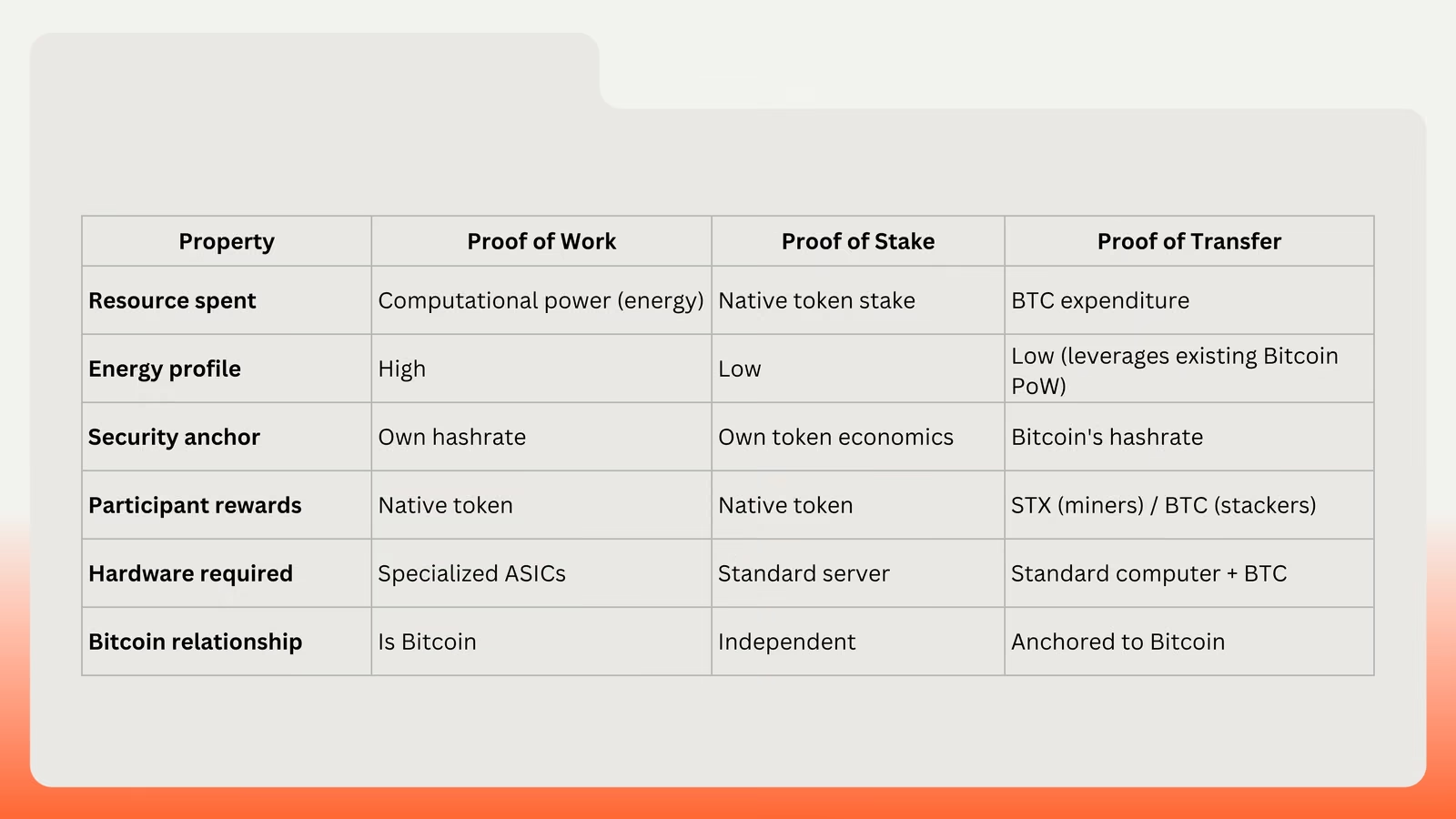
The defining property of PoX is that it does not replicate Bitcoin's security from scratch. It inherits it. A Proof of Stake network's security is bounded by the value of its staked tokens. PoX security is backed by Bitcoin - an asset with a market capitalization orders of magnitude larger than any Layer 2 token.
How Is Stacks Different from Bitcoin Sidechains and L2s?
Most Bitcoin Layer 2 solutions and sidechains rely on some form of trust assumption: a federation of signers, a multisig arrangement, or a centralized bridge operator. If those parties act maliciously or become compromised, user funds are at risk.
Stacks takes a different approach:
No bridge required for consensus. Stacks doesn't "bridge" assets to a separate chain. It uses Bitcoin transactions directly as part of its consensus mechanism. Miner commitments and block anchors are native Bitcoin transactions.
Verifiable on Bitcoin. The canonical Stacks chain can be independently determined by reading the Bitcoin blockchain. No trust in Stacks nodes is required to verify chain state.
sBTC is decentralized. Unlike wrapped Bitcoin products that depend on custodians, sBTC is managed by the Signer set - the same decentralized group of STX stackers that secures the network. There is no single custodian or federation to trust.
What Drives STX Demand?
A common question: if the yield is in BTC, why does STX have value? The answer is a self-reinforcing economic loop.
Miners transfer BTC to earn STX block rewards and transaction fees. Their willingness to compete depends on a healthy STX ecosystem generating transaction volume. As more miners compete, aggregate BTC payouts to stackers increase. Attractive stacking yields incentivize more STX lock-up, reducing circulating supply. DeFi activity on Stacks - lending, DEXs, sBTC applications - generates the organic demand that supports miner economics.
When does the loop weaken? During sustained market downturns or periods of low network utilization, miner participation declines and yields compress. This is an expected dynamic. Critically, unlike centralized platforms, reduced yield does not create insolvency risk. The protocol adjusts naturally. But prospective participants should model downside scenarios - compressed yields may not always justify the STX price exposure and operational overhead.
How to Start Stacking STX
Stacking is accessible through several paths:
Solo stacking. Participants with sufficient STX (the current minimum is dynamic and based on network conditions) can stack directly by interacting with the Stacks protocol. This requires managing a Bitcoin reward address and committing for full cycle durations.
Pooled stacking. Participants below the solo threshold can join stacking pools, which aggregate STX from multiple holders. Pools handle the technical requirements and distribute BTC rewards proportionally.
Custodial stacking. Institutional participants can stack through qualified custodians. Fireblocks, BitGo, Copper, and Hex Trust offer or are integrating Stacks stacking support.
What Are the Risks of STX Stacking?
Three primary considerations:
STX price volatility. STX is locked for the full cycle duration. If STX depreciates significantly during the lock-up, BTC yield may not offset the loss in position value. Net returns are a function of both BTC earned and STX price movement.
Yield variability. There is no fixed-rate guarantee. BTC rewards fluctuate based on miner participation and network conditions. Historical yields are not predictive of future performance.
Smart contract risk. The Stacks protocol has been in production since 2021 and has undergone multiple independent security audits, but no software system is risk-free.
Clarity: Bitcoin-Native Smart Contracts
Stacks uses Clarity, a decidable smart contract language purpose-built for Bitcoin. Two properties make Clarity distinctive:
Decidability. Clarity is not Turing-complete by design. The behavior of any Clarity contract can be fully analyzed before execution. This eliminates an entire class of vulnerabilities common in Turing-complete languages like Solidity.
Bitcoin state access. Clarity contracts can read Bitcoin chain state directly - verifying transactions, checking balances, and responding to on-chain events without relying on oracles. This is possible because every Stacks node maintains a complete view of the Bitcoin blockchain as part of its consensus process.
Further Reading
- Stacks Documentation - Full technical documentation
- PoX Whitepaper - Original mechanism design paper
- sBTC Overview - Decentralized Bitcoin peg documentation
- Stacking Overview - Guide to participating in stacking
- Nakamoto Upgrade - Technical details on the upgrade
Stacks is the leading Bitcoin Layer 2 for smart contracts, DeFi, and BTC yield. Learn more at stacks.co.
Get more of Stacks
Get important updates about Stacks technology, projects, events, and more to your inbox.