.avif)
Best Bitcoin Layer 2 Projects in 2026: Complete Comparison Guide
Bitcoin was built to be secure and decentralised above all else. That design made it the most trusted cryptocurrency in the world, but it came with trade-offs: low throughput, constrained scripting, and limited programmability. For years, none of that mattered much. Bitcoin was a store of value, and the base layer was enough.
That is no longer the case. As BTC evolves into a productive asset (collateral, yield-bearing, spendable at speed), the limitations of mainnet become structural bottlenecks. The scalability and programmability problems need to be solved at a different layer.
This is where Bitcoin Layer 2s come in. Rather than competing with the base layer, they extend it: adding throughput, smart contract execution, and new transaction types while (ideally) inheriting Bitcoin's security guarantees.
Unlike Ethereum, there is no standard definition of what constitutes a Bitcoin L2. The term covers payment channels, sidechains, rollups, statechains, and federated networks. Some inherit Bitcoin's security directly. Others rely on their own validator sets with trust assumptions that have little to do with the base layer. The working definition: any protocol that extends Bitcoin's functionality, scales demand for BTC-denominated applications, and maintains a meaningful connection to mainnet.
What follows is a breakdown of the most notable Bitcoin L2 projects heading into mid-2026: what they do, how they work, and where they differ. For a broader directory of the full landscape, Bitcoin Layers tracks the growing ecosystem of projects building on top of Bitcoin.
1. Citrea
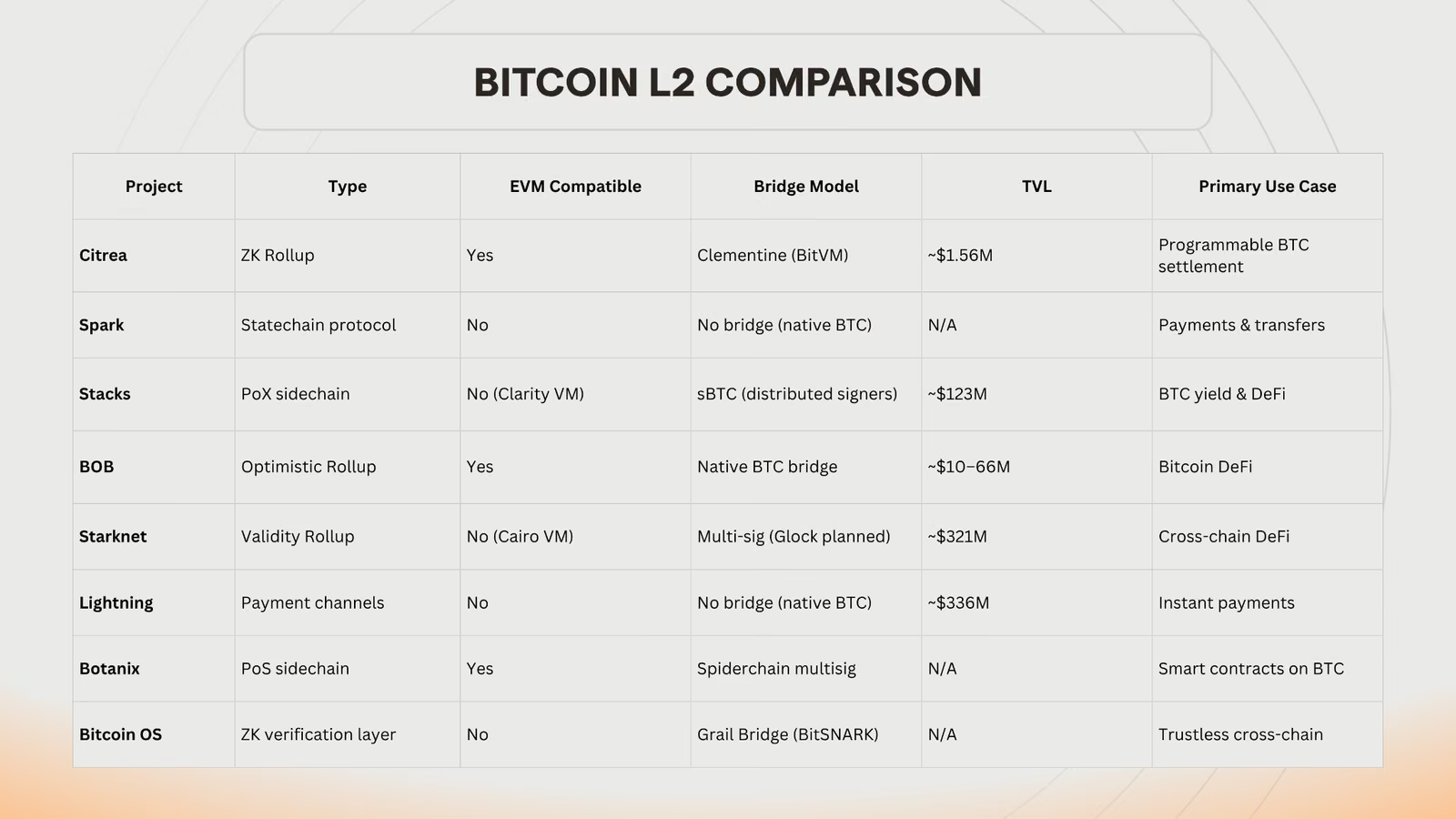
Architecture: ZK rollup settling directly on Bitcoin via BitVM
Mainnet: January 2026
TVL: ~$1.56M
Citrea approaches Bitcoin's programmability problem from the base layer up. Where most L2s work around Bitcoin's limitations through off-chain systems or custody arrangements, Citrea uses zero-knowledge proofs and BitVM to make Bitcoin a fully programmable settlement layer without touching the protocol.
The mechanism: Citrea bundles thousands of transactions, generates a ZK proof confirming their validity, and writes that proof directly to Bitcoin. This makes the base chain both the data availability layer and the settlement layer. Everything on Citrea traces back to, and is verifiable against, the Bitcoin network.
Execution happens in a fully EVM-compatible environment, meaning Ethereum developers can deploy on Bitcoin without rewriting their code. The sequencer is currently centralised (a liveness dependency, though not a validity risk). A misbehaving sequencer cannot post an invalid state because the ZK proof enforces correctness at the base layer. Decentralisation of the sequencer is in development.
The bridge is where Citrea's technical distinction becomes clearest. Clementine is the first trust-minimised two-way peg built on BitVM and the first mechanism that verifies fraud proofs on Bitcoin without a protocol change. Instead of a multisig federation, it uses a challenge-response model: any honest watcher can contest a fraudulent withdrawal, and the offending operator gets slashed. A single honest participant is sufficient to maintain integrity.
Two native assets: cBTC (BTC bridged into Citrea, verifiable via ZK proofs and BitVM) and ctUSD (a stablecoin backed by short-term US Treasuries and cash, intended as the primary liquidity layer for Bitcoin capital markets).
Why it matters: Citrea is the most direct attempt to date to make Bitcoin the base layer of a programmable financial system, without protocol changes and without delegating custody to a third party. The trade-off is that it is early; TVL is modest and the sequencer remains centralised.
2. Spark
Architecture: Off-chain statechain protocol
Status: Live
Primary focus: Payments
Most Bitcoin L2s are built around making BTC productive as collateral. Spark is solving a more fundamental problem: making BTC spendable, at speed, with no fees.
Spark is not a blockchain. It is an off-chain protocol built on statechains, where users deposit BTC into a shared mainnet address held jointly with the Spark Entity. What transfers between parties is not the Bitcoin itself but the right to spend it; no transaction ever hits the base layer. There is no bridge, no wrapped asset, and no custody handover. Exiting means broadcasting directly to Bitcoin mainnet, with settlement enforced by the base layer.
The architecture is built for payments. Flashnet, Spark's native AMM, targets the performance standards of traditional finance while keeping users in control of their funds.
It supports native BTC and stablecoin transfers with near-instant finality, no fees, and Lightning compatibility. Withdrawals to mainnet are available at any time, unilaterally, with no intermediary. The roadmap includes instant deposits, privacy features, EVM and Solana bridging, and lending.
Why it matters: Spark sits at a different point in the stack from most Bitcoin L2s. It is not competing with protocols building collateral infrastructure for institutional BTC. It is building the layer where Bitcoin moves between people, and it does this without introducing new trust assumptions beyond the Spark Entity co-signing model.
3. Stacks
Architecture: Proof of Transfer (PoX) consensus, Clarity VM
Mainnet: Live since January 2021
TVL: ~$123M
Stacks is the most established Bitcoin L2, and the one with the deepest track record in BTC yield. It holds more BTC than any other L2, its TVL has remained stable through the early 2026 downturn, and stablecoin volume has grown 23x since Q1 2025. That liquidity is deployed across Zest (lending), Bitflow (concentrated liquidity DEX), and Hermetica (BTC yield vaults).
The core mechanism is Proof of Transfer. Miners compete for block production by bidding BTC. Winners receive newly minted STX plus transaction fees; the BTC they spend is distributed to STX stackers proportional to their locked amount (historically returning up to 10% APY in BTC). Across five years, Stacks has distributed over 4,000 BTC to participants.
An upcoming upgrade embeds self-custodial BTC staking directly into PoX, extending rewards to both BTC and STX stackers. Holders locking both assets receive higher yields, giving long-term BTC holders a reason to engage without surrendering custody. For institutions evaluating BTC yield without custody risk, this is a meaningful development.
Security is tightly integrated with the base layer. Stacks transactions are anchored to Bitcoin's proof-of-work and benefit from 100% of Bitcoin finality; reversing them would require reorging Bitcoin itself. Smart contracts on Stacks can read Bitcoin transactions and state changes trustlessly, executing in response to on-chain activity without relying on bridges or oracles.
The Nakamoto upgrade (launched Q4 2024) brought transaction confirmation down to seconds. A subsequent upgrade expanded DeFi throughput by 30x.
sBTC is how Stacks makes BTC productive. It is a trust-minimised, 1:1 BTC-pegged token governed by a distributed signer set rather than a single custodian or closed federation. Peg-out transactions do not depend on a centralised entity, reducing counterparty risk compared to existing wrapped BTC solutions.
Satoshi upgrades extend sBTC with three features that matter for institutional adoption: self-custodial minting (BTC backing stays under the user's control throughout the process), post-conditions (developers define Bitcoin scripts constraining exactly where and how BTC can move on L1, narrowing the trust assumption from the signer set to application logic), and fee abstraction (users pay fees in sBTC, with the protocol handling STX conversion in the background).
Why it matters: Stacks has the most mature ecosystem, the highest TVL among purpose-built Bitcoin L2s, and the deepest BTC yield track record. The trade-off is complexity; PoX, STX tokenomics, and Clarity VM create a steeper learning curve than EVM-based alternatives.
4. BOB (Build on Bitcoin)
Architecture: OP Stack-based optimistic rollup
Status: Live
TVL: ~$10–66M (varies by metric)
BOB takes the most familiar approach for developers coming from Ethereum. Built on the OP Stack, it is an optimistic rollup that combines Bitcoin security with full EVM compatibility and a native BTC bridge.
The design is pragmatic: give Solidity developers access to Bitcoin without asking them to learn new tooling. Smart contracts deploy exactly as they would on Optimism or Base, but settlement and security anchor to Bitcoin mainnet. The native bridge allows direct BTC deposits (not wrapped tokens), which matters for protocols building around BTC as pristine collateral.
In 2025, BOB integrated Fireblocks for institutional custody, signalling a focus on bringing regulated capital into Bitcoin DeFi. Primary use cases centre on yield generation, lending against BTC, and general-purpose smart contract applications.
Why it matters: BOB is the easiest on-ramp for Ethereum-native developers and institutions who want Bitcoin exposure with familiar tooling. The trade-off is that optimistic rollups carry a fraud proof challenge period, meaning withdrawals are slower than ZK-based alternatives.
5. Starknet
Architecture: STARK-based validity rollup (Cairo VM), dual Bitcoin + Ethereum settlement
Status: Live on Ethereum; Bitcoin settlement in development
TVL: ~$321M (primarily Ethereum-side)
Starknet was built as an Ethereum L2 but is expanding into something more ambitious: the first rollup to settle on both Bitcoin and Ethereum.
The technical approach uses STARK proofs and the Cairo VM. Transactions execute off-chain, get batched into STARK proofs, and are verified on-chain. For Bitcoin settlement, Starknet is developing the S-TWO protocol to post proofs directly to Bitcoin mainnet. The Glock bridge (being built with Alpen Labs) aims to replace current multi-sig federation models with a trust-minimised mechanism using cryptographic verifiers on Bitcoin itself.
Bitcoin adoption on Starknet has been rapid: BTC staking grew from zero to 1,700 BTC (~$160M) in three months through late 2025. The Xverse wallet integration enables Bitcoin-native users to interact with Starknet's DeFi ecosystem, and the Garden protocol launched in early 2026 for direct Bitcoin liquidity.
The dual-settlement design is the key differentiator. Protocols on Starknet can compose across both ecosystems, accessing Ethereum's DeFi liquidity and Bitcoin's security guarantees simultaneously. Privacy features through strkBTC enable confidential DeFi transactions.
There are headwinds. Chain revenue has dropped significantly from 2023 peaks, and StarkWare recently restructured. Cairo VM also means a steeper developer learning curve than EVM-compatible alternatives.
Why it matters: Starknet is betting that the future is multi-chain settlement, not Bitcoin-only or Ethereum-only. If the Glock bridge and S-TWO protocol deliver, it offers something no other L2 does: composability across the two largest crypto ecosystems. The risk is execution; it is the most technically ambitious project on this list.
6. Lightning Network
Architecture: Payment channel network
Status: Live since 2018
Capacity: ~5,637 BTC (~$336M) across ~15,000 nodes
Lightning is the original Bitcoin L2 and remains the most widely deployed. It works through payment channels: two parties lock BTC into a multisig address, transact off-chain as many times as they want, and settle the final balance to Bitcoin when the channel closes.
The result is sub-second settlement, fees measured in fractions of a cent, and throughput limited only by the network's channel liquidity, not by block space. For payments, nothing on Bitcoin comes close.
Recent protocol upgrades have addressed long-standing friction points. BOLT 12 (Offers) adds reusable payment codes and improved privacy. Splicing allows channels to be resized dynamically without closing them. Lightning Service Providers (LSPs) abstract away the complexity of channel management, making the network more accessible to wallets and applications.
Transaction volume surged 266% year-over-year through early 2025, and capacity hit all-time highs. Institutional adoption continues to grow, with major exchanges and payment processors adding Lightning support.
The limitations are well understood. Lightning is a payment network, not a smart contract platform. Liquidity management remains non-trivial, node operation is complex for non-technical users, and security vulnerabilities like replacement cycling are active areas of research.
Why it matters: Lightning is the only Bitcoin L2 that has achieved meaningful real-world payment adoption. It does one thing: fast, cheap BTC transfers. It does it at scale. The trade-off is that its scope is narrow by design; for anything beyond payments, you need a different solution.
7. Botanix
Architecture: EVM-compatible sidechain with Spiderchain consensus
Mainnet: July 2025
Block time: 5 seconds
Fees: ~$0.02
Botanix takes a different approach to securing an EVM-compatible chain with Bitcoin: the Spiderchain. Rather than relying on a static multisig federation, Botanix uses a rotating set of multisig wallets managed by Orchestrator nodes. A new multisig is generated with every Bitcoin block, using randomised subsets of Orchestrators and threshold signatures with distributed key generation, meaning no single entity ever holds a complete key.
The current federation is 16 nodes (Galaxy Digital, Fireblocks, Alchemy, Antpool, among others), with plans to expand beyond 100 operators in 2026. Consensus is proof-of-stake with BTC-staked Orchestrators, and finality requires two-thirds approval.
Users bridge BTC by locking it in Spiderchain multisig wallets, receiving btcBTC on the EVM side. Root hashes are inscribed on Bitcoin, tying Spiderchain finality to Bitcoin's. The DeFi ecosystem launched with Palladium (a BTC-backed stablecoin) and Bitzy (a DEX).
Why it matters: Botanix's rotating multisig design is a pragmatic middle ground between a static federation and a fully trust-minimised bridge. EVM compatibility keeps the developer barrier low. The trade-off is that security still rests on the honesty of the Orchestrator set, and the federation is small for now.
8. Bitcoin OS
Architecture: ZK verification layer using BitSNARK
Status: In development (mainnet components rolling out)
Key innovation: On-chain ZK proof verification without protocol changes
Bitcoin OS is not an L2 in the traditional sense. It is a verification layer that enables any chain to settle trustlessly on Bitcoin by verifying zero-knowledge proofs directly in Bitcoin Script.
The core technology is BitSNARK, which compresses complex computations into ~300-byte proofs that can be verified on-chain. This was demonstrated on Bitcoin mainnet in July 2024: the first-ever ZK proof verification on Bitcoin. It uses a two-party protocol where the prover stakes BTC alongside a zk-SNARK proof; verification happens on-chain, with slashing for false proofs.
The Grail Bridge extends this into a trustless cross-chain vault. BTC is locked on mainnet while wrapped tokens are minted on connected chains; unlocking requires a zk-proof-verified burn transaction. No federation, no multisig, no counterparty. Recent integrations include Cardano and B2 Network. The institutional products (Grail Pro, zkBTC) are designed for custody-grade security, targeting allocators who find current bridge trust assumptions unacceptable.
Why it matters: Bitcoin OS is the most infrastructure-level project on this list. If BitSNARK verification matures, it provides a primitive that other L2s and cross-chain protocols can build on; trustless settlement on Bitcoin for any chain, without forks. The trade-off is that much of this is still pre-mainnet, and TVL data is limited.
Challenges Facing Bitcoin L2s
The Bitcoin L2 ecosystem is still early, and several structural challenges remain unresolved.
No unified standard. Unlike Ethereum, where rollups share common frameworks (OP Stack, Polygon CDK, ZK-EVM), Bitcoin L2s have wildly different architectures, trust assumptions, and definitions of what "L2" even means. This makes comparison difficult and creates confusion for users and developers evaluating the space.
Bridge security remains the central risk. The majority of BTC locked in L2s passes through some form of multisig, federation, or trust-minimised bridge. Each carries different risk profiles: from Clementine's BitVM-based challenge model to Lightning's native payment channels to static federations. A bridge failure on any major L2 would set back the entire ecosystem.
Liquidity fragmentation. Every new L2 creates another pool of BTC liquidity that does not compose with the others. A user's sBTC on Stacks cannot be used as collateral on Citrea. BTC locked in Lightning channels is not available for DeFi. This is the multi-chain problem, and Bitcoin L2s have not solved it.
Developer fragmentation. Some L2s use the EVM (Citrea, BOB, Botanix), some use their own VMs (Stacks' Clarity, Starknet's Cairo), and some are not programmable at all (Lightning, Spark). There is no shared standard, which splits developer attention and slows ecosystem growth.
Regulatory uncertainty. Bridges, staking mechanisms, and yield products operate in a legal grey area in many jurisdictions. Institutional adoption depends on clarity that has not yet arrived.
Sequencer centralisation. Most rollup-based L2s (Citrea, BOB, Starknet) currently rely on a single sequencer. While this does not compromise validity (proofs enforce correctness), it creates liveness risk and censorship concerns that need to be addressed before these networks can credibly claim decentralisation.
How to Choose the Right Bitcoin L2
The right L2 depends on what you are trying to do with your BTC.
If you want to earn yield on BTC: Stacks has the longest track record and the most mature DeFi ecosystem. sBTC and the upcoming Satoshi upgrades make it the default choice for BTC yield, particularly for users who want self-custodial options. BOB is an alternative for users who prefer EVM tooling.
If you want to make payments: Lightning is the clear answer for fast, cheap BTC transfers. Spark is worth watching for users who want similar speed without the complexity of channel management, plus native stablecoin support.
If you are an Ethereum developer building on Bitcoin: Citrea and BOB offer full EVM compatibility. Citrea's ZK-based settlement provides stronger security guarantees; BOB's OP Stack foundation is more familiar to developers already building on Optimism or Base. Botanix is a third option with low fees and fast blocks.
If you need cross-chain composability: Starknet is the only project attempting dual Bitcoin-Ethereum settlement. If your use case requires liquidity or functionality from both ecosystems, this is where to look.
If you care most about trust minimisation: Citrea (BitVM-based bridge, ZK settlement) and Bitcoin OS (BitSNARK on-chain verification) represent the most aggressive approaches to removing trust assumptions. Lightning also scores well here, since BTC never leaves the base layer.
If you are an institution evaluating custody risk: The spectrum runs from Lightning and Spark (BTC stays on mainnet or is directly redeemable) through Stacks' sBTC (distributed signer set) and Citrea's Clementine (BitVM fraud proofs) to federation-based models. The Satoshi upgrades on Stacks and the Grail Bridge on Bitcoin OS are specifically designed for institutional custody requirements.
Conclusion: The Future of Bitcoin Scaling
Bitcoin L2s in 2026 are where Ethereum L2s were in 2021: fragmented, fast-moving, and full of competing approaches not yet tested at scale. ZK rollups like Citrea are pushing toward trust-minimised settlement. Lightning remains the only L2 with real payment adoption. Starknet is betting on cross-ecosystem composability. Bitcoin OS is building verification primitives that could underpin the next generation of bridges.
But among all of these projects, Stacks stands out as the one that has moved furthest beyond experimentation into a functioning economy. It has the highest TVL of any purpose-built Bitcoin L2, the longest track record of distributing real BTC yield through Proof of Transfer, and the most active DeFi ecosystem, with Zest, Bitflow, and Hermetica already handling meaningful volume.
What separates Stacks from the field is its roadmap. The Satoshi upgrades (self-custodial sBTC minting, post-conditions constraining BTC movement at the script level, and fee abstraction) are designed to close the gap between what institutions require and what Bitcoin L2s currently offer. For large BTC holders who have stayed on the sidelines because custody risk was unacceptable, these upgrades may change the calculus.
Bitcoin's evolution from store of value to productive asset is not guaranteed. But the infrastructure being built (particularly on Stacks) makes it more plausible than it was a year ago. The question is no longer whether Bitcoin needs Layer 2s. It is which ones will earn the trust of the ecosystem that values trust above all else.
Get more of Stacks
Get important updates about Stacks technology, projects, events, and more to your inbox.