.avif)
Digital Asset Treasuries (DATs): The Complete Guide to Bitcoin Treasury Stocks

Digital Asset Treasuries are publicly traded companies that hold bitcoin and other crypto assets as their core balance-sheet strategy.They have quietly become one of the most significant structural trends in both crypto and public equities.
As of late 2025, CoinGecko's DATCo report tracked 142 digital asset treasury companies with a combined market cap exceeding $130 billion, more than double since the start of that year. The number has continued to climb in 2026, with new bitcoin treasury stocks launching nearly every week. Together, these firms hold a meaningful and growing share of the total circulating supply of BTC, ETH, and SOL.
Yet most market participants, including many institutional allocators, still don't fully understand what digital asset treasuries are, how bitcoin treasury companies work, or why they matter. This guide breaks it down.
What Is a Digital Asset Treasury (DAT)?
A DAT is a publicly listed company whose core business strategy is to accumulate digital assets, usually one primary asset like bitcoin, on its balance sheet and let investors access that exposure through its equity.
Most DATs today are effectively bitcoin holding companies, though a smaller cohort focuses on ETH or SOL.
Three traits define a DAT:
Publicly listed, balance-sheet first.
A DAT is a publicly traded company whose primary "product" is its treasury of digital assets, not a traditional operating business. The balance sheet is the business model.
Structured exposure, not a one-off trade.
Unlike a corporation that makes a single opportunistic purchase, a DAT treats digital asset accumulation as a formal, ongoing treasury policy. Purchases, funding mechanisms, and balance-sheet composition are disclosed and managed over time. Much like a Real Estate Investment Trust manages its property portfolio.
Not an ETF.
DATs are operating companies, not passive trusts. They can borrow, issue equity or convertible debt, and actively manage their holdings. Their stock can trade at a premium or discount to net asset value (NAV), and management teams can use capital markets to lever up or restructure exposure as market conditions shift.
For investors, bitcoin treasury stocks function as public market proxies for a given digital asset. Instead of buying BTC directly or through an ETF, investors access similar, or leveraged, exposure through the company's stock.
Bitcoin Treasury Stocks vs. Bitcoin ETFs: What's the Difference?
One of the most common questions from traditional finance investors: why not just buy a bitcoin ETF?
DATs offer structural advantages that ETFs and direct spot holdings cannot replicate:
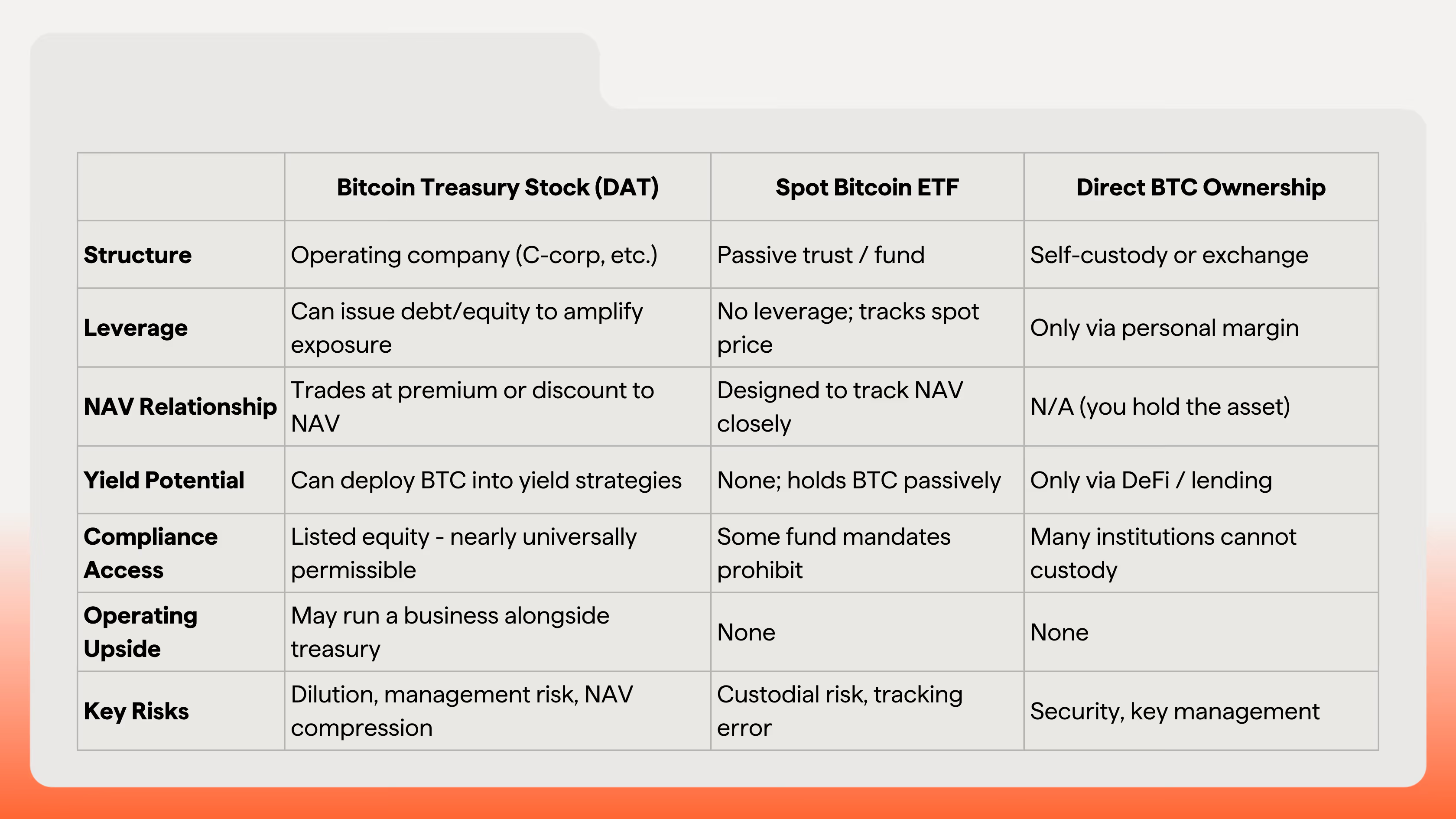
Why Investors Choose DATs Over ETFs
Built-in leverage. DATs can issue debt, convertible notes, or new equity to expand their treasury, giving investors amplified exposure to the underlying asset without using personal margin or derivatives.
Operating upside. If the company runs a revenue-generating business alongside its treasury (as some do), investors capture that additional value.
Compliance-friendly access. Many institutional fund mandates prohibit direct crypto custody or ETF holdings. Listed equity, however, is nearly universally permissible - making bitcoin treasury stocks a backdoor into digital asset exposure for pensions, endowments, and insurance portfolios.
NAV arbitrage. DAT stocks persistently trade at premiums or discounts to the mark-to-market value of their underlying holdings, creating a tradeable spread that simply does not exist with ETFs pegged to NAV.
The simplest way to think about a bitcoin-focused DAT: a publicly traded bitcoin holding company with more flexibility - and more risk - than a spot ETF.
Why Are Bitcoin Treasury Companies Emerging Now?
The environment around bitcoin treasury stocks has shifted fundamentally since 2020. What began as a niche corporate experiment has matured into a recognizable asset class. CoinGecko's 2025 DATCo report found that 76 new DATs were formed in 2025 alone, with DATCo crypto holdings more than doubling (+139.6%) over the course of the year.
Four forces explain the acceleration:
The Strategy and Metaplanet Proof Points
Strategy (formerly MicroStrategy) now holds approximately 767,000 BTC - more than 3.5% of total supply - making it the largest corporate bitcoin holder in the world by a wide margin. Its total cost basis exceeds $33 billion. Meanwhile, Japan-based Metaplanet has accumulated over 40,000 BTC since its 2024 bitcoin pivot, vaulting to the third-largest corporate holder globally. Both companies have demonstrated that a listed vehicle built around a bitcoin treasury can attract significant capital and, in strong market cycles, substantially outperform the underlying asset.
Corporate Crypto Adoption Is Now Structural
Public companies, ETFs, and sovereign entities together hold a significant and growing share of bitcoin's circulating supply. U.S. spot bitcoin ETFs alone hold approximately 1.3 million BTC, while governments including the United States and China collectively hold roughly 520,000 BTC. This is no longer experimental - bitcoin is an established balance-sheet asset class.
Regulatory and Accounting Clarity
FASB's ASU 2023-08, effective for fiscal years beginning after December 15, 2024, now requires fair value accounting for qualifying crypto assets. This removes a longstanding barrier: under previous impairment-only rules, companies had to write down bitcoin losses but could never mark up unrealized gains. The new standard levels the playing field and makes balance-sheet crypto far more defensible for boards, auditors, and institutional investors.
Capital Markets Demand for Crypto Beta with Leverage
U.S. spot bitcoin ETFs have attracted over $65 billion in cumulative net inflows since their January 2024 launch, proving deep institutional appetite for regulated BTC exposure. DATs extend this thesis by offering equity in leveraged treasuries - where investors can also trade premiums and discounts to NAV, adding a layer of tactical opportunity that passive ETF structures cannot provide.
The infrastructure is built. Regulation is clearer. Institutional adoption is measurable. DATs are the corporate wrapper that turns digital asset treasury strategies into investable listed equities.
The Biggest Bitcoin Treasury Companies in 2026
The bitcoin treasury landscape is dominated by a handful of large holders, with a long tail of smaller entrants. Here are the leading bitcoin treasury stocks by BTC held:
.avif)
In total, publicly traded companies held over 1.13 million BTC as of March 2026, according to BitcoinTreasuries.net. The market is heavily concentrated: Strategy alone accounts for roughly two-thirds of all corporate bitcoin holdings.
How to Evaluate a Bitcoin Treasury Stock
For investors accustomed to traditional equity analysis, bitcoin treasury stocks require a different toolkit. These are the key metrics that matter:
BTC per share.
The most important metric for any DAT. It measures how much bitcoin each share of the company represents. If a DAT issues new equity to buy more BTC, the question is whether total BTC holdings grew faster than share dilution - increasing BTC per share over time.
Premium or discount to NAV.
DAT stocks rarely trade at exactly the value of their underlying bitcoin. A stock trading at a 50% premium to NAV means investors are paying $1.50 for every $1.00 of bitcoin exposure. Premiums can persist for months or compress rapidly during sell-offs.
mNAV (multiple of NAV).
A shorthand for the premium/discount. An mNAV of 1.0 means the stock trades at par with its bitcoin holdings. Strategy has historically traded at mNAVs ranging from 1.2 to 3.0+, depending on market sentiment and leverage expectations.
Dilution rate.
DATs frequently issue new shares or convertible debt to fund bitcoin purchases. The rate of dilution - and whether it's accretive (BTC per share goes up) or dilutive (BTC per share goes down) - is critical to long-term returns.
Cost basis per BTC.
The average price at which the company acquired its bitcoin. A low cost basis relative to current prices provides a margin of safety; a high cost basis introduces risk if prices decline.
Leverage ratio.
How much debt the company has issued relative to the value of its BTC holdings. Higher leverage amplifies both gains and losses. Some DATs operate with minimal debt; others, like Strategy, use aggressive convertible note issuance.
Understanding these metrics is essential for distinguishing between well-managed bitcoin treasury companies and those that may be destroying shareholder value through excessive dilution or overpriced acquisitions.
Why Bitcoin Is Becoming a Treasury Reserve Asset
Most new DATs are built around a single objective: accumulating bitcoin.
Among digital assets, bitcoin is the easiest for boards, regulators, and allocators to defend as a long-term reserve. It has a fixed supply of 21 million coins, a transparent and predictable issuance schedule, and a 15-year track record as a high-performing, liquid asset often described as "digital gold." No other crypto asset comes close to matching its Lindy effect or institutional credibility.
The backdrop reflects a clear shift in institutional behavior. Public companies, ETFs, and sovereign entities now hold a substantial portion of circulating supply, firmly establishing BTC as a legitimate balance-sheet asset. Strategy and Metaplanet have demonstrated how a bitcoin-focused treasury model can reshape both valuation and market perception. And key geographies - especially Europe - remain underpenetrated by pure-play bitcoin DATs, leaving a large addressable market for new entrants.
Bitcoin has also gained practical utility as corporate collateral. It can sit passively in treasury, be pledged against financing facilities, or be deployed through bitcoin-native yield platforms. This is the mechanism many DATs use to expand: they post existing BTC as collateral to borrow capital, then deploy that liquidity to purchase additional bitcoin - a strategy sometimes called a "bitcoin flywheel."
Bitcoin's monetary design, market performance, and accelerating institutional adoption make it the natural core reserve asset for Digital Asset Treasuries.
How Bitcoin Treasury Companies Earn BTC Yield
What do DATs actually do with the BTC sitting on their balance sheets?
A DAT treasury's job is to turn passive bitcoin reserves into productive, yield-generating capital. The approaches vary widely in risk and sophistication.
Traditional (Off-Chain) Strategies
Most DATs have relied on familiar corporate treasury tools: issuing debt or convertible notes to fund additional BTC purchases, running basis and options strategies against their holdings, and engaging in lending or margin funding through centralized counterparties. These are standard capital markets operations, but they cap yield potential and carry counterparty and rehypothecation risk - risks that were laid bare during the 2022 credit contagion.
On-Chain Yield for ETH and SOL Treasuries
Ethereum and Solana DATs have a structural advantage here. They can grow their token holdings natively through proof-of-stake staking and DeFi protocols. ETH staking alone generates roughly 3–4% annualized yield. Their treasuries compound over time with no additional capital outlay required.
That creates direct competitive pressure on bitcoin DATs. Without native staking, a bitcoin treasury risks falling behind in relative performance as ETH and SOL treasuries quietly compound quarter after quarter.
Bitcoin-Native Yield via Stacks
This is where Stacks enters the picture.
Stacks is the leading Bitcoin Layer 2 by BTC capital deployed, with approximately 5,000 sBTC on the network and over $545 million in total value locked. It is also the only Bitcoin L2 announced as a partner with Circle to bring USDCx - a USDC-backed stablecoin - to the network, powered by Circle's xReserve infrastructure.
On Stacks, a bitcoin-focused DAT could:
Borrow against BTC and recycle capital through lending and borrowing protocols like Zest and Granite. Zest alone has over $70 million in deposits, enabling treasuries to lever up without selling their underlying bitcoin.
Deploy into BTC yield vaults on platforms like Hermetica, targeting annualized yields of up to 8% APY denominated in BTC.
Earn native BTC yield simply for holding BTC on Stacks via the Dual Stacking upgrade, which allows simultaneous stacking of STX and earning of BTC rewards. For a deeper look, see our guide on How to Earn Bitcoin Yield in 2026.
This gives bitcoin DATs a way to generate on-chain yield while keeping BTC at the center of their balance sheet. It positions Stacks as the natural institutional-grade infrastructure layer for institutions that want bitcoin-native yield - rather than migrating capital to Ethereum or Solana to chase returns.
Risks of Investing in Bitcoin Treasury Stocks
DATs offer unique advantages, but they come with risks that are distinct from holding bitcoin directly or through an ETF. Investors should understand these before allocating capital:
Dilution risk.
DATs frequently issue new shares or convertible debt to fund bitcoin purchases. If the company issues equity at a premium to NAV, this can be accretive - shareholders end up with more BTC per share. But if premiums compress or management misjudges timing, dilution erodes value. Unlike an ETF, there is no mechanism guaranteeing that share issuance benefits existing holders.
NAV premium compression.
During bull markets, DAT stocks can trade at substantial premiums to the value of their underlying bitcoin. In downturns, those premiums collapse - sometimes to a discount. An investor who buys at a 2x mNAV and watches it fall to 1x has lost 50% of their investment even if bitcoin's price is unchanged.
Leverage amplifies losses.
The same debt structures that amplify returns in rising markets accelerate losses when bitcoin declines. DATs with high leverage ratios face margin calls, forced selling, or balance-sheet distress in sustained drawdowns.
Management and governance risk.
DAT performance depends heavily on the judgment of a small leadership team. Poor capital allocation, ill-timed purchases, or mismanagement of debt facilities can destroy shareholder value in ways that don't apply to passive bitcoin holdings.
Liquidity and concentration.
Many smaller DATs are thinly traded, and the entire category is heavily correlated to bitcoin's price. During market stress, liquidity can evaporate.
These risks don't disqualify DATs as an investment vehicle, but they do mean the category is higher-risk and higher-reward than passive alternatives like spot ETFs. Investors should size positions accordingly.
Frequently Asked Questions About Bitcoin Treasury Stocks
What is a bitcoin treasury company?
A bitcoin treasury company - also called a Digital Asset Treasury (DAT) - is a publicly listed company whose primary strategy is accumulating bitcoin on its balance sheet. Investors gain exposure to bitcoin by buying the company's stock rather than purchasing BTC directly. The most well-known example is Strategy (formerly MicroStrategy), which holds over 767,000 BTC.
How many companies hold bitcoin on their balance sheet?
As of early 2026, approximately 145 publicly traded companies hold bitcoin as a treasury asset, according to BitcoinTreasuries.net. Together, they hold over 1.13 million BTC. Hundreds more private companies also hold bitcoin, though their holdings are not publicly disclosed.
What is the difference between a bitcoin ETF and a bitcoin treasury stock?
A bitcoin ETF is a passive fund that tracks the price of bitcoin as closely as possible. A bitcoin treasury stock is equity in an operating company that holds bitcoin - and can use leverage, issue debt, earn yield on its holdings, and make strategic capital allocation decisions. DAT stocks can trade at significant premiums or discounts to the value of their underlying bitcoin, while ETFs are designed to stay close to NAV.
Are bitcoin treasury stocks a good investment?
Bitcoin treasury stocks offer leveraged exposure to bitcoin through listed equity, which can outperform BTC in bull markets but underperform in downturns. They carry additional risks including dilution, NAV premium compression, management risk, and leverage. Whether they're appropriate depends on an investor's risk tolerance, portfolio construction, and view on bitcoin's long-term trajectory. This article is for informational purposes and does not constitute investment advice.
What is BTC per share and why does it matter?
BTC per share measures how much bitcoin each share of a treasury company represents. It is the single most important metric for evaluating whether a DAT's capital raising activities are accretive (increasing BTC per share over time) or dilutive (decreasing it). A well-run DAT should show BTC per share growing consistently, meaning that equity issuance is adding more bitcoin to the treasury than it is diluting existing shareholders.
Can bitcoin treasury companies earn yield on their BTC?
Yes. While bitcoin does not have native staking like Ethereum, bitcoin treasury companies can earn yield through several methods: issuing debt to fund additional BTC purchases, running options and basis strategies, lending BTC through centralized or decentralized platforms, and deploying BTC into yield protocols on Bitcoin Layer 2 networks like Stacks. On-chain BTC yield is an emerging and rapidly growing category. For a primer on how it works, see BTCFi Explained: Bitcoin Lending, Yield, and DeFi Infrastructure in 2026.
Stacks is the leading Bitcoin L2 for smart contracts, DeFi, and bitcoin-native yield. Learn more about how Stacks enables institutional BTC yield →
Further Reading from Stacks
- Why Stacks Is Now Institutional-Grade Bitcoin Infrastructure
- Dual Stacking: The First Protocol Where Bitcoin Earns Bitcoin
- USDCx Launches on Stacks: Bitcoin Gets Its Top-Tier Stablecoin
- Stacks' Institutional-Grade Primitives That Unlock Bitcoin's Economy
- What Is STX? Understanding the Token Behind the Stacks Network
Get more of Stacks
Get important updates about Stacks technology, projects, events, and more to your inbox.

.png)