.avif)
From BitBonds to Protocol Bonds: Bitcoin Is Becoming a Yield Asset

The US government proposed bonds backed by bitcoin. Stacks has built a mechanism that lets individuals create their own.
The BitBonds Proposal
In early 2025, the Bitcoin Policy Institute proposed that the United States Treasury issue bonds partly backed by bitcoin.
The proposal, supported publicly by VanEck's head of digital assets research Matthew Sigel, works as follows: the US would issue "BitBonds," hybrid Treasury bonds where 90% of proceeds fund standard government operations and 10% are allocated to purchasing bitcoin. Investors would accept a lower interest rate (1% versus the standard approximately 4.5%) in exchange for exposure to bitcoin's upside. If BTC appreciates, investors share in the gains up to a 4.5% yield-to-maturity, with amounts above that threshold split 50/50 with the government.
According to the Bitcoin Policy Institute's analysis, at $2 trillion in issuance (roughly 20% of 2025 refinancing needs), BitBonds could save the government an estimated $70 billion per year in interest costs.
BitBonds have not been implemented. However, the proposal established an important premise: that bitcoin and structured debt instruments are compatible, and potentially complementary.
How Protocol Bonds Work
While the BitBonds proposal remains under discussion, Stacks has built a mechanism that operates on a related principle: individuals create their own bond-like positions backed by bitcoin.
These are called protocol bonds. If the BitBonds structure is familiar, protocol bonds will be intuitive:
1. Lock BTC on Bitcoin. A standard timelock under the holder's own keys. Approximately six-month term. The bitcoin does not leave Bitcoin L1.
2. Pair it with STX on Stacks. Lock STX worth 5% of the BTC position value. This pairing creates the bond, analogous to how BitBonds pair Treasuries with BTC.
3. Earn BTC yield from miners. Stacks miners commit BTC approximately every 10 minutes through Proof of Transfer. Protocol bond holders are paid first (senior tranche) each reward cycle (approximately 28 days). STX only stakers are paid next. A reserve fund buffers cycle-to-cycle variability.
4. At maturity, everything unlocks. The BTC timelock expires. The STX unlocks. Principal is returned in full. There is no slashing and no counterparty risk.
Capacity is allocated through a sealed-bid auction. Participants bid the lowest yield they would accept, and all successful participants earn the same uniform clearing rate. This mirrors how US Treasury auctions allocate capacity, and the parallel is by design.
The Structural Parallel
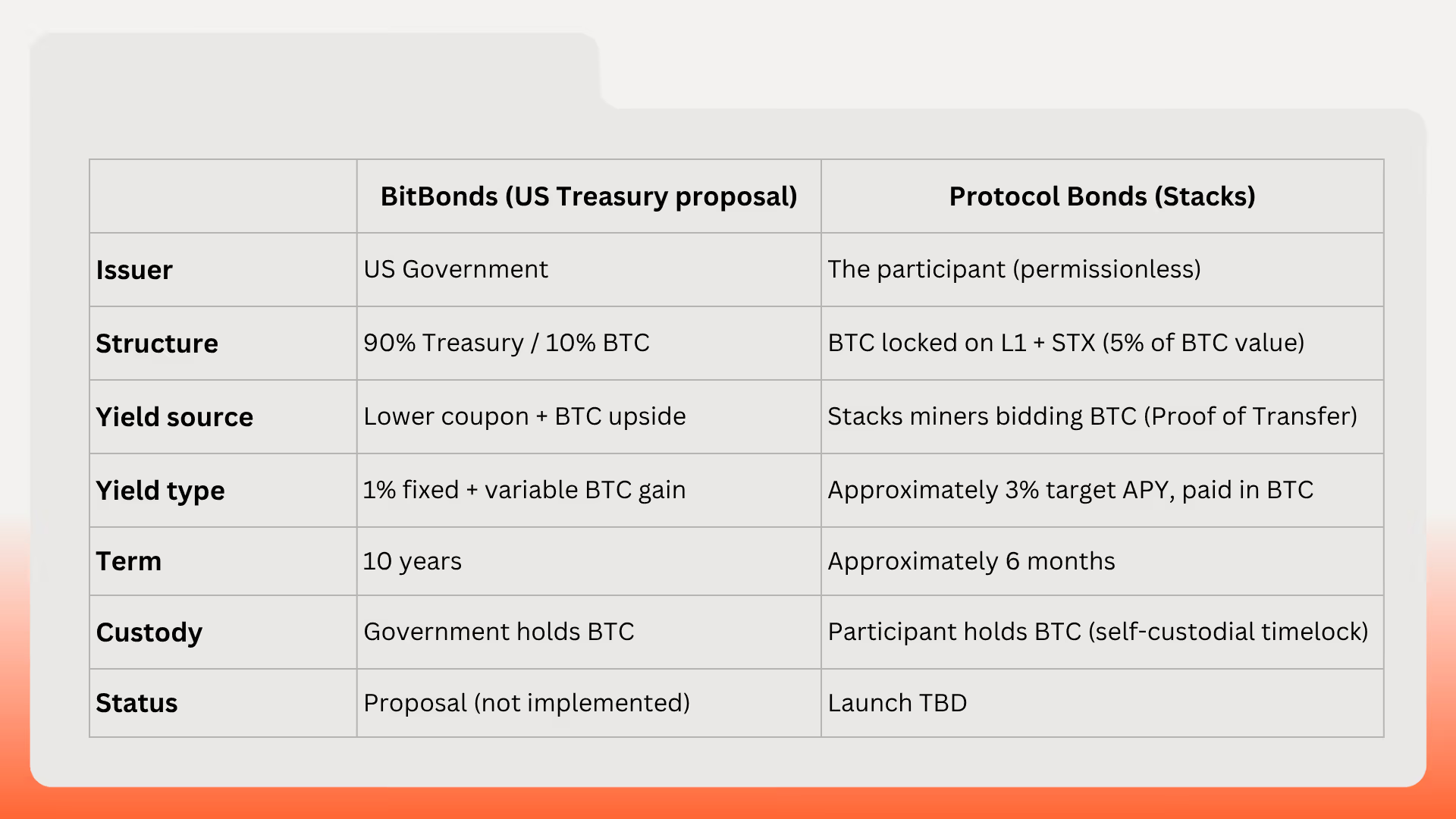
The structural logic is the same in both cases. Both recognize that bitcoin can serve as the foundation for a yield-bearing instrument. Both pair BTC with another asset (Treasuries in one case, STX in the other) to create a structured position. Both offer a return tied to real economic activity rather than token emissions.
The difference is in who maintains control. BitBonds require the US government to purchase and hold bitcoin on the investor's behalf. Protocol bonds allow the participant to lock their own bitcoin, under their own keys, on Bitcoin's own blockchain. One is a sovereign instrument. The other is a self-custodial one.
Why This Matters for Bitcoin
The BitBonds proposal and protocol bonds reflect the same underlying development: bitcoin is transitioning from a store-of-value asset to a productive one.
Governments are treating BTC as a reserve asset
The US Strategic Bitcoin Reserve executive order (March 6, 2025) marked a significant shift. New Hampshire issued the first bitcoin-backed municipal bond, which received a Ba2 rating from Moody's. Multiple states are advancing legislation to place BTC on their balance sheets. When governments begin structuring debt instruments around bitcoin, the asset class has reached a different stage of institutional acceptance.
Institutions want structured BTC exposure
The BitBonds proposal exists because there is demand for bitcoin exposure within a familiar fixed-income structure. Protocol bonds on Stacks address related demand from a different direction: structured yield, senior priority, defined term, and a documented risk framework, using mechanics and language that institutional participants recognize.
Self-custodial yield is now operational
BitBonds would require investors to trust the government with the bitcoin component. Protocol bonds do not require trust in any third party. BTC is locked on Bitcoin L1 via OP_CHECKLOCKTIMEVERIFY, a standard Bitcoin script, under the participant's own keys. The yield comes from Stacks miners who have been committing BTC since January 2021 through Proof of Transfer. All activity is onchain and verifiable.
The Broader Context
A year ago, the concept of "bitcoin bonds" existed primarily in speculative commentary. Today, the Bitcoin Policy Institute has presented the proposal to policymakers. VanEck has published modeling. New Hampshire has issued municipal bonds backed by BTC. And Stacks is launching a protocol-level mechanism that enables any BTC holder to create a structured, self-custodial bond position.
These are related developments. Bitcoin is being integrated into the structures of traditional finance, and in the case of protocol bonds, those structures are being rebuilt natively on Bitcoin.
The question is no longer whether bitcoin becomes a yield-bearing asset. It is whether that yield is accessed through a government instrument, a corporate product, or a protocol the participant controls directly.
Read the full Bitcoin Staking Whitepaper.
Read next: Stacks vs. CoreDAO vs. Babylon
Get more of Stacks
Get important updates about Stacks technology, projects, events, and more to your inbox.

.png)


