.avif)
Bitcoin Staking Whitepaper Quick Overview
.avif)
What Bitcoin Staking Is
Bitcoin Staking is a proposed upgrade to Stacks' Proof of Transfer consensus that lets BTC holders earn BTC yield while keeping custody of their bitcoin.
Lock BTC on Bitcoin L1, pair it with a small amount of STX on Stacks, and earn yield generated by Stacks miners. Your bitcoin stays on Bitcoin, under your own keys, for the entire period. No bridges, no wrapping, no counterparty.
The yield comes from miners spending real BTC to compete for block rewards, a mechanism live since January 2021 that has distributed over 4,200 BTC. Bitcoin Staking takes that existing flow and structures it into something more predictable and accessible.
Protocol Bonds: How Bitcoin Staking Works
The participation structure is called a protocol bond. It has two components:
BTC on Bitcoin
A timelocked UTXO on Bitcoin L1 under the participant's own keys for approximately six months (25,200 Bitcoin blocks). No one else can move it.
STX on Stacks
STX worth approximately 5% of the BTC position value, locked in a smart contract. This is what secures the participant's allocation in the bonding period.
Together, these create a protocol bond with a target annualized yield. APY is calculated on a 52,560-block Bitcoin year (50 weekly cycles), so the 6 month bonding period (25,200 blocks, 24 weekly payouts) delivers about 48% of the headline rate, roughly 1.44% at the 3% target.
Where the Yield Comes From
Approximately every 10 minutes, Stacks miners commit BTC to compete for block rewards. The BTC they spend forms the reward pool distributed to stakers.
This is a direct transfer of BTC from block producers to network participants, enforced by consensus and recorded onchain on Bitcoin. The mechanism has operated continuously for over five years.
The Waterfall
Each reward cycle (~7 days), the miner BTC pool is distributed in order:
Tranche 1 : Protocol bond holders. Paid first at the clearing yield rate. First claim on the reward pool.
Tranche 2: STX only stakers. Paid next from the remaining pool. More variable returns.
Tranche 3: Reserve fund. 15% of excess revenue is set aside to buffer future cycles where miner revenue falls short.
How Capacity Is Allocated
Each bonding period has algorithmically determined capacity. Allocation happens through a sealed-bid auction: participants bid the lowest yield they would accept, bids clear lowest-first, and all winners earn the same uniform clearing rate. Note: during the initial bootstrap phase of Bitcoin Staking, capacity and yield rate will be managed off-chain by the Stacks Endowment.
Two Ways to Participate
Native BTC path. Lock BTC directly on Bitcoin L1 via timelock. Maximum self-custody. The bitcoin never leaves Bitcoin.
sBTC path. Use sBTC, a 1:1 bitcoin-backed asset on Stacks, in place of an L1 timelock. DeFi-composable, with the same yield and senior tranche priority.
Key Parameters
.avif)
What Protects Participants
BTC cannot be seized. Locked via Bitcoin's own consensus rules under the participant's keys.
No slashing. Principal returned in full regardless of behavior or performance.
No counterparty. Enforced by two blockchains, not a business relationship.
Early exit available. Participants can unlock BTC before the timelock expires, forfeiting remaining yield.
The Risks
Illiquidity
BTC is locked for approximately six months. Early exit forfeits yield.
STX exposure
The 5% STX position does not earn yield and is subject to price movement.
Yield variability
~3% is a target, not a guarantee. APY is annualized over a 52,560-block Bitcoin year; realized payout in any given bonding period may vary slightly with miner economics, coverage ratios, and network conditions.
Reflexivity
Circular dependency between BTC staking demand, STX price, miner profitability, and yield. The protocol manages this through capacity constraints, reserve buffers, and algorithmic adjustment, but does not eliminate it.
Smart contract risk
BTC-side risk is limited (standard Bitcoin timelock). Stacks-side contracts are new code, mitigated by audits and staged activation.
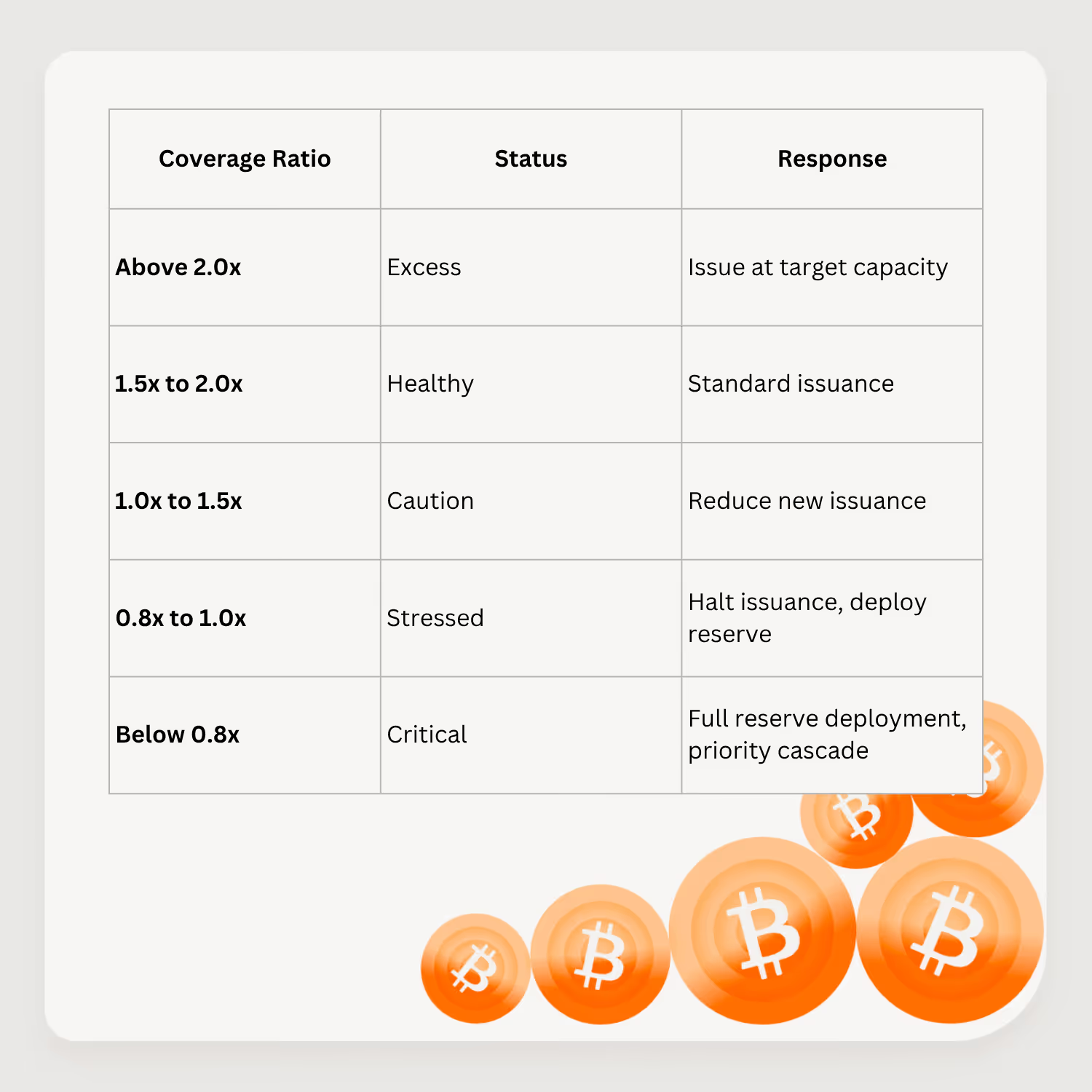
Coverage Monitoring
The protocol tracks a coverage ratio (reward pool / bond obligations) with five response bands:
Launch Timeline
PoX-5 (Bootstrap): Initial phase with vetted partners and a community tranche. Controlled rollout before opening fully.
PoX-6 (Permissionless): Fully decentralized operation. Auction mechanics and governance shift to onchain control.
May 13: Whitepaper published
Mid-May: SIP process starts
Q3: Mainnet target launch
Keep reading: The full Bitcoin Staking Whitepaper | The Risk Profile of Bitcoin Staking Explained
Get more of Stacks
Get important updates about Stacks technology, projects, events, and more to your inbox.

.png)


