.avif)
Stacks Q2 at a Glance
- Stacks’ Bitcoin Staking's mechanism for BTC/STX, PoX-5, built and deployed to public testnet, now in audit ahead of mainnet in Q3 2026
- Two major institutional partnerships announced: Fireblocks and UTXO Management (subsidiary of public Bitcoin treasury company Nakamoto Inc.)
- Cumulative Stacks users hit the 1,6M milestone, growing 8.0% quarter over quarter. New wallets created increase by ~50% QoQ from 72K in Q1 to 110K in Q2
- Stacks’ leading Decentralized Exchange BitFlow crossed 5B total txn volume and $575M swap volume, all time.
- New Stacks Endowment program announced to onboard Bitcoin-native finance teams, and Q2 Grantees include funding a private programmable Bitcoin protocol on Stacks.
Intro: Progress This Quarter
Bitcoin has spent years establishing itself as an asset. The next chapter is making that asset productive, and Stacks made strong progress on that front in Q2 2026.
Our thesis is clear: Stacks is the place where Bitcoin becomes productive capital. Self-custodial Bitcoin Staking anchors this thesis, enabling BTC holders to earn yield without giving up custody. That inflow of new Bitcoin capital then moves into a fast-growing Bitcoin-native financial ecosystem on Stacks, from vaults and lending protocols to decentralized exchanges.
Q2 focused on building the foundation. Core contributors ran a private PoX-5 testnet with institutional infrastructure providers and released the public testnet after feedback implementation. Fireblocks and UTXO Management were announced as key Bitcoin Staking launch partners. The ecosystem is making significant progress on the Stacks roadmap released earlier this quarter.
Q3 is where this infrastructure becomes a working product and starts bringing new Bitcoin capital into the ecosystem. Bitcoin Staking ships first, while new upgrades to the Bitcoin-native finance app stack will let BTC holders put that capital to work on-chain. Meanwhile, the builder pipeline for new use cases will expand through the Endowment's Foundry program.
The quarter ahead is an important one for the broader Stacks ecosystem, and we are determined to capture a larger share of the Bitcoin sitting idle today.
Alex Miller, CEO, Stacks Labs
Bitcoin Staking: Progress This Quarter
Bitcoin Staking is the defining product of Stacks' 2026 roadmap. Q2 moved it from whitepaper to tested infrastructure, with a completed public testnet and two major institutional partnerships announced.
Private & Public Testnet
Q2 saw PoX-5, the on-chain mechanism that powers Bitcoin Staking, move from design into testing. The upgrade was built and deployed to a private testnet for institutional partners to test their infrastructure in a safe and secure environment. After this, PoX-5 moved to public testnet, and is now in audit ahead of mainnet.
UTXO: Inaugural Launch Partner
UTXO Management, the Bitcoin-native asset management subsidiary of Nakamoto Inc. (NASDAQ: NAKA), was announced as the inaugural participant for Bitcoin Staking on Stacks, committing a portion of its existing BTC holdings to the protocol. UTXO's participation marks one of the first times that an institutional Bitcoin manager has pursued BTC-denominated yield while retaining full custody of its Bitcoin on the base layer. The top 100 Bitcoin treasury companies hold over 1.2 million BTC, roughly 5% of total supply, and as those companies face growing investor pressure to make their balance sheets productive, UTXO's move signals that institutional Bitcoin is ready to move.
Fireblocks: Institutional Custody Infrastructure
Fireblocks, the leading institutional digital asset platform that facilitated the transfer and storage of over $10 trillion in digital assets, was announced as an infrastructure partner for Bitcoin Staking on Stacks. Fireblocks' involvement provides institutional participants with the SOC 2 Type II-compliant custody and MPC wallet infrastructure they require to engage with Bitcoin Staking at scale.
The Numbers: Q2 2026 in One View
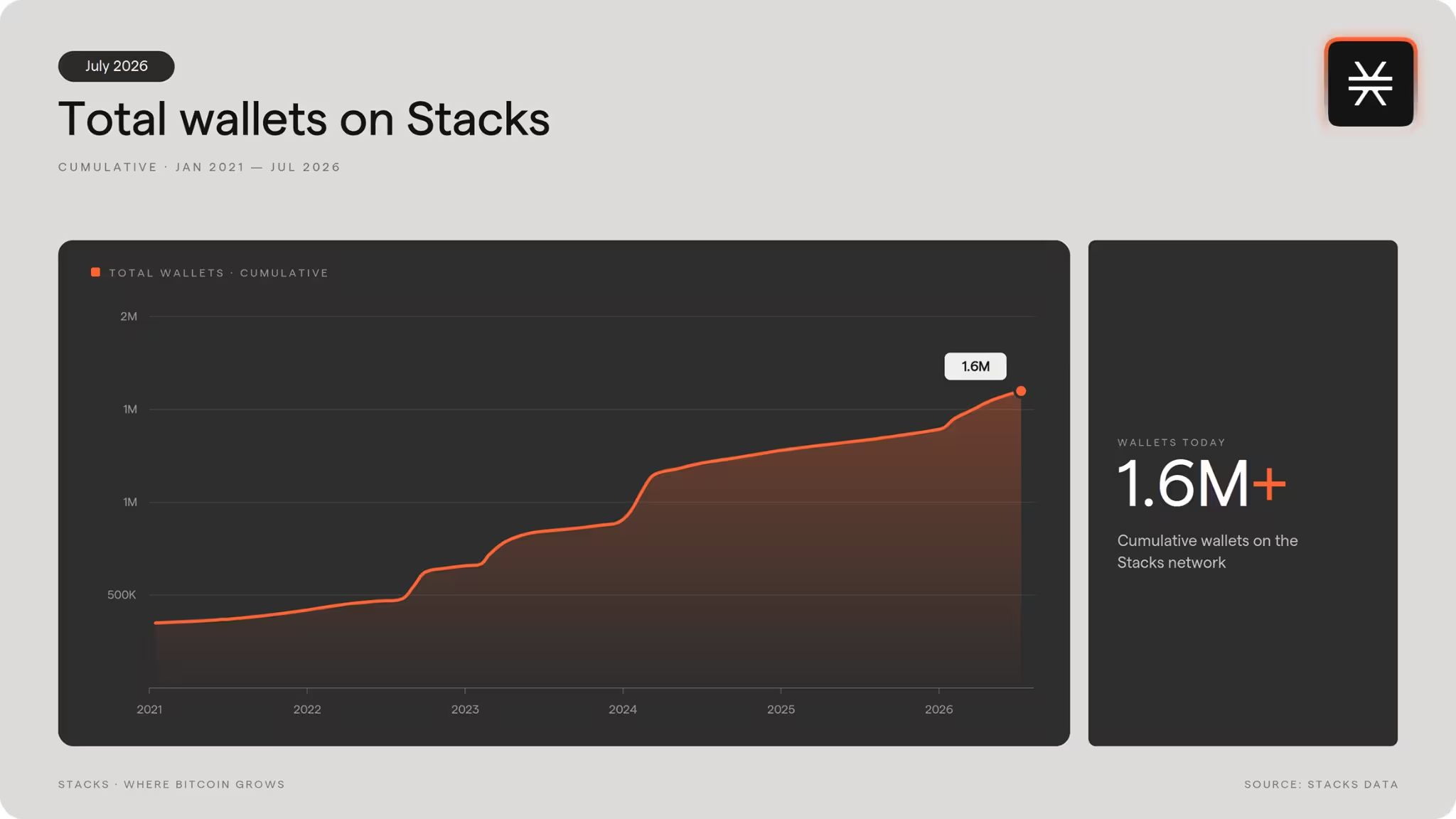
Wallet growth held up through Q2's broader market pullback. The cumulative number of actively used wallets on Stacks grew 8.0% quarter over quarter to 1,601,594. Cumulative DeFi users grew 2.0% over the same period.
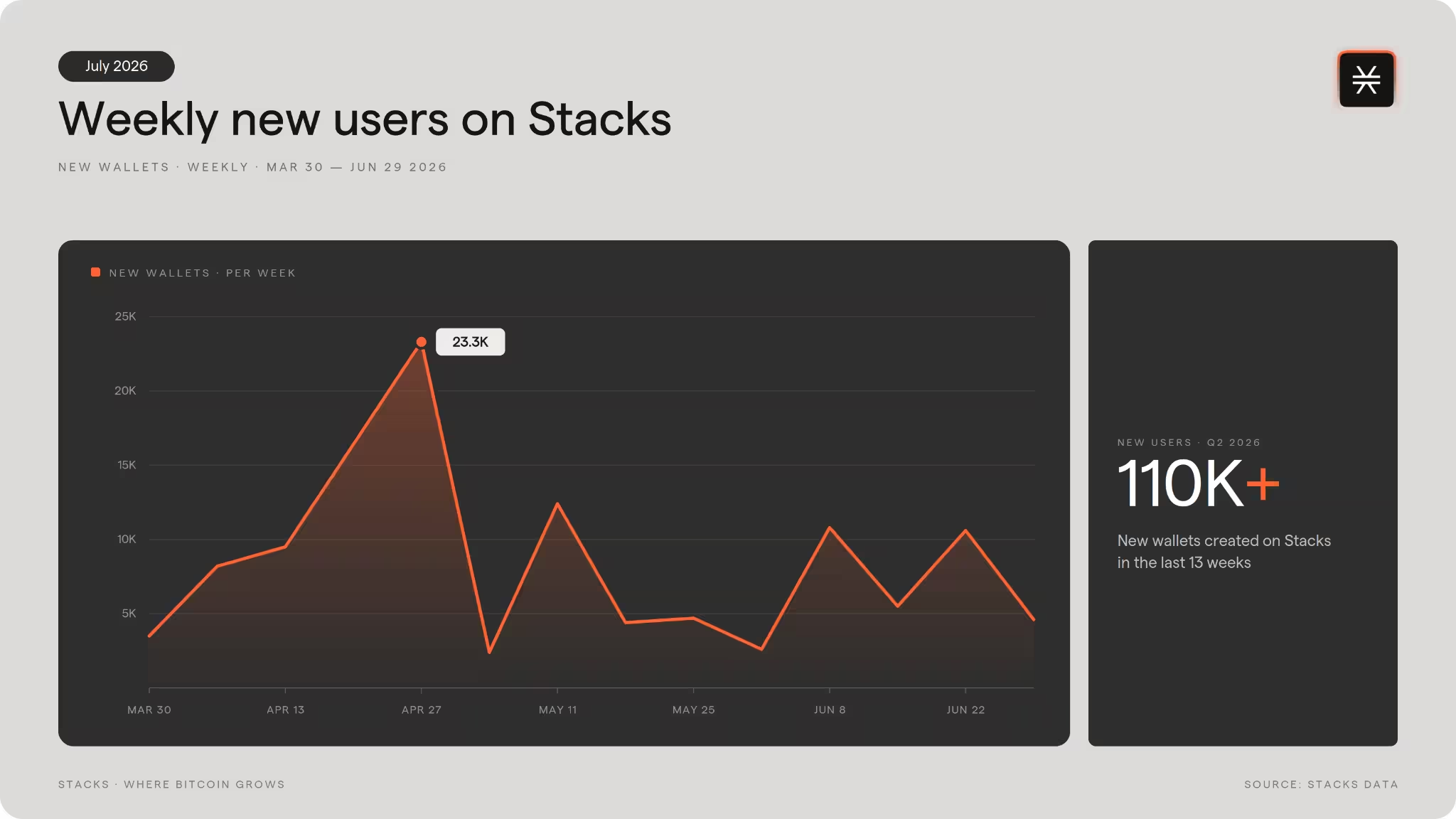
Moreover, the amount of new users (measured by wallets with activity on the network) grew ~50% QoQ from 72K in Q1 to 110K in Q2. Note that this takes out a large ~40,000 spike in Q1 that’s caused by the launch of an AI agent protocol. Daily active users are up by 55% QoQ from ~2,7K in Q1 to ~4,2K daily users in Q2 2026.
sBTC supply stood at 2,949 BTC at quarter end, with ecosystem focus moving to Bitcoin staking and stBTC for Q2. sBTC capital is expected to be a focus again later this year. TVL in STX terms held up better than USD, reflecting market pricing pressure across the industry rather than a pullback in on-chain activity.
Bitcoin-Native Finance: Ecosystem Development Spotlight
Stacks' ambition is to house the full Bitcoin-native finance stack. Right now, that stack has four load-bearing pillars, Zest Protocol, Stacking DAO, BitFlow, and Hermetica, and each of them grew in both users and infrastructure in Q2. This means that when new Bitcoin staking related products like stBTC arrive, it is able to flow into a stack that has been running, growing, and battle-tested for years.
Zest Protocol
Zest Protocol is Stacks' leading Bitcoin lending market, giving BTC holders a way to earn yield and access liquidity without leaving Bitcoin-native infrastructure.
Q2 was Zest's biggest quarter to date. ZEST launched on May 19 via Binance Alpha, reaching a $200M FDV within hours and ranking #1 trending on both CoinGecko and CoinMarketCap, one of the strongest Binance Alpha launches in recent history. The protocol remains the top DeFi protocol on Stacks, with $70M in TVL, over 800 sBTC deposited, and more than 1,500 liquidations processed with zero bad debt.
Stacking DAO
Stacking DAO is the STX Stacking infrastructure layer for the Stacks ecosystem, and the team building stBTC, the liquid staking token that will carry Bitcoin Staking yield-bearing BTC into the broader ecosystem.
Q2 TVL reached an all-time high of 110M STX. LST looping went live at scale on Zest Protocol v2, with roughly 10M STX now borrowable against stSTX collateral. The headline is the stBTC announcement: the first Bitcoin liquid staking token for Stacks, built with support from Stacks Labs. stBTC is completing an audit now and targeting an August launch, and as the canonical BTC LST it will let holders earn Bitcoin Staking yield while staying liquid and composable across Stacks DeFi.
BitFlow
BitFlow is Stacks' primary decentralized exchange and automated market maker. It provides the liquidity infrastructure that Bitcoin-native assets need to move efficiently through the ecosystem.
BitFlow has now processed over $5B in cumulative transaction value, with more than $270M of that flowing through HODLMM swaps, and has grown to 29,677 cumulative users. New concentrated-liquidity pools launched with Zest's TGE and Hermetica's USDh, extending BitFlow's reach across the Bitcoin-native finance stack.
The efficiency numbers back up this quarter's growth. The $ZEST TGE pools delivered a 28x volume-to-TVL ratio, showing HODLMM's strength as a launch primitive that any Stacks project can use to bootstrap a market from day one. Yield has followed that growth: BitFlow's two primary sBTC pairs, sBTC/USDCx and STX/sBTC, delivered an estimated average of 17.9% Bitcoin APY over the past 30 days (26.6% and 9.2% respectively), on top of the underlying sBTC yield baseline.
BitFlow also shipped new AI Agent Tooling and a supervision dashboard in Q2, giving users the ability to deploy and monitor autonomous trading agents across multiple wallets. In Q3, BitFlow is building on that foundation, expanding its Keeper automation and limit-order system, API, and agentic infrastructure so trading and market-making strategies can run autonomously on-chain.
Hermetica
Hermetica brings Bitcoin-denominated yield products to Stacks. It gives BTC holders access to structured yield strategies that are native to the ecosystem.
Q2 saw continued allocator demand for BTC yield. hBTC reached 75 BTC in TVL, and its latest capped allocation filled within 24 hours. USDh averaged 8% APY over the quarter, while Hermetica advanced its STRC integration, expanding the yield infrastructure supporting USDh.
Looking ahead, Hermetica is focused on expanding the infrastructure stack behind hBTC and USDh through additional asset and platform integrations, including USDCx.
Network and Protocol Development
Q2 focused on executing against the roadmap outlined earlier this year: preparing the network, tooling, and infrastructure required to bring Bitcoin Staking to mainnet.
For Bitcoin Staking, the Stacks core engineers finalized the protocol's economic and security model, including waterfall bond structuring. PoX-5, the Epoch 3.5 upgrade that powers Bitcoin Staking on-chain, was built, deployed to a private and public testnet, and entered audit ahead of mainnet.
Alongside the staking protocol itself, engineers shipped three stable 3.4.x mainnet node releases while strengthening network security through its Immunefi bug bounty program and an agentic testing harness that identified and patched multiple vulnerability classes.
The builder and institutional tooling outlined in the roadmap also continued to come online. Fireblocks' custody integration advanced following a signed partnership, Leather expanded toward becoming the primary launch wallet with multisig and Ledger support, a new sBTC bridge was released, and Clarinet shipped six new versions (v3.16–v3.20) with PoX-5 support.
Together, these milestones move the ecosystem closer to a production-ready Bitcoin Staking launch and a broader Bitcoin-native finance platform, ensuring the protocol, developer tooling, wallets, and institutional infrastructure are all progressing in parallel.
Capital Deployed: Strategic Ecosystem Grants
According to the Endowment's June 2026 Treasury Committee update and the Q2 report, the Endowment's capital strategy this quarter was built around one organizing principle: every dollar deployed is in service of a successful Bitcoin Staking launch and the ecosystem that receives its capital. That discipline shows up across treasury management, grants, liquidity, and the Foundry.
Treasury and Liquidity
The Endowment has managed its treasury conservatively through the current bear market. Long-term treasury holdings stand at 112 million STX. Approximately $7.3 million has been deployed across DeFi liquidity and market-making, the first time the Endowment has maintained equal deployment across centralized and decentralized venues simultaneously.
Q2 Grants
Q2 grants closed with submissions organized around four strategic themes: DeFi and Perpetuals, Real World Assets, Agentic Applications, and Privacy. These represent the product surface area Stacks will need for its long-term Bitcoin-native finance roadmap to succeed. Grantees include new yield vault protocols, payment protocols, privacy products for sBTC,and agentic payment methods.
Stacks Foundry: Validate Cohort One Complete
The Foundry's first program, Validate, completed its inaugural cohort. Sixty participated actively across the five-week program, and twenty-five progressed toward grant applications with a sharper customer profile and clearer product direction than when they started. The program's purpose is to improve grant quality and give early-stage builders a real signal before they commit months to building in the wrong direction.
The next Foundry program is Onboard, designed to welcome established teams and founders with a proven track record into the Stacks ecosystem, with a focus on bringing the app's existing users to the network and reach a wider userbase together.
STX in the News
The Stacks narrative moved across multiple outlets, ranging from institutional research group releases to crypto-native media placements. Below follows 5 highlights of Q2.
1. Bitcoin Magazine: Stacks turning Idle Bitcoin into productive capital
Bitcoin Magazine covered UTXO Management's entry into Bitcoin Staking, reporting that the Nakamoto Inc. subsidiary is targeting roughly 3% BTC-denominated yield while keeping its Bitcoin under its own custody on the base layer. Stacks founder Muneeb Ali is quoted framing the move as a step toward turning idle Bitcoin into productive capital. This coverage matters because it's a mainstream Bitcoin outlet validating that institutional treasuries are willing to put BTC to work without compromising custody, the exact thesis Bitcoin Staking is built on. More.
2. CryptoBriefing: Stacks Leads AI Agent Activity on Bitcoin Layers, Tenero Research Finds
Tenero Research's findings, covered by Crypto Briefing, identified Stacks as the leading Bitcoin Layer 2 for autonomous AI agent activity, with active agents growing from 105 to 766 week over week. The report tied this to Bitcoin Policy Institute research showing AI models preferred Bitcoin over stablecoins and fiat in the large majority of tested cases. This matters because it positions Stacks at the center of an entirely separate growth narrative, AI agent economies, beyond Bitcoin Staking alone. More.
3. Rand Group's STX Demand Thesis
Rand Group, a research firm serving a crypto community of over 350,000, published a thesis on how Bitcoin Staking's fixed STX-to-BTC pairing creates structural, recurring demand for STX as bonded BTC grows. The report pointed to Ethereum and Solana's staking-to-DeFi flywheel as a precedent for how that demand could compound across the Stacks ecosystem. More.
4. Castle Labs Stacks Review
Castle Labs, a crypto research and advisory firm, broke down the mechanics behind the Bitcoin Staking whitepaper, including the waterfall reward structure and the phased rollout from a managed bootstrap phase (PoX-5) to a fully permissionless model (PoX-6). The piece noted that Stacks has already distributed more than 4,200 BTC to ecosystem participants since 2021, framing Bitcoin Staking as a natural extension of that track record. More.
5. Stacy Muur's Stacks Thesis
Stacy Muur, a crypto researcher and STX holder, framed Bitcoin Staking as the moment STX gains a mechanical role in capturing Stacks' network activity, drawing a comparison to how staking turned ETH and SOL into productive, yield-bearing assets. More.
What's Next: Q3 2026
Q3 is the quarter where the groundwork of Q2 should see meaningful traction entering the network. Three priorities shape the next three months for the Stacks ecosystem:
1. Ship Bitcoin Staking
Bitcoin Staking launches in Q3. The protocol redefines demand for STX as staking capacity, the first time STX demand will be tied to Bitcoin holders seeking yield. Stacks Labs aims to announce multiple new institutional bond participants and staking launch partners alongside the launch, with meaningful new Bitcoin capital entering the ecosystem through the bonding mechanism from day one.
2. Build the Liquid Staking Ecosystem
stBTC, the liquid staked version of Bitcoin by Stacking DAO, is the mechanism that carries Bitcoin Staking yield into the rest of the ecosystem. In Q3, the Bitcoin-native financial primitives, Zest, BitFlow, and Stacking DAO are expected to announce and ship the upgrades that allow stBTC to move through them efficiently. The goal is a seamless path from staking to active deployment, with Bitcoin capital compounding across the ecosystem.
3. Expand the Builder Pipeline
The Endowment will announce new strategic grants through its Foundry program, targeting teams building toward the long-term depth the ecosystem needs. Products and services range from Bitcoin-native AI agent activity, Bitcoin privacy and confidentiality protocols, and additional financial products.
Growing Bitcoin with STX at its core
Every workstream in this report points at the same outcome: growth in Bitcoin activity on Stacks, driven by Bitcoin Staking and the Bitcoin-native finance stack, with STX as the engine behind it. Bitcoin Staking bootstraps Bitcoin capital into the ecosystem and creates structural demand for STX as staking capacity. Liquid staking carries that Bitcoin into applications, where Bitcoin-native finance upgrades bring more users and more onchain activity. That activity generates fees for stakers, the first evidence that the network and its staking layer can become self-sustaining. New builder efforts deepen the activity with fresh financial use cases, reinforcing STX's role as the asset powering Bitcoin-native finance.
The alignment between network usage and STX is structural by design. Every Bitcoin put to work on Stacks strengthens the network and expands the Bitcoin economy it serves. Q3 is where that starts: growing Bitcoin.
Get more of Stacks
Get important updates about Stacks technology, projects, events, and more to your inbox.