.avif)
Bitcoin Staking Bond 2 Filled by Bitcoin DeFi
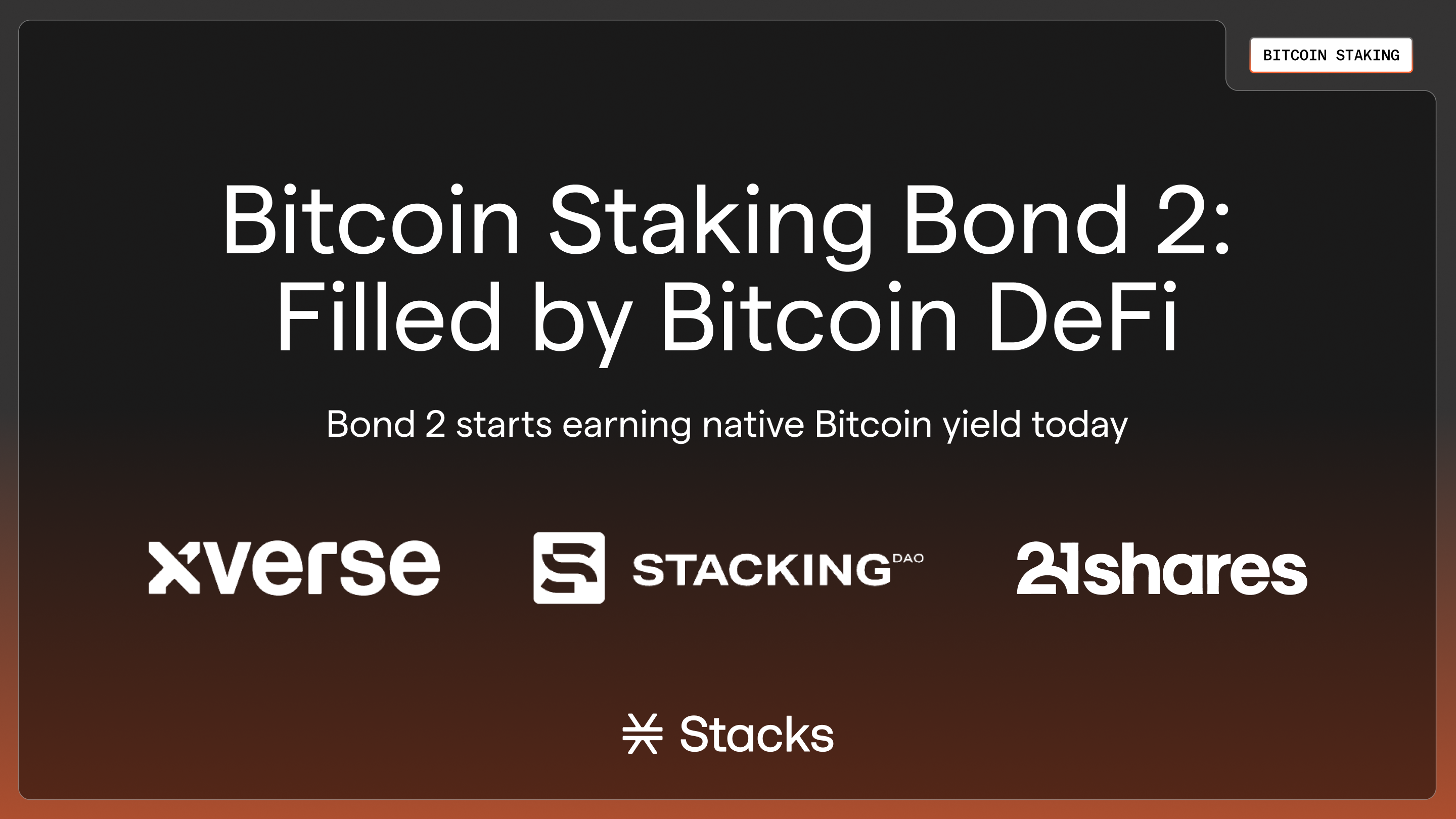
All ~500 BTC of capacity in Bond 2, the second Bitcoin Staking bond, is filled, with 6.7M+ STX bonded alongside it. The yield is targeting 3% on BTC, paid in BTC.
The second bond is also the first filled by Bitcoin DeFi, through Stacking DAO's liquid staking and the Xverse pool. The Stacks Endowment allocated nearly all of Bond 2’s capacity to Bitcoin DeFi so that staked BTC would move deeper into the financial apps on Stacks, where it keeps earning while also being put to work as collateral and liquidity. A full bond’s capacity taken in through ecosystem protocols shows that Bitcoin DeFi on Stacks can now absorb staked BTC at the scale of the program itself.
Bond 2 runs alongside the Genesis Bond
The institutions in the Genesis Bond (UTXO Management, 21Shares, HashKey and Sypher Capital) remain enrolled, and their BTC rewards have paid out every week since September 17. Bond 2 runs alongside them. Up to six bonds can run at once, and two are active now.
Each bond has two routes in, self-custodial staking for whitelisted participants and open pools run by ecosystem partners, and both fill capacity under the same bond rules. Whichever route it comes through, every bonded BTC is paired with STX as staking capacity.
Filled through liquid staking
Institutions evaluating Bitcoin Staking are interested in what else a position can do beyond earning the base yield rate, such as staying liquid and earning in other protocols. A bond filled through liquid staking shows that mechanism in production.
Most of Bond 2 was filled through Stacking DAO, one of the longest-running pools on Stacks. Stacking DAO offers liquid staking: you stake BTC and get back stBTC, a token that represents your staked BTC.
Your BTC keeps earning staking yield, and you can still use the stBTC in apps on Stacks. For example, you can post it as collateral to borrow USDCx, the USDC stablecoin on Stacks. Stacking DAO's docs explain how it works.
Opening Bond 2 to liquid staking was intentional, to see how staked BTC moves through the ecosystem once it stays liquid. Institutions want to know whether a staked position can still be used, and liquid staking shows that it can.
Liquid and pooled staking run on sBTC, the Bitcoin-backed asset on Stacks. sBTC is secured by a decentralized set of institutional signers where no single party controls the BTC. Pooled Bitcoin Staking on Stacks: How It Works covers the full model.
Bond 3 opens around November 10
Bond 2 showed staked BTC working inside the financial apps on Stacks, which matters to institutions that want a position to do more than earn the base yield. Bond 3 is expected to build on that with more institutions joining. Many hold their BTC with a tier-1 qualified custodian and prefer to stake through that custodian’s infrastructure, which makes custody support a key part of how they come on board. Integrations with custodians including Anchorage are in progress and should open Bitcoin Staking to a wider group of institutions from Bond 3 onward.
There are two ways into Bond 3.
Self-custodial Bitcoin Staking. During the bootstrap phase, self-custodial Bitcoin staking is whitelisted for anchor participants: institutions and individual holders committing durable BTC capital and STX staking capacity to the long-term growth of the Bitcoin economy on Stacks. Participants apply for capacity with a 50 BTC minimum, and approval is not guaranteed. Approved BTC is timelocked directly on Bitcoin under the participant's custody. Applications go through the institutional Bitcoin Staking page.
Pooled Bitcoin Staking. The open path runs through Stacks ecosystem partners. The confirmed pools are Stacking DAO, Xverse and Esbee DAO (from the makers of Fast Pool), and each pool sets its own capacity, timing and requirements on its own channels.
For more information on how to prepare for Bond 3, visit stacks.co/bitcoinstaking.
Get more of Stacks
Get important updates about Stacks technology, projects, events, and more to your inbox.