.avif)
Bitcoin Staking on Stacks: PoX-5 and PoX-6 Explained
Bitcoin Staking on Stacks runs in two phases of Proof of Transfer (PoX), the mechanism that pays BTC to participants. PoX-5, the bootstrap phase, went live in the July 30, 2026 hard fork. PoX-6 is the fully decentralized phase, and the one Bitcoin Staking was built to reach: any Bitcoin holder bonds directly, under their own custody, with no whitelist, and the bids they place set the yield.
Why two phases? Bitcoin Staking is a mechanism with multiple variables: capacity, target yield, the BTC:STX ratio, miner commitments, and reserve balances. Scaling it up calls for a closely monitored environment before it opens to everyone. PoX-5 creates that environment and sets the parameters for PoX-6, which opens direct Bitcoin Staking to any Bitcoin holder, prices yield through an open auction, and gives STX a larger role across the applications built on Stacks.
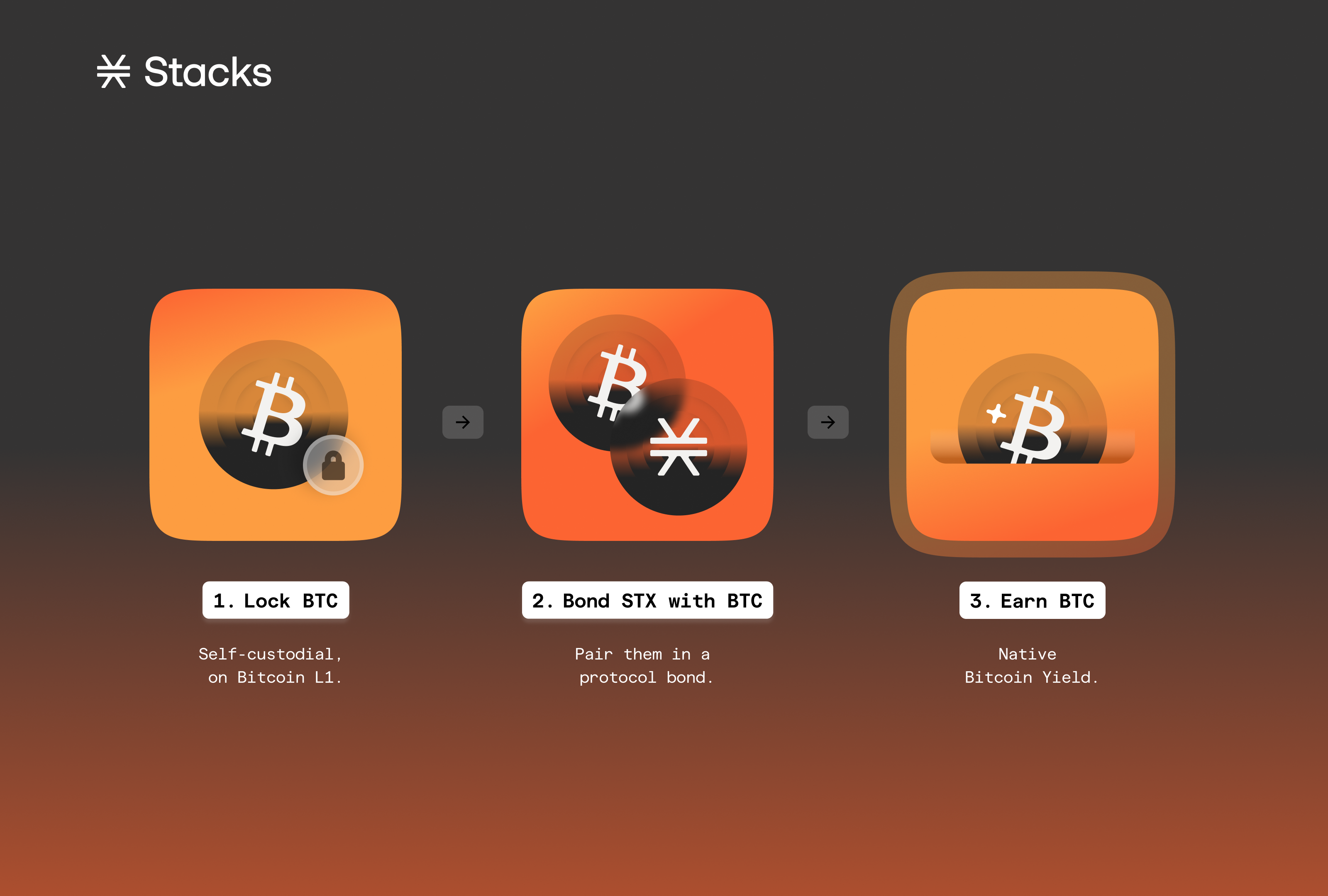
Stacks Labs CTO Adriano Di Luzio explained the biggest difference between the two phases in an October 3, 2026 video. PoX-6 is the fully decentralized, algorithmic end state. Capacity is sold through blind auctions and yield adjusts onchain. This article goes further on what that unlocks and why PoX-5 comes first.
Both phases are defined in the Bitcoin Staking whitepaper and go through the Stacks Improvement Proposal (SIP) process, the community vote that has approved every PoX upgrade since 2021. SIP-045, which introduced PoX-5, passed on July 21, 2026.
What is PoX-5?
PoX-5 is the first phase of Bitcoin Staking and is expected to run about twelve months from activation. The Stacks Endowment sets three numbers for each bonding period: capacity, target yield, and the BTC:STX ratio.
A bonding period works like this:
- A new period opens about once a month.
- Each lasts six months, so six run at the same time.
- Staking capacity goes to whitelisted anchor participants ahead of each opening.
- A share of each bonding period's capacity, targeted at approximately 10%, is reserved for pools.
The BTC:STX ratio stays at 5% for all of PoX-5. Under PoX-6, the system calculates it. The reserve fund runs in accrual only mode throughout the bootstrap, building coverage before its drawdown behavior activates with PoX-6.
Why is PoX-5 whitelisted?
A limited group of participants creates an environment to gather data while the system runs at scale for the first time, with real BTC and STX on the line. Each period, the Endowment looks at what miners are paying and how many people are bonding, then adjusts capacity, yield, and the ratio to match. That works with a known group. If thousands of positions of every size joined at once, there would be no way to tell which change moved which number.
During the bootstrap phase, self-custodial Bitcoin staking is whitelisted for anchor participants: institutions and individual holders committing durable BTC capital and STX staking capacity to the long-term growth of the Bitcoin economy on Stacks.
Pooled staking is open today, and STX-only staking has no cap and no whitelist. For the pooled path, see Pooled Bitcoin Staking on Stacks: How It Works.
What is PoX-6?
PoX-6 is the end state Bitcoin Staking was designed to reach. Any Bitcoin holder can bond directly, under their own custody, without applying to anyone. Yield is no longer a target chosen each period; it is the price bidders set in an open auction, so it tracks what the market will pay for it. Capacity, yield, and the BTC:STX ratio are calculated onchain from miner revenue, reserve balances, and active obligations, with no administrator in the loop. Capacity is sold through a permissionless auction run by a decentralized signer set: bidders say what yield they will accept, and bids clear on yield. The whitelist ends, and anchor participants and pools use the same open process.
PoX-6 also activates three mechanisms:
- Reserve fund drawdown.
- Coverage band responses, calculated onchain.
- Signer accountability, including loss of signer yield for misbehavior.
These let the Endowment step back from active management. The auction's exact rules, such as the bid format, how bids clear, and any minimums, are not set yet. They will be written into the PoX-6 SIP and decided by the vote on it.
Why does PoX-5 matter for PoX-6?
PoX-6 moves parameter setting from administrators to protocol rules, and those rules are designed during PoX-5. Core engineers study miner commitments, bonding demand, and reserve balances across each period to decide which variables PoX-6 should respond to and how its mechanisms should behave. The exact parameters are then proposed through the SIP process, built on measured behavior rather than assumptions. Here is what PoX-6 unlocks:
- Open access: anyone can bond BTC directly, not only approved participants.
- Market-priced yield: bids set the yield, and blind bidding keeps anyone from gaming it.
- Rules that run themselves: the network sets capacity and ratio and adjusts yield onchain, with no administrative input.
- Accountability: signers lose yield if they misbehave.
Taken together, a bonded position becomes a self-custodial Bitcoin asset that pays BTC at a market-set rate, that anyone can open, and that applications on Stacks can build on. Demand for STX grows with it, since every bonded BTC position needs STX paired against it as staking capacity.
Here is what PoX-5 contributes:
- Data: every monthly period shows how miners and participants behave.
- Institutional use: the Genesis Bond opened on September 10, 2026 with four institutions bonding BTC: 21Shares, HashKey, UTXO Management, and Sypher Capital.
- Tested tools: custody is live through Fireblocks and Fordefi, and Leather supports multisig setups through Ledger.
- Weekly payouts: each bonding period pays out BTC every week for six months.
By the time PoX-6 is proposed, PoX-5 will have run roughly twelve bonding periods with institutional BTC bonded, weekly BTC payouts made, and the reserve funded. That is what the whitelist comes off against.
How does the move to PoX-6 happen?
There is no fixed activation date. Core engineers draft PoX-6 as a SIP once the bootstrap data supports a specific auction design and parameter set, and once the signer, wallet, and custody tooling it depends on is in place. STX holders vote on the proposal, as they did for SIP-045. If it passes, PoX-6 activates through a hard fork, and the whitelist ends with it.
What stays the same between phases?
The phases change who sets the numbers and who can join. They do not change how self-custodial Bitcoin Staking works:
- Bonded BTC stays locked on Bitcoin L1 under the participant's custody for the full term.
- Yield is BTC that Stacks miners commit through Proof of Transfer, the mechanism that has already distributed more than 4,200 BTC to participants.
- Bonded BTC has first claim on that BTC through the reward waterfall.
- There is no slashing.
- Principal returns in full at the end of the term, or earlier through the early exit option.
To get started today, see Pooled Bitcoin Staking on Stacks: How It Works and Bitcoin Staking Genesis Bond: How It Works.
FAQ
What is PoX-5?
The first phase of Bitcoin Staking on Stacks. It has run since the July 30, 2026 hard fork and lasts about twelve months. The Stacks Endowment sets capacity, yield, and the BTC:STX ratio for each bonding period.
What is PoX-6?
The fully decentralized phase. The system calculates capacity, yield, and the ratio onchain, and capacity is sold through a permissionless auction with no whitelist.
Why is self-custodial Bitcoin Staking whitelisted right now?
The Endowment sets and monitors capacity, yield, and ratio each period while the system is new. That needs a known group of participants.
When does self-custodial Bitcoin Staking open to everyone?
When PoX-6 activates. There is no fixed date; it depends on bootstrap results and tooling readiness. Pooled Bitcoin Staking is open today with no whitelist.
Why is pool capacity allocated to liquid staking?
Liquid staking keeps BTC earning yield while its token is used across apps on Stacks. That puts Bitcoin capital to work in the ecosystem.
Who decides when PoX-6 activates?
The Stacks community, through the SIP process.
Did PoX-5 change anything for existing STX stakers?
Yes. It removed the cooldown cycle, made solo and pooled staking simpler, and reordered the reward waterfall. The hard fork released existing locks, so STX holders restaked after activation on July 30, 2026.
Get more of Stacks
Get important updates about Stacks technology, projects, events, and more to your inbox.
.png)

.png)


