.avif)
Genesis Bond 14 Day Recap
.png)
The Genesis Bond went live on September 10, 2026, and in its first 14 days participants bonded 230 BTC alongside 310K STX and received 0.28 BTC in rewards, paid weekly and sourced from Stacks miners through Proof of Transfer.
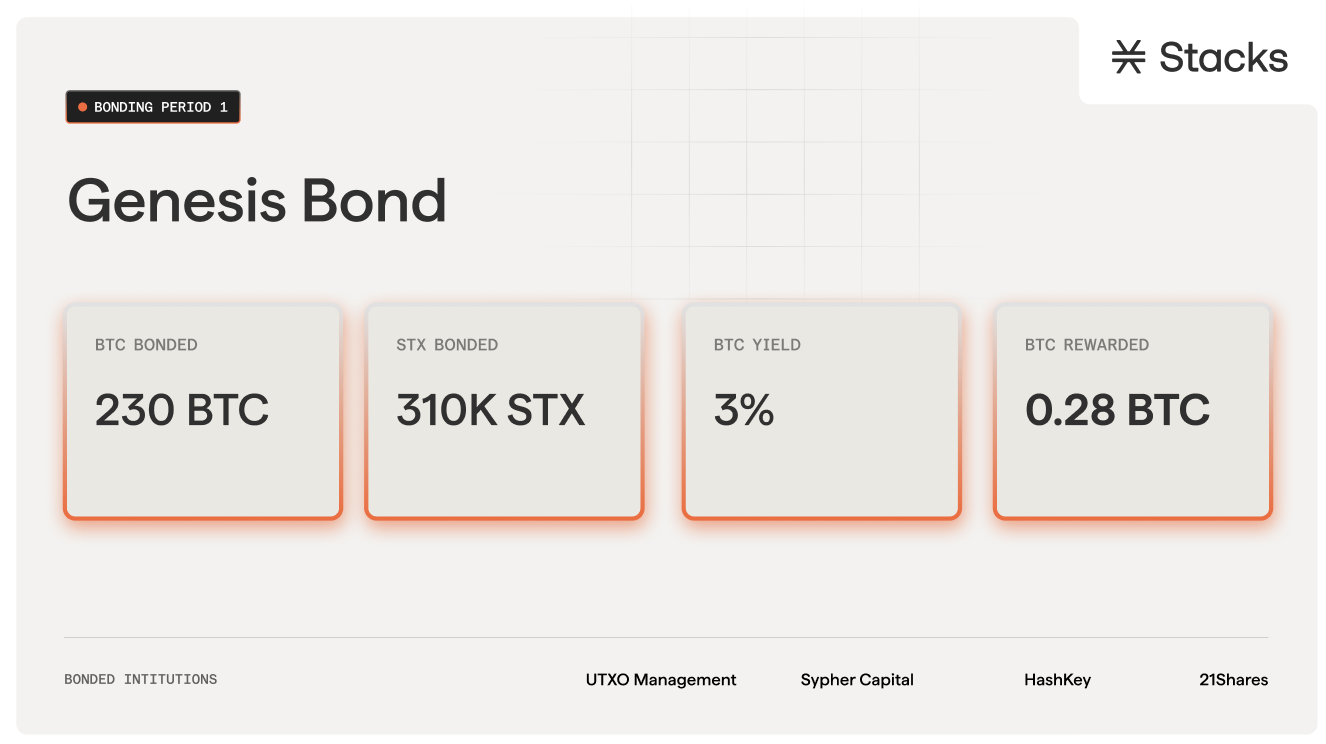
Four institutions took part: UTXO Management, 21Shares, and HashKey on the self-custodial path, and Sypher Capital through liquid staking with StackingDAO. Bonding Period 2 opens October 10 with more capacity.
This is the first time institutions have run Bitcoin Staking in production. Genesis was sized small on purpose: participants operate the product firsthand, then capacity scales period over period.
The Genesis Bond by the Numbers
As of September 24, 2026, two weeks after launch, the Genesis Bond stands at:
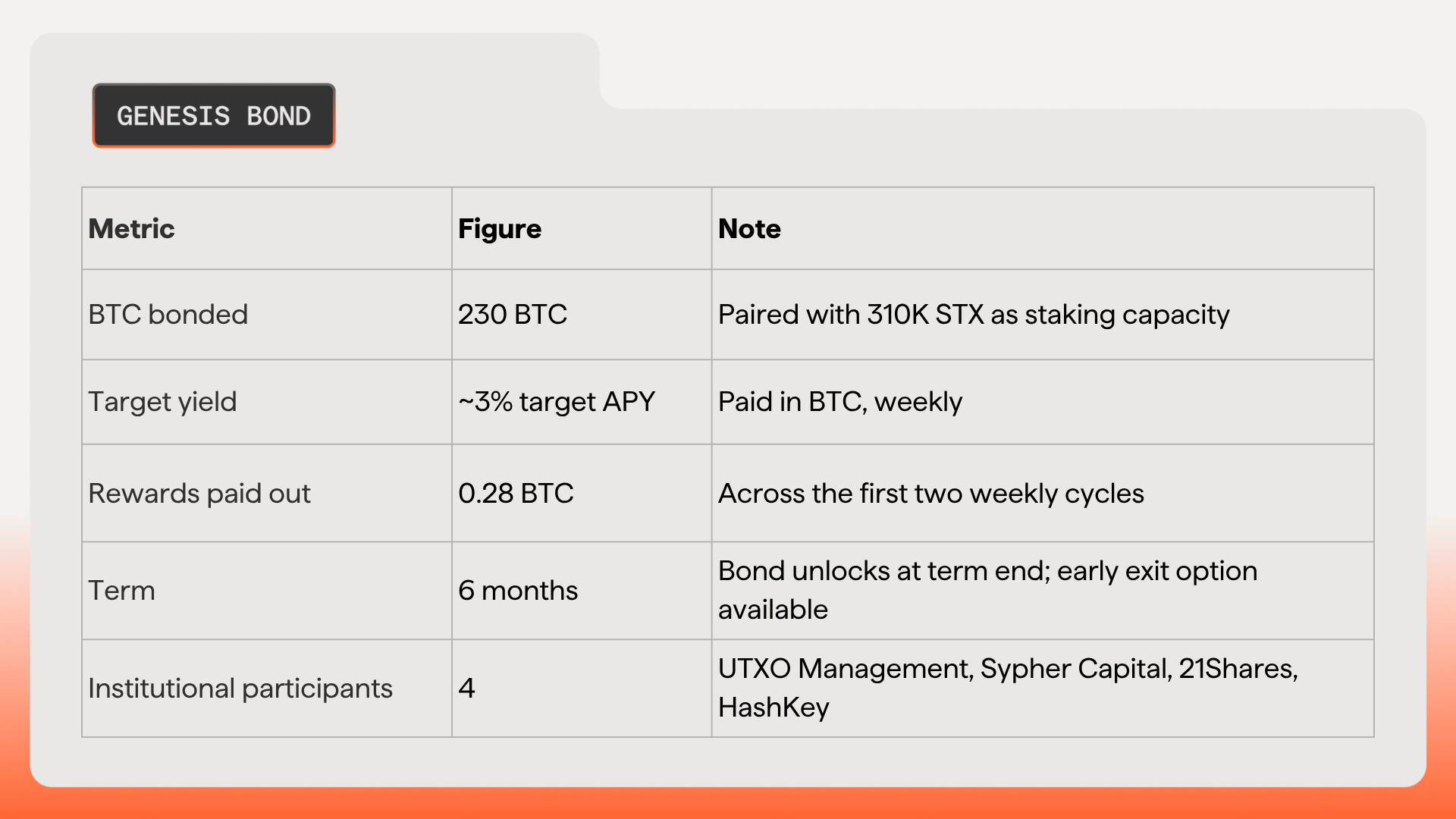
The 0.28 BTC came from Stacks miners committing BTC through Proof of Transfer (PoX), the consensus mechanism that has run in production for over five years and paid out 4,200+ BTC since January 2021. The Genesis Bond is the first time that yield has been paid to bonded BTC.
Bonding requires an STX position worth roughly 5% of the BTC being bonded, which is why 230 BTC brought 310K STX with it. As more BTC is bonded, more STX is needed as staking capacity.
Where Does the Bitcoin Staking Yield Come From?
Every block, Stacks miners commit BTC to mine STX. That BTC is collected over each reward cycle (roughly one week) and paid out in a fixed order:
- Protocol bonds are paid first, at the ~3% target APY. This covers self-custodial bonds on Bitcoin L1 and pooled and liquid staking on Stacks.
- STX stakers receive 85% of what remains, the same Proof of Transfer reward they have earned since 2021.
- A reserve fund receives the other 15%, so bonds keep paying if mining slows.
.png)
Bonds sit at the front of the line and the reserve fund backstops them. That order is what supports the 3% target rate.
How Custody Works on Each Path
Self-custodial (UTXO Management, 21Shares, HashKey). BTC is timelocked on Bitcoin L1 via standard Bitcoin script and stays under the participant's custody for the full term. There is no wrapping or bridging, so no smart contract touches the BTC, and there is no slashing. Fireblocks and Fordefi (SOC 2 Type II) support the path, with Leather and Ledger for hardware signing. At term end the bond unlocks. During the bootstrap phase this path is whitelisted for anchor participants with a 50+ BTC minimum.
Liquid staking through StackingDAO (Sypher Capital). This path runs on Stacks through sBTC, secured by a decentralized signer set that needs 70% consensus to move funds. It is not self-custodial. The yield still starts with miners; the pool is the payout step. A 70% signer threshold is a materially different trust model from one custodian, and it is what opens Bitcoin Staking to participants without a whitelist.
What the First 14 Days Mean
The mechanism worked as designed: miner BTC in, bond rewards out, weekly, bonds paid first. Two weeks and 0.28 BTC is a small sample, and it confirms the full payment path runs in production.
For institutions. Four named participants ran Bitcoin Staking in production on a six-month term with weekly BTC payments, ~3% target APY, early exit, and custody infrastructure that matches how BTC is already held. The Genesis cohort is the reference point for Bonding Period 2. Details at stacks.co/institutional-bitcoin-staking.
For BTC holders. The open path runs through pooled and liquid staking, with no whitelist and no self-custody. The confirmed pools are StackingDAO and Fast Pool; capacity and requirements live on their own channels. Entry point: Xverse. Mechanics: Pooled Bitcoin Staking on Stacks: How It Works.
For STX stakers. Your Proof of Transfer reward is unchanged: bonds are paid first, then 85% of the remaining miner BTC goes to you as before. What is new is 310K STX of staking capacity demand after one period.
For builders. stBTC is now backed by bonded BTC earning miner yield. That asset is what the next phase builds on: self-custodial lending and borrowing, stBTC bootstrapping the apps, confidential sBTC transactions, AI capital management, sBTC payments, and R&D, all putting the same BTC to work.
Bonding Period 2 Opens October 10
Bonding Period 2 opens October 10, 2026 with 500 BTC of capacity, more than double Genesis. Rate and period size are set by the Stacks Endowment during the bootstrap phase, with roughly 10% of capacity reserved for pools. Self-custodial capacity goes to the participants that grow the Bitcoin economy on Stacks, measured by the lasting capital and new users they bring.
Institutions and holders with 50+ BTC can Speak to the team before October 10. Live figures are at staking.stacks.co.
FAQ
What is the Genesis Bond? The first live Bitcoin Staking period on Stacks. It launched September 10, 2026 with UTXO Management, Sypher Capital, 21Shares, and HashKey, bonding 230 BTC with 310K STX for a six-month term with weekly BTC rewards.
Where does the yield come from? Stacks miners commit BTC every block through Proof of Transfer. Bonds are paid first, then 85% of the remainder goes to STX stakers and 15% to a reserve fund. This mechanism has paid out 4,200+ BTC since January 2021.
Is the ~3% APY guaranteed? No. It is a target rate set by the Endowment during the bootstrap phase. Bonds are paid before other participants and backstopped by the reserve fund, which is what makes the target credible.
Does my BTC leave Bitcoin? On the self-custodial path, no: it is timelocked on Bitcoin L1 under your custody with no slashing and unlocks at term end. On the pooled path, BTC is represented as sBTC on Stacks, secured by a 70%-consensus signer set, and is not self-custodial.
How do I participate? Self-custodial Bitcoin Staking is whitelisted for anchor participants with 50+ BTC; apply through the institutional page. The open path runs through StackingDAO and Fast Pool via Xverse; check the pools' own channels for capacity.
Get more of Stacks
Get important updates about Stacks technology, projects, events, and more to your inbox.

.png)


