.avif)
STX Ecosystem Report: Q3 2026
Stacks Q3 at a Glance
- Bitcoin Staking went live on mainnet and has brought ~735 BTC into the Stacks ecosystem across its first two bonding periods. The PoX-5 hard fork activated on July 30, and the Genesis Bond opened on September 10 with 230 BTC bonded.
- STX staked has climbed more than 25% from its post-PoX-5 baseline, from 392M STX restaked after the hard fork (cycle 144) to 448M STX at quarter end and 493M STX with Bonding Period 2.
- 21shares, HashKey Cloud, UTXO Management (subsidiary of Nakamoto Inc., NASDAQ: NAKA), and Sypher Capital became the first institutions to bond BTC on Stacks, earning BTC-denominated yield through Bitcoin Staking.
- Stacking DAO launched stBTC on September 3 as the first Bitcoin liquid staking token on Stacks, and its first 150 BTC of capacity filled in under 24 hours.
- Zest Protocol passed $80M in value locked, $122M in deposits, and $42M in total borrows, with 800 BTC deployed as collateral.
- Weekly DEX volume on Stacks reached a 12-month high of $16.7M in the week of September 28, after holding above $10M a week through most of August and September.
- Stacks reached 1,620,364 cumulative wallets, with 2,487 BTC in sBTC supply.
Progress This Quarter
In our Q2 report, we set out to ship Bitcoin Staking in Q3 and to build the liquid staking ecosystem around it, and both are now live on mainnet. This quarter turned infrastructure that had only existed on testnet into a working product with institutional Bitcoin inside it.
The PoX-5 hard fork activated on July 30, and Stacking DAO launched stBTC on September 3, giving BTC holders a liquid path into staking yield. A week later, the Genesis Bond filled every unit of its 230 BTC capacity, with 21shares, HashKey Cloud, UTXO Management, and Sypher Capital among the first institutions earning BTC yield through Bitcoin Staking.
The hard fork also tested our community, since PoX-5 unlocked all staked STX and every staker had to restake under the new contract. Stakers restaked 392M STX right away, and by quarter end STX staked had climbed back to 448M. With Bonding Period 2, STX staked has now reached 493M, more than 25% above the post-fork baseline.
Our thesis has stayed the same all year: Stacks is the place where Bitcoin becomes productive capital. Bitcoin Staking brings new BTC into the ecosystem, and Bitcoin-native finance on Stacks gives that capital somewhere to go.
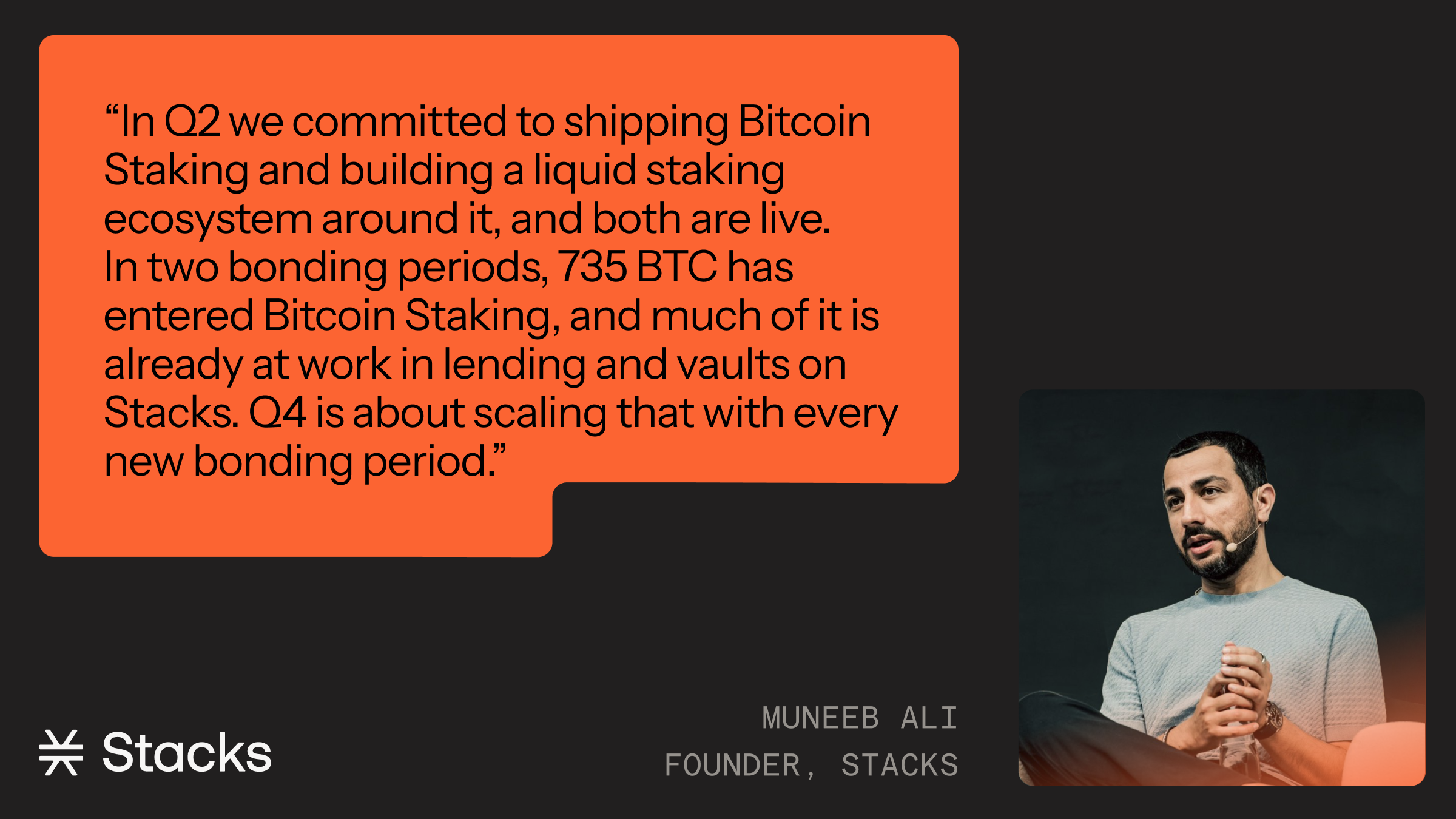
The Genesis Bond was intentionally small, so institutions could run the product in a live environment before capacity grows. Bonding Period 2 then brought 505 BTC into Bitcoin Staking, double the Genesis Bond, with 483 BTC of it coming through liquid staking on Stacking DAO.
Bitcoin Staking: Progress This Quarter
Bitcoin Staking is the defining product of Stacks' 2026 roadmap, and Q3 took it from an audited testnet to a live mainnet product. The PoX-5 hard fork activated on July 30, and on September 10 the Genesis Bond filled with 230 BTC bonded, delivering the first goal Stacks core contributors set out in the Q2 report.
PoX-5 Activates on Mainnet: The PoX-5 hard fork activated as Epoch 4.0 on July 30, 2026 at Bitcoin block 960,230. It introduced protocol bonds, which pair BTC timelocked on Bitcoin L1 with STX locked on Stacks as staking capacity, and removed the cooldown cycle between staking periods. The release followed the testnet rollout laid out in Q2: integration partners tested on a private testnet and builders ran the full staking lifecycle on a public testnet ahead of mainnet activation.
STX Staked Climbs Back After the Unlock: PoX-5 unlocked all staked STX, which meant every staker had to restake under the new contract. Stakers restaked 392M STX shortly after the hard fork, and by quarter end STX staked had reached 448M, a 14.3% climb from the post-fork level. Bonding Period 2 then added 6.7M STX bonded alongside its BTC, and STX staked now stands at 493M, more than 25% above the post-fork baseline. That recovery shows new STX holders moving with the network into its new role as staking capacity for Bitcoin.
.png)
The Genesis Bond: The Genesis Bond opened on September 10 at Bitcoin block 966,350 as the first institutional bonding period of Bitcoin Staking. Participants bonded 230 BTC at launch with all available capacity filled.
21shares, the world's largest crypto ETP issuer, bonded BTC from its treasury holdings under its own custody. HashKey Cloud, the institutional staking arm of Hong Kong-listed HashKey Group, bonded self-custodially and also joined the sBTC signer set this quarter. UTXO Management, the Bitcoin-native asset management subsidiary of Nakamoto Inc. (NASDAQ: NAKA), moved from its Q2 role as inaugural participant into a live position, while Sypher Capital, manager of the Sypher Bitcoin Yield Fund, participated through liquid staking via Stacking DAO.
Bonding Period 2: Bonding Period 2 opened just after quarter end, on October 8, and brought 505 BTC into Bitcoin Staking, double the Genesis Bond, with 6.7M STX bonded alongside it. Liquid staking led the period, with Stacking DAO taking its full 483 BTC allocation and bringing stBTC holders into Bitcoin Staking at a scale the first bond was not sized for. New bonding periods open monthly through 2026, with capacity growing each period.
Institutional Infrastructure: Three institutional custody providers now support Bitcoin Staking. Fireblocks, the platform behind more than $10 trillion in digital asset transfers, expanded its integration so institutional clients can bond through the custody and compliance tools they already use. Fordefi added institutional self-custody support, and Anchorage Digital brought its institutional custody to Bitcoin Staking late in the quarter.
Holders who are not anchor participants can join through pooled Bitcoin staking with providers including Xverse, Fast Pool, and Stacking DAO, which runs on sBTC and requires no whitelist. With custody, pooled access, and a live bond in place, the next step is moving that staked Bitcoin into applications across Stacks.
The Numbers: Q3 2026
.png)
Cumulative active wallets on Stacks reached 1,620,364 in Q3, as the network moved through the PoX-5 transition and into its first live bonding period. The network added ~12K new users with onchain activity, and daily active users averaged about 1,010 as activity settled into a steady baseline ahead of the scaling phase.
Onchain trading picked up sharply in the run-up to Bitcoin Staking, with weekly DEX volume on Stacks holding above $10M through most of August and September and peaking at $16.7M in the week of September 28, the highest in twelve months.
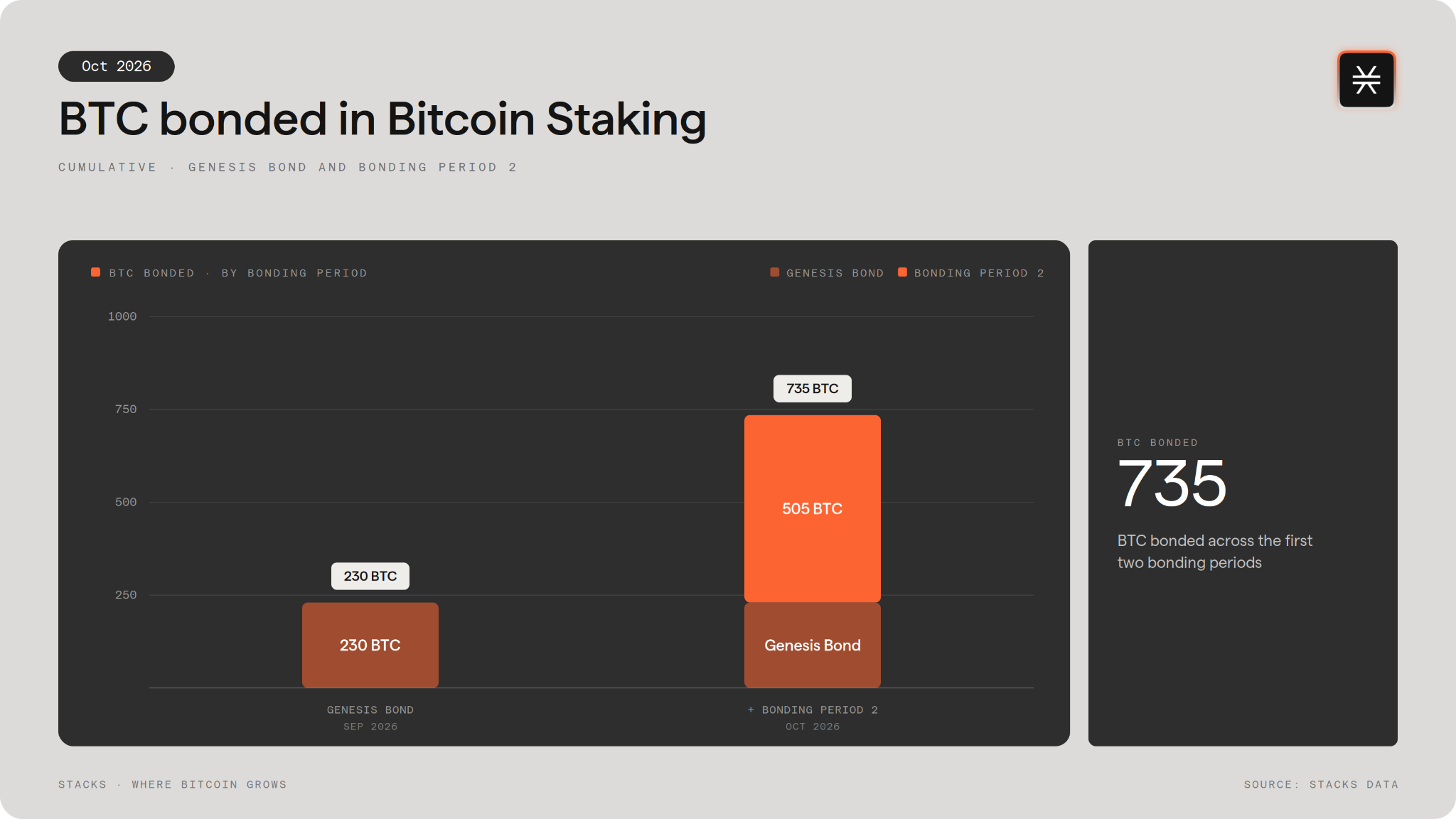
sBTC supply finished at 2,487 BTC at the end of Q3. Bitcoin Staking added a new source of Bitcoin capital on Stacks this quarter, with 230 BTC bonded in the Genesis Bond and a further 505 BTC in Bonding Period 2, for a total of ~735 BTC across the first two bonds. STX staked closed the quarter at 448M STX and has since reached 493M with Bonding Period 2, more than 25% above the post-fork baseline of 392M.
Q4 will be the first full quarter of monthly bonding periods, giving the clearest read yet on how much Bitcoin the staking layer brings into the ecosystem.
Bitcoin-Native Finance: Ecosystem Development Spotlight
Stacks' ambition is to house the full Bitcoin-native finance stack, and Q3 was the first quarter that stack received staked Bitcoin. Delivering on the second goal core contributors set out for Q3, stBTC went live on September 3, and within weeks liquid staked Bitcoin was earning in Zest's vaults and lending markets.
Stacking DAO: Stacking DAO is the liquid staking layer for Stacks and the issuer of stBTC, the liquid staking token that carries Bitcoin Staking yield into the rest of the ecosystem.
stBTC went live on September 3, and its first 150 BTC of capacity filled in under 24 hours. Holders earn auto-compounding Bitcoin Staking yield in BTC, currently an estimated 2.3%. Stacking DAO accounted for 65% of the Bitcoin staked in the Genesis Bond, including Sypher Capital, which bonded through stBTC rather than the native bond.
That demand carried into October, when Stacking DAO took its full 483 BTC allocation in Bonding Period 2. stBTC supply now stands at 636 BTC, with 97% of it posted as collateral on Zest Protocol, and total Stacking DAO TVL has passed $85M, up from $31.6M at the end of August.
Zest Protocol: Zest Protocol is Stacks' leading Bitcoin lending market and the largest financial application on the network, giving BTC holders a way to earn yield and access liquidity without leaving Bitcoin-native infrastructure.
The Stacks Market passed two milestones in Q3, with 800 BTC in BTC-denominated collateral and $7M borrowed in USDCx. Across the protocol, Zest now holds more than $122M in deposits and $42M in total borrows, and has processed more than 1,500 liquidations since launch with zero bad debt.
Zest also launched the Levered Bitcoin Staking Vault on September 3, the same day as stBTC. The vault loops stBTC into additional Bitcoin Staking yield in one click, without manual borrowing or rebalancing, and its first 20 BTC allocation earned up to 1.5% extra APY in BTC on top of the base yield. The vault reopened on October 8 with 100 BTC of capacity and was filled.
Bitflow: Bitflow is the primary decentralized exchange on Stacks, providing the liquidity infrastructure Bitcoin assets need to move through the ecosystem.
Bitcoin Staking has been a catalyst for on-chain activity, with liquidity operations and trading volume both stepping up over the past few months. As the top Bitcoin DEX, Bitflow has processed over $17B in cumulative transaction value, and in Q3 its concentrated-liquidity AMM (HODLMM) handled $280M+ in swaps. Bitflow trading volume climbed to an average of about $10M per week from late August, peaking at $16M.
Bitflow released its v2 API endpoints for better performance and reliability, as well as an open-source starter kit for market-making operations. The upcoming Super Router release makes swaps more efficient by checking every major AMM on Stacks and keeping quotes fresh as new blocks arrive, so users know they're getting the best available rate. The team plans to release a new concentrated-liquidity (CLAMM) design in Q4 that will unlock at least 10x more throughput for swaps and liquidity operations.
Hermetica: Hermetica brings Bitcoin-denominated yield products to Stacks, giving BTC holders access to structured yield strategies native to the ecosystem.
hBTC TVL stands at $4M, and USDh, Hermetica’s Bitcoin-backed dollar, delivered an average APY of 8%. In October, Hermetica integrated Clear Street, a U.S. broker-dealer and FINRA and SIPC member. Clear Street now executes, settles and custodies the USDh reserve’s securities, starting with STRC, giving USDh reserve capital a direct route into Bitcoin-backed credit, with the preferred dividends those securities pay accruing to the reserve strategy.
Xverse: Xverse is the leading Bitcoin wallet for Stacks, giving BTC holders a single self-custodial way to stake STX, put sBTC to work in Bitcoin Staking, and access Bitcoin-native finance on Stacks.
Xverse integrated Bitcoin Staking from the first bond after the PoX-5 upgrade, and its pool for Bonding Period 2 filled its capacity, with rewards paid in sBTC. Xverse was also the exclusive wallet partner for Zest Protocol's Bitcoin Collateral Vaults, live on mainnet since late September, which let users borrow against native BTC on Stacks without leaving self-custody.
In October, Xverse closed a strategic funding round led by Draper Associates, with participation from Trust Machines and Draper Dragon, and launched Xverse Perps on iOS and Android, powered by Hyperliquid. Xverse is now building multisig vaults and 2FA signing to support institutional-grade Bitcoin Staking participation as each bonding period adds capacity.
Leather: Leather is a Bitcoin and Stacks wallet built for both individuals and teams, giving users self-custodial access to Bitcoin Staking and the wider Stacks ecosystem.
Leather launched multisig vaults on mainnet on September 10, the same day the Genesis Bond opened. Teams set up shared Bitcoin and Stacks vaults, sign with Ledger devices, and propose and approve transactions together. Vaults can enroll in Bitcoin Staking, and institutions in the Genesis Bond were among the first users.
After the PoX-5 hard fork on July 30, Leather moved its staking page to PoX-5 and in September added Bitcoin Staking pools alongside its STX pools. The extension now counts bonded BTC in the wallet balance and shows each bond’s amount, unlock date and rewards on one page.
Network and Protocol Development
Q3 delivered the first priority of the Stacks roadmap on schedule, shipping PoX-5 to mainnet along with the custody, signer, and market infrastructure that institutions and holders need to use it.
Epoch 4.0 and the PoX-5 Transition: PoX-5 activated as Epoch 4.0 on July 30 at Bitcoin block 960,230. STX committed through the previous contract unlocked during the upgrade, and stakers restaked under the new PoX-5 contract using the restaking guide. Dual Stacking, the Bitcoin staking pilot product, wound down on September 10 as the full self-custodial Bitcoin staking product took its place.
A Broader sBTC Signer Set: Ankr, The Tie, and HashKey Cloud joined the sBTC signer set in Q3, expanding the institutional-grade group that secures sBTC deposits and withdrawals with new operators and an Asia-based infrastructure provider. On August 25, BitGo added institutional custody for sBTC, widening institutional access to sBTC across the Stacks ecosystem.
Market Access: STX became available for trading on Bullish, the NYSE-listed institutional digital asset exchange, on September 3, alongside sBTC. Eligible institutions across more than 50 jurisdictions can now access STX through the same order book where they already trade Bitcoin.
With PoX-5 live, core engineering focus moves to Epoch 4.1, the next network upgrade, covered in the Q4 outlook below.
Capital Deployed: Stacks Endowment
The Stacks Endowment took on an operating role in Bitcoin Staking in Q3, approving anchor participants and setting capacity and yield for each bonding period during the bootstrap phase. Its capital deployment this quarter focused on giving staked Bitcoin productive places to go.
Stack Sats: 1 BTC a Month for Bitcoin-Native Finance: Stack Sats opened on September 10 and distributes 1 BTC per month, 3 BTC in total, through December 10. Bitflow directs 0.50 BTC each month to traders and market makers in its sBTC/USDCx and STX/USDCx pairs, and Zest directs 0.50 BTC each month to its USDCx lending markets, split between sBTC suppliers and USDCx borrowers.
Q3 Grants: The Q3 grants cycle ran from August 31 to September 23 across three themes: Bitcoin Staking and sBTC utility, distribution and integrations, and market efficiency and risk. With PoX-5 live, the cycle moved the focus from core infrastructure to what gets built on top of it, favoring teams that bring existing users and distribution into the ecosystem. Grantees will be announced once review closes.
Participation data from Stack Sats will shape the Endowment's long-term DeFi incentive framework once the program closes in December.
STX in the News
Q3 coverage followed Bitcoin Staking from the hard fork to live institutional bonds, with The Defiant, Crypto Briefing, and crypto.news reporting on the Genesis Bond launch, 21shares' participation, and HashKey Cloud's dual role as bond participant and sBTC signer. Muneeb Ali also took the main stage at Korea Blockchain Week and TOKEN2049 Singapore to lay out the road to Stacks in 2030, with Bitcoin capital markets at its center, ahead of his appointment as CEO of Stacks Labs, effective October 15.
What's Next: Q4 2026
Q4 is the quarter Stacks scales what it launched in Q3, growing the Bitcoin that Bitcoin Staking brings in and putting that capital to work. Three priorities shape the next three months for the Stacks ecosystem.
1. Scale Bitcoin Staking: Bonding Period 2 brought in 505 BTC, double the Genesis Bond, and new bonding periods open monthly through the end of 2026 with capacity growing each time. Stacks Labs will announce new anchor participants as each period opens, alongside the liquid and pooled staking paths that brought the most BTC into Bonding Period 2, with broader outreach to Bitcoin holders and institutions supporting each new period.
2. Scale BTC Deployed in Bitcoin-Native Finance: The next step puts bonded and liquid staked BTC to work across Stacks. Self-custodial borrowing against staked BTC is on the roadmap, alongside Earn vaults and deeper stBTC integrations across Zest, Bitflow, and Hermetica, while Stack Sats continues to reward lending and trading activity through December 10.
3. Ship Epoch 4.1: Epoch 4.1, the next Stacks network upgrade, is targeting activation in early December. It makes Clarity 7 the default for new smart contracts and delivers a set of Clarity fixes and improvements. Stacks Labs will publish the activation block height at least 30 days ahead so exchanges, node operators, and signers can prepare.
Bitcoin Capital Markets with STX at Its Core
Q3 put the full Bitcoin Staking loop into motion for the first time. Bitcoin Staking brings BTC into the ecosystem and creates structural demand for STX as staking capacity, liquid staking carries that Bitcoin into applications, and activity in those applications makes Bitcoin productive on Stacks. Each new bonding period adds capacity to that loop, which places STX at the center of growing the Bitcoin economy.
Get more of Stacks
Get important updates about Stacks technology, projects, events, and more to your inbox.

.avif)