What Are Bitcoin Capital Markets? Yield, Credit and Trading for the World's Leading Digital Asset
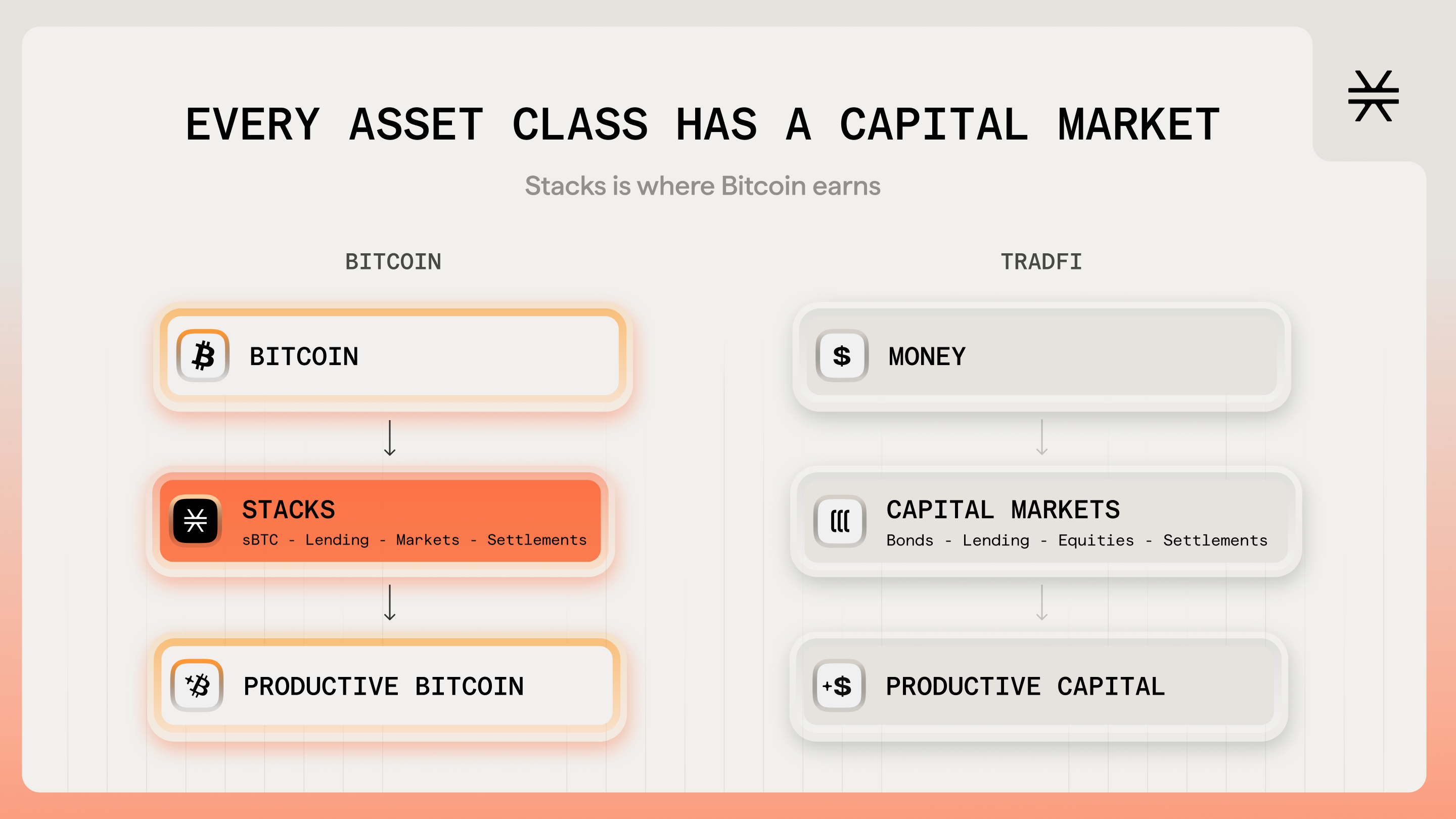
Bitcoin capital markets are the yield, credit and trading markets that let bitcoin holders earn on their BTC, borrow against it and trade it, channeling the world's leading digital asset into long-term productive use without selling it. They are the Bitcoin equivalent of the bond, repo and secondary markets that make dollar savings productive in traditional finance.
Most bitcoin has no access to these markets today. As of September 2026, only about 104,105 BTC, or 0.52% of circulating supply, was deployed in productive onchain strategies, according to a joint report from Yield Basis and Valueverse. By comparison, Spark research estimates that roughly 15% of ETH supply is active in Ethereum's decentralized finance (DeFi) markets.
The gap matters now because traditional finance is building products around Bitcoin faster than Bitcoin is building markets of its own. US spot Bitcoin ETFs held about 1.28 million BTC as of October 31, 2026, and Strategy's STRC preferred stock reached $8.5 billion outstanding by May 2026. This guide explains what capital markets are, how they work in traditional finance and crypto, why Bitcoin still lacks native capital markets and what has to be built for Bitcoin to have them.
What Are Capital Markets?
Capital markets are financial markets in which long-term debt and equity securities, such as bonds and shares lasting more than a year, are bought and sold, as defined by economists Arthur O'Sullivan and Steven Sheffrin. Money markets handle short-term debt that is often repaid within days, and together the two form the financial markets in the narrow sense of the term.
Capital markets exist because the people who save money are rarely the people with the best uses for it. Frederic Mishkin, author of one of the most widely used textbooks on money and banking, explains that financial markets move funds from savers to borrowers with productive investment opportunities, which makes the whole economy more efficient. A household with savings can help fund a factory, a road or a new company it would never run itself.
Capital markets are divided into primary markets, where governments and companies issue new bonds and shares to raise money, and secondary markets, where investors trade those securities with each other afterward. Bonds are the larger of the two main asset classes, with about $160 trillion outstanding globally according to SIFMA's 2026 Capital Markets Fact Book, against roughly $126 trillion in global stock market value.
Economist Ross Levine, in a widely cited 1997 review in the Journal of Economic Literature, groups what a financial system does into five functions: mobilizing savings, allocating resources, monitoring managers, facilitating the trading and pooling of risk and easing the exchange of goods and services. For anyone who owns a financial asset, those functions come down to three practical choices.
How Capital Markets Work: Yield, Credit and Trading
Capital markets give anyone who owns a financial asset three things to do with it besides holding it: earn income on it, borrow against it and sell it to someone else. In traditional finance, those three uses map to three markets, with bonds providing yield, repo providing credit and secondary trading providing liquidity. Mature financial systems have all three, because each one makes the other two work better.
Bonds: earning on capital
A bond is a loan that investors make to a government or company in exchange for regular interest payments and the return of the original amount on a set date. An investor who buys a 10-year government bond for $1,000 is lending that money to the government, which pays interest every year and repays the full $1,000 when the bond matures.
Bonds make up the largest part of global capital markets, at about $160 trillion outstanding according to SIFMA, which is why commentators often describe the bond market as the plumbing of the financial system. Government bond yields also serve as the benchmark rate for the wider system. A government bond is treated as the lowest-risk way to earn on money, so mortgages, corporate loans and most other investments are priced as a premium above that rate.
Repo: borrowing without selling
A repurchase agreement, or repo, is a short-term loan backed by a bond. The holder sells the bond for cash today and agrees to buy it back at a slightly higher price later, often the next day, and the difference between the two prices is the interest on the loan.
The closest everyday comparison is a pawnshop for financial institutions. The bond is handed over as security, cash comes back immediately and the bond returns once the loan is repaid. Because the seller has committed to buying the bond back at its original price plus interest, they keep the bond's gains and losses throughout the loan, as the International Capital Market Association (ICMA) explains. Lenders protect themselves with a haircut, lending slightly less than the bond is worth, so a 2% haircut on a $100 bond releases $98 in cash.
Repo is what makes a bond useful beyond its interest payments. Banks, dealers and funds can raise cash against bonds they already own without selling them, and IMF research by Manmohan Singh shows that large banks and dealers reuse collateral pledged to them, which helps keep the global financial system liquid. The US repo market averaged about $12.6 trillion in daily exposures in the third quarter of 2025, according to the Office of Financial Research, and Europe adds about €13.65 trillion outstanding.
Repo is formally classed as a money market, since most repo lending is short-term and the US market is mainly overnight. ICMA still counts repo and collateral among the core areas of capital markets, alongside primary and secondary markets, because repo funding underpins how bonds are issued and traded.
Trading: selling when needed
The secondary market is where bonds and shares change hands between investors after they are first issued. These trades raise no new money for the issuer, yet they matter because investors are more willing to buy in the first place when they know they can sell quickly if they need their money back. A ticket resale market works the same way, making people more comfortable buying tickets months ahead.
Research shows that how easily assets trade matters more for growth than how large a market is. In a study of 49 countries from 1976 to 1993, economists Ross Levine and Sara Zervos found that stock market liquidity, measured as trading relative to market size, was positively linked with current and future economic growth, capital accumulation and productivity, while market size and volatility were not robustly linked with growth.
How bonds, repo and trading compare
The table below compares the three markets by what each lets an asset holder do.
BondsRepoTradingWhat the holder doesLends money and earns interestBorrows cash against bonds they ownSells to another investorEveryday comparisonAn IOU that pays interestA pawnshop loan for institutionsA ticket resale marketTypical time horizonYears to decadesMostly overnight to weeksImmediateWhat it gives the systemThe benchmark rateCash without sellingConfidence to invest long termScaleAbout $160 trillion outstanding (SIFMA)About $12.6 trillion in daily US exposures (OFR)About $1.2 trillion traded daily in US Treasuries (SIFMA)Capital markets functionYieldCreditTrading
Bond yields set the price of money, repo lets holders raise cash without giving up that yield and trading gives investors a way out. Combined, they turn savings into capital that can be put to long-term productive use. Crypto rebuilt each of these markets onchain over the past decade, starting with a benchmark rate of its own.
How Crypto Rebuilt Capital Markets
Crypto rebuilt the three legs of capital markets onchain over the past decade, starting with a benchmark rate. On proof-of-stake networks such as Ethereum, holders lock their tokens to help secure the network and receive newly issued tokens and fees in return, which gives the asset a native yield set by the protocol rather than by a central bank.
That staking yield now plays the role a government bond yield plays in traditional finance. Mara Schmiedt framed Ethereum's staking reward as "The Internet Bond" in an August 2020 report, arguing it could become the risk-free rate of a decentralized financial system, and CoinDesk Indices and CoinFund later formalized it as a benchmark, the Composite Ether Staking Rate (CESR). Lenders have little reason to lend ETH below the staking rate, so staking yield acts as a floor for other ETH interest rates.
Stablecoins and tokenized Treasury funds supply the cash and money-market leg, letting dollars move and earn onchain. Tokenized US Treasury funds held about $14.7 billion as of late October 2026, according to RWA.xyz data, and the IMF's October 2026 Global Financial Stability Report puts all publicly reported tokenized assets at roughly $65 billion, against about $300 trillion in global capital markets.
Decentralized lending protocols such as Aave and Morpho supply the credit leg. Users deposit assets to earn interest and borrow against collateral, with rates set automatically by supply and demand, and a Bank for International Settlements (BIS) working paper on Aave found that search for yield is a key driver of activity on these platforms. Bitcoin, the largest crypto asset, has taken part in very little of this, because it never gained the first leg.
Why Bitcoin Lacks Native Capital Markets
Bitcoin lacks native capital markets because its base layer produces no native yield. Bitcoin uses proof of work, where miners secure the network and earn the block rewards, so a bitcoin holder has no protocol-level equivalent of staking income or a bond coupon.
Without a native rate, the credit and trading legs have little to build on. A bitcoin holder today can hold or sell, with few native ways to earn on BTC or borrow against it. The Yield Basis and Valueverse report found that lending accounts for 81% of productive BTC, yet lending yields average around 0.01%, because there is little demand to borrow BTC itself.
Bitcoin is therefore one of the largest financial assets in the world, while only a small share of it earns or circulates in onchain markets. Bitcoin's market capitalization was about $1.5 trillion in September 2026, according to CoinGecko, while Spark research estimates that Bitcoin DeFi reaches between 0.46% and 0.8% of supply, compared with roughly 15% for Ethereum.
Bitcoin does have deep spot and derivatives trading on exchanges, so price exposure is easy to buy and sell. What it lacks is native yield and native credit: a benchmark rate earned on BTC itself, and a way to borrow against BTC without handing it to an intermediary. Traditional finance has started to fill part of that gap from the outside, which is where most current definitions of Bitcoin capital markets begin.
Markets Around Bitcoin and Markets on Bitcoin
Bitcoin capital markets are developing in two places: around Bitcoin, through traditional financial products that hold or reference BTC, and on Bitcoin, through markets where BTC itself earns, serves as collateral and trades. Both belong to Bitcoin capital markets, and the distinction explains why definitions of the term differ.
Markets around Bitcoin have grown quickly. US spot Bitcoin ETFs held about 1.28 million BTC, roughly 6.4% of circulating supply, as of October 31, 2026. Strategy has built what it calls digital credit on top of its bitcoin holdings, led by STRC, a perpetual preferred stock that reached $8.5 billion outstanding by May 2026 according to its SEC filings, and which is unsecured preferred equity rather than debt secured by bitcoin. Coinbase reported $2.3 billion in crypto-backed loans outstanding as of October 2026, routed through the Morpho lending protocol.
Markets on Bitcoin are the native layer, where the BTC itself is the asset that earns, is borrowed against or trades. Markets around Bitcoin show that institutions want yield and credit on BTC, and markets on Bitcoin decide whether holders can reach them without handing their BTC to an intermediary.
The table below compares the two.
Markets around BitcoinMarkets on BitcoinWhat changes handsShares, fund units and loans that reference BTCBTC itself, or tokens directly backed by itExamplesSpot Bitcoin ETFs, Strategy's STRC, bank and exchange BTC-backed loansBitcoin staking, borrowing against BTC, onchain BTC lending and tradingWho holds the BTCA fund, company or custodianThe holder, or a protocolWhat it provesDemand for yield and credit on BitcoinWhether native infrastructure can meet that demand
The rest of this guide focuses on markets on Bitcoin, because that is where Bitcoin's capital markets are still being built.
What Bitcoin Capital Markets Need
Bitcoin capital markets need the same three legs as any other capital market, rebuilt for an asset whose base layer pays no yield. The yield leg needs a native way to earn on BTC, ideally earned in BTC and without giving up custody, so it can act as Bitcoin's benchmark rate.
The credit leg needs a way to borrow against that earning position without selling it, which plays the role repo plays for bonds. The trading leg needs apps where BTC and its earning positions can be lent, borrowed and traded, so holders can exit or reposition whenever they need to.
Several approaches are working on these legs, and they differ mainly in where the BTC sits and what the yield is earned in. The table below compares the main ones as of November 2026.
ApproachWhere the BTC sitsWhat the yield is earned inCredit legWrapped BTC on Ethereum and Base (such as cbBTC and WBTC)With a custodian, represented by a token on another chainLending interest, low for BTC because borrow demand is thinYes, through lending protocols such as Aave and MorphoBabylon Bitcoin stakingTimelocked on the Bitcoin L1Tokens of the proof-of-stake networks it helps secureThrough liquid staking tokens used in DeFi on other chainsBitcoin staking with StacksTimelocked on the Bitcoin L1 in the holder's own custody (self-custodial path); pools and liquid staking go through sBTCBTCSelf-custodial Bitcoin borrowing planned for 2027; stBTC already lent and borrowed in apps
Only a native yield earned in BTC gives Bitcoin a benchmark rate denominated in its own asset, which is the step that came first in every other capital market. Stacks is one of the approaches built around that step, with a plan that covers all three legs.
How Stacks Is Building Bitcoin Capital Markets
Stacks is a Bitcoin layer building Bitcoin capital markets, starting with Bitcoin staking, which is live today. Through Bitcoin staking, holders stake BTC on Bitcoin and earn BTC with Stacks. In the self-custodial path, the BTC stays timelocked on the Bitcoin L1 under the holder's own custody, and other holders join through pools and liquid staking.
Each staking round, called a bond, sets a 3% target annual yield before it opens, fixed for the bond's term. The yield comes from Stacks miners, who spend BTC to mine Stacks blocks and earn STX, the native asset of Stacks, and that BTC is paid to BTC stakers. Every staked BTC is paired with STX, at a current parameter of 5% of the BTC value, which gives Bitcoin the capacity to earn.
From bonds to an open market
After the first bonds, Bitcoin staking becomes an open market for any BTC holder. In 2027, an open auction will let anyone stake BTC in the self-custodial path, with STX bids setting how much BTC can be staked. The upgrade that introduces the open auction is known as PoX-6, the next version of Proof of Transfer, the mechanism through which Stacks miners pay BTC to stakers.
Borrowing against staked BTC
The credit leg is planned for 2027 through self-custodial Bitcoin borrowing. Holders will be able to borrow stablecoins against staked BTC without selling it, while it keeps earning, which plays the role repo plays for bonds in traditional finance. Those stablecoins can then be used in apps on Stacks or put toward other long-term uses, so one staked bitcoin supports both yield and credit at the same time.
Apps for lending, borrowing and trading
The trading leg is already live through apps on Stacks. Holders who use liquid staking receive stBTC, which can be lent, borrowed and traded in apps such as Zest and Bitflow, and 636 BTC of stBTC is in circulation, 97% of it supplied on Zest. With staking and borrowing in place as building blocks, BTC can flow deeper into this app stack, giving Bitcoin the yield, credit and trading markets that other assets already have.
Savings that earn and can be borrowed against are what traditional capital markets are built on, and Stacks is bringing the same pairing to Bitcoin. Stacks is where Bitcoin earns.
For the longer view of how these markets develop, read Stacks: Enabling Bitcoin Capital Markets. For treasury workflows and yield strategies, see Bitcoin Capital Markets: Yield Strategies & Productive Treasuries.
Frequently Asked Questions
What are Bitcoin capital markets?
Bitcoin capital markets are the yield, credit and trading markets that let bitcoin holders earn on their BTC, borrow against it and trade it without selling it. They include products built around Bitcoin, such as spot ETFs and BTC-backed loans, and native markets on Bitcoin, where BTC itself earns and serves as collateral.
Why doesn't Bitcoin have native yield?
Bitcoin uses proof of work, so miners secure the network and earn the block rewards, and holders receive nothing at the protocol level. Native yield on BTC has to come from a mechanism built alongside Bitcoin, such as Bitcoin staking with Stacks, where Stacks miners pay BTC to stakers.
How is Bitcoin staking different from Ethereum staking?
Ethereum staking secures Ethereum itself, and stakers earn ETH from new issuance and fees. Bitcoin staking does not change how Bitcoin is secured: with Stacks, BTC is timelocked on the Bitcoin L1 and earns BTC paid by Stacks miners, while other Bitcoin staking designs pay rewards in the tokens of the networks the BTC helps secure.
Can you borrow against Bitcoin without selling it?
Yes. Centralized lenders, exchanges such as Coinbase and DeFi protocols that accept wrapped BTC all offer loans against bitcoin today, usually with the BTC held by a custodian or protocol. Self-custodial borrowing of stablecoins against staked BTC, while it keeps earning, is planned for 2027 with Stacks.
What is BTCFi?
BTCFi, short for Bitcoin decentralized finance, refers to onchain apps where BTC is lent, borrowed, staked and traded. DefiLlama recorded about $4.11 billion in Bitcoin DeFi total value locked as of September 1, 2026, and BTCFi forms the native, onchain part of Bitcoin capital markets.
Further reading
- Levine, R. (1997). Financial Development and Economic Growth: Views and Agenda. Journal of Economic Literature 35(2)
- Levine, R. & Zervos, S. (1998). Stock Markets, Banks, and Economic Growth. American Economic Review 88(3)
- Singh, M. (2011). Velocity of Pledged Collateral: Analysis and Implications. IMF Working Paper 11/256
- Cornelli, G., Gambacorta, L., Garratt, R. & Reghezza, A. (2024). Why DeFi lending? Evidence from Aave V2. BIS Working Papers No. 1183
- IMF (October 2026). Global Financial Stability Report, Chapter 3: Scaling Tokenization: New Efficiencies, New Vulnerabilities
- SIFMA (2026). Capital Markets Fact Book, 2026 Edition
- Office of Financial Research (December 2025). Sizing the U.S. Repo Market
- Yield Basis & Valueverse (September 2026). Productive bitcoin report, via Bitcoin.com News
Get more of Stacks
Get important updates about Stacks technology, projects, events, and more to your inbox.