Bitcoin Staking With Institutional-Grade Custody
Bitcoin Staking on Stacks gives institutions a way to earn BTC rewards while keeping native BTC on Bitcoin L1 under their own custody.
The BTC is locked using Bitcoin script rather than bridged, wrapped, or lent to a counterparty. Rewards are paid in BTC and sourced from Stacks miners through Proof of Transfer.
Institutional infrastructure is also being built around Bitcoin Staking. Fordefi and Fireblocks support the workflow, and Anchorage Digital is building support through Anchorage Digital Bank.
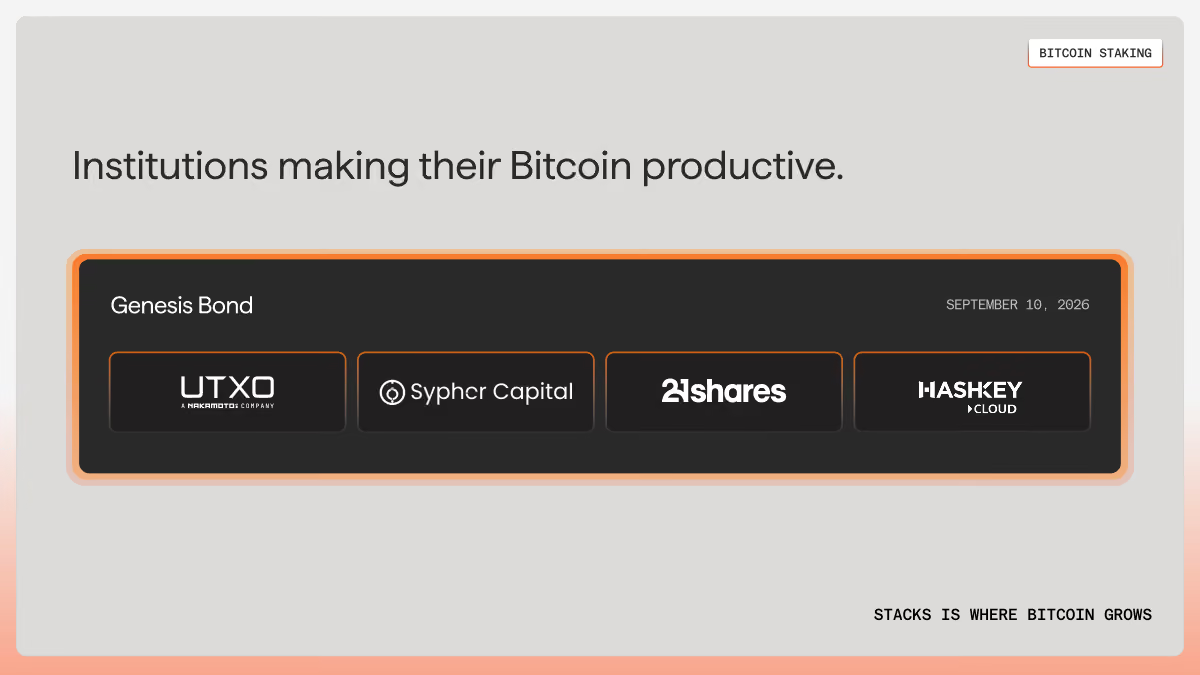
The model is already being used with institutional capital. The Genesis Bond launched in September 2026 with UTXO Management, 21Shares, HashKey, and Sypher Capital participating.
What Is Institutional Bitcoin Staking?
Institutional Bitcoin staking refers to using BTC in a protocol level staking mechanism while meeting institutional requirements around custody, liquidity, and risk.
On Stacks, this takes the form of a protocol bond. Participants pair native BTC on Bitcoin L1 with STX locked on Stacks. The BTC remains under the participant’s keys while the bond earns BTC rewards funded through Proof of Transfer.
Bitcoin itself does not use Proof of Stake. Bitcoin Staking on Stacks instead uses a mechanism connected to Stacks’ Proof of Transfer consensus, which has distributed more than 4,200 BTC since 2021.
This is different from lending BTC to a borrower, depositing it with a centralized company, or earning yield through temporary token incentives.
For institutions, that creates a structure where custody, source of yield, reward asset, liquidity terms, and protocol risk can each be evaluated separately.
How Does Bitcoin Staking on Stacks Work?
Bitcoin Staking is built into Stacks’ Proof of Transfer, or PoX, consensus system.
Stacks miners commit BTC to compete for the right to produce Stacks blocks and receive STX block rewards and transaction fees. That miner BTC forms the source from which Bitcoin Staking rewards are paid.
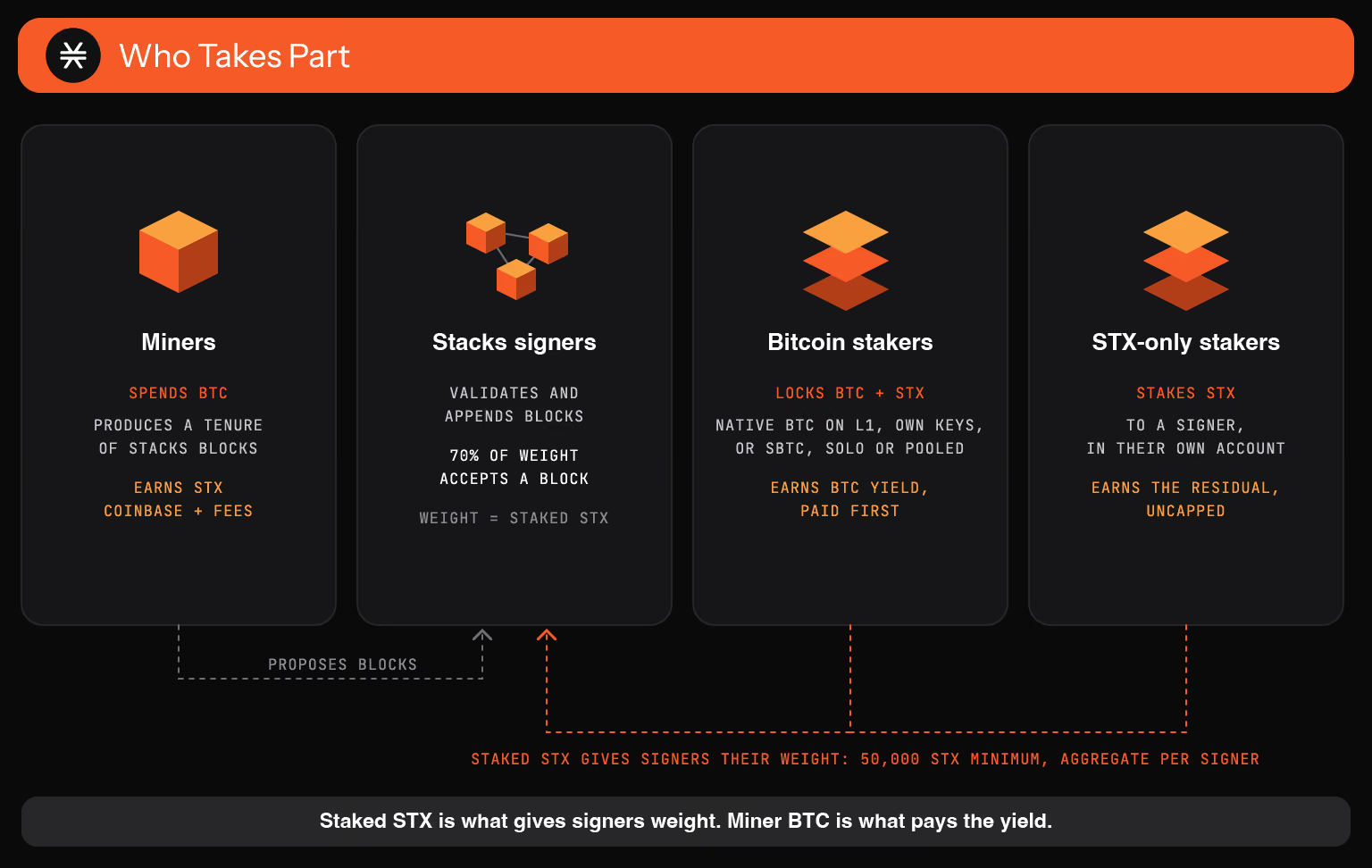
For the direct self custodial route, a protocol bond contains two assets:
BTC on Bitcoin L1. The Bitcoin is locked using a standard Bitcoin timelock and remains under the participant’s keys.
STX on Stacks. During the current bootstrap phase, the bond pairs the BTC position with STX worth approximately 5% of its value.
Bitcoin Staking currently targets approximately 3% annualized BTC yield during the bootstrap phase. Rewards are distributed weekly in BTC. The target rate is not guaranteed and can vary with miner activity and protocol conditions.
The standard bond term is approximately six months. BTC can also be exited before maturity. Exiting early forfeits future BTC rewards, while the paired STX remains locked until the original term ends.
At maturity, the Bitcoin timelock expires and the BTC becomes spendable again by its owner.
What Makes Bitcoin Staking on Stacks Suitable for Institutions?
Several characteristics of Bitcoin Staking on Stacks are particularly relevant to institutional BTC holders.
Native Bitcoin stays under the holder’s custody. The direct staking path lets institutions keep BTC on Bitcoin L1 under their own keys instead of transferring it to a bridge, lending counterparty, or staking provider. This allows existing custody controls around the underlying Bitcoin to remain in place.
BTC yield comes from ongoing protocol economics. Rewards come from BTC committed by Stacks miners through Proof of Transfer. The bonded Bitcoin is not lent or rehypothecated to generate the return, and rewards do not depend on temporary token emissions. Yield is paid directly in BTC.
The risk and liquidity terms are defined upfront. Bitcoin Staking has no protocol slashing mechanism. The early exit mechanism also gives institutions a way to recover BTC before the approximately six month term ends if liquidity needs change. The tradeoff is forfeiting future BTC rewards while the paired STX remains locked.
Institutions still need to evaluate STX price exposure, operational risk, and variability in BTC rewards.
Institutional custody and transaction approval infrastructure supports the operational workflow. Fordefi provides institutional MPC wallet support for Bitcoin Staking. Fireblocks supports the current self custodial workflow, while Anchorage Digital is building support through Anchorage Digital Bank.
These providers do not all offer the same implementation. Together, they extend Bitcoin Staking into custody, transaction approval, and security infrastructure institutions already use.
When evaluating Bitcoin staking platforms, institutions can use the following framework:
Other routes to Bitcoin yield work differently. Custodial lending transfers BTC to a counterparty that can lend it out, wrapped BTC strategies introduce a bridge or additional custody layer, and some staking models pay rewards in a separate token. Bitcoin Staking on Stacks keeps native BTC on Bitcoin L1 and pays rewards in BTC from miner activity. The tradeoffs include STX price exposure, variable BTC rewards, and an approximately six month term, although BTC can be exited early by forfeiting future rewards.
Institutional grade Bitcoin staking should ultimately be evaluated through these mechanics rather than through the label itself.
Institutions should be able to identify where their Bitcoin sits, who controls it, what generates the return, what risks can affect the position, and how capital can be exited.
Request Institutional Bitcoin Staking Access
Bitcoin Staking on Stacks is moving from its initial institutional cohort into broader participation.
Institutions evaluating the direct self custodial path can request access through the institutional Bitcoin Staking page.
Institutional Bitcoin Staking FAQ
Are there Bitcoin staking platforms with institutional-grade custody?
Yes. Bitcoin Staking on Stacks is live with institutional participation and can be accessed through institutional custody and transaction approval infrastructure. Direct participants keep native BTC on Bitcoin L1 rather than bridging or lending it. Fordefi and Fireblocks support institutional workflows around Bitcoin Staking, while Anchorage Digital is building support through Anchorage Digital Bank.
Can institutions stake Bitcoin while keeping self custody?
Yes. The direct Bitcoin Staking path on Stacks keeps native BTC on Bitcoin L1 under the participant’s keys. The BTC is locked through a standard Bitcoin timelock rather than moved to another blockchain or transferred to a staking provider. UTXO Management, 21Shares, and HashKey used this self custodial structure in the Genesis Bond.
Where does the Bitcoin staking yield come from?
Bitcoin Staking yield on Stacks comes from Stacks miners. Through Proof of Transfer, miners commit BTC to compete for Stacks block production. That BTC funds rewards for staking participants. The yield does not come from lending the bonded Bitcoin or from temporary token incentives, and rewards are paid in BTC.
Does Bitcoin Staking on Stacks have slashing?
No. Bitcoin Staking on Stacks does not have a protocol slashing mechanism that can reduce bonded BTC because of participant behavior or downtime. This does not make Bitcoin Staking risk free. Institutions still need to evaluate STX price exposure, operational risk, and variability in BTC rewards.
How long is Bitcoin locked, and can institutions exit early?
The current Bitcoin Staking bond runs for approximately six months. BTC can be exited before maturity through the early exit mechanism, giving participants additional liquidity flexibility. Exiting early forfeits future BTC rewards, while the paired STX remains locked until the original bonding term ends.
Get more of Stacks
Get important updates about Stacks technology, projects, events, and more to your inbox.