Zest, the Bitcoin lending app on Stacks, launched Stacks Pools on November 10, 2026, a trading venue live on Stacks mainnet with STX/USDCx and ZEST/STX pools (USDCx is the USDC stablecoin on Stacks). Stacks Pools run on Zest Protocol CLMM, Zest's concentrated liquidity market maker, where liquidity providers place capital within a chosen price range, which gives traders deeper markets near the current price and earns providers more fees per dollar deposited while the price trades in their range.
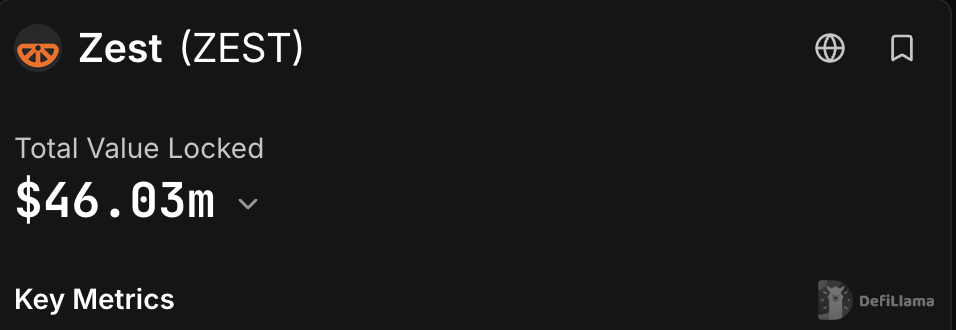
Zest holds $45 million in total value locked (TVL) as of November 10, 2026, according to DefiLlama.
Zest has run lending markets on Stacks since 2024. Holders supply sBTC (the 1:1 Bitcoin-backed asset on Stacks) and stBTC (the liquid staking token on Stacks) to earn BTC, or borrow stablecoins against them. Of the 636 BTC of stBTC on Stacks, 97% is posted on Zest, and the protocol has executed more than 1,500 liquidations without bad debt.
Concentrated liquidity is the standard way to provide liquidity on most major chains, and Stacks Pools bring Zest's version to Stacks. $ZEST already trades on three other chains, and market makers can bring the strategies they already run there.
How Concentrated Liquidity Works on Stacks Pools
Zest Protocol CLMM divides each pool's price range into small bins, and each bin trades as its own curve between two price edges. Inside a bin the price moves smoothly with every trade, and when a bin runs out of liquidity, the trade continues into the next bin at the price where the last one ended.
Liquidity providers on Zest's Stacks Pools choose which bins to fill and earn a share of trading fees while the price trades through them, so capital placed near the current price works harder than capital spread across every possible price. Fees compound directly into each bin, so providers have nothing to claim, and deposits can be made in any ratio of the two tokens. When the price moves outside a provider's bins, that liquidity stops earning fees and sits entirely in one of the two tokens. The Stacks Pools docs cover pool settings, fees and how bins work in detail.
Who Stacks Pools Are For
Traders on Zest's Stacks Pools get less price impact because liquidity sits close to the current price, and a swap settles in a single Stacks transaction. Market makers can run the same strategies they use on other chains, because a price range on Zest Protocol CLMM behaves like a standard concentrated liquidity range.
Liquidity providers who want their range managed for them can use Liquidity Vaults, which go live alongside the pools. A Liquidity Vault lets a market maker manage a provider's range while the tokens stay in the vault contract, and the provider can withdraw at any time.
Why Trading Belongs Next to Lending on Zest
Bitcoin lacks native capital markets, the yield, credit and trading markets that make other assets productive, and Zest's Stacks Pools add trading to the app where most stBTC on Stacks is already lent and borrowed. Holders who lend or borrow on Zest can now trade and provide liquidity in the same app, without moving assets to a separate venue.
The launch pools give STX a dollar market on Stacks and bring $ZEST to Stacks alongside its markets on other chains. Next up, Zest is launching pools for:
- sBTC/USDCx
- STX/stSTX (stSTX is StackingDAO's liquid staking token for STX)
- sBTC/stBTC
These extend trading to the BTC and staked assets that holders already use across Zest.
What the Launch Means for Bitcoin Capital Markets on Stacks
Stacks is building Bitcoin capital markets, starting with Bitcoin staking, and Zest's Stacks Pools add trading depth to the apps where that capital is used. Bitcoin capital markets run on STX, and both launch pools are paired with it. Every swap or change to a liquidity position pays its network fee in STX, like every transaction on Stacks.
In 2027, self-custodial borrowing will let holders borrow stablecoins against staked BTC while it keeps earning. The STX/USDCx pool already gives those stablecoins a market on Stacks.
How to Get Started With Stacks Pools
- Open the Zest app and connect a Stacks wallet that holds the tokens for the pool you want to join.
- Choose a pool and pick the bins for your liquidity, using a wider range for a more passive position or bins close to the current price to concentrate capital where most trading happens. To have a market maker manage the range for you, deposit into a Liquidity Vault instead.
- You can move your range when the price leaves it or withdraw at any time.
- Read the Stacks Pools docs for pool settings, fees and how bins work in detail.
Frequently Asked Questions
What is a concentrated liquidity market maker?
A concentrated liquidity market maker (CLMM) is a type of automated market maker where liquidity providers choose the price range for their capital instead of spreading it across every possible price. This gives traders deeper liquidity near the market price and lets providers earn more fees per dollar deposited while the price trades in their range.
Which pools are available on Stacks Pools?
Stacks Pools launched on Stacks mainnet with STX/USDCx and ZEST/STX pools. Zest is launching sBTC/USDCx, STX/stSTX and sBTC/stBTC pools next, and the Stacks Pools docs list the current pools and their settings.
How do liquidity providers earn on Stacks Pools?
Liquidity providers on Stacks Pools earn a share of the swap fee on every trade that passes through their bins. Those fees compound into each bin, so the value of a provider's share grows without any claiming.
How do bins in Zest Protocol CLMM work?
Each bin in Zest Protocol CLMM trades on the same curve as a single-range concentrated liquidity position one bin wide, but every provider in a bin shares that curve and holds interchangeable share tokens. That lets fees be tracked per bin instead of per position, and lets Liquidity Vaults hold positions on a provider's behalf.
Has Zest Protocol CLMM been audited?
The Zest Protocol CLMM and Liquidity Vault contracts were audited by Clarity Alliance, a smart-contract security firm, and the full report is available in Zest's Security and Audits page.
Stacks is where Bitcoin earns.
Get more of Stacks
Get important updates about Stacks technology, projects, events, and more to your inbox.