Best Bitcoin Staking Options for Small Amounts of BTC on Stacks
You do not need to hold a large amount of Bitcoin to access Bitcoin Staking. On Stacks, smaller BTC holders can participate through pooled Bitcoin Staking with Xverse, Esbee by Fast Pool, and through liquid Bitcoin Staking with Stacking DAO.
These routes aggregate smaller deposits into Bitcoin Staking positions, removing the need to meet the requirements of a direct bond. Direct Bitcoin Staking currently targets around 3% APY in BTC, while pooled and liquid Bitcoin Staking currently offer around 2.4–2.5% APY, depending on the provider and product. Rates vary over time and are not guaranteed.
Can You Stake Small Amounts of Bitcoin?
Yes. Pooled and liquid Bitcoin Staking make it possible to participate with much smaller BTC positions.
Direct Bitcoin Staking is currently primarily designed for larger approved participants during the bootstrap phase, with a 50+ BTC threshold for the self custodial route. Pools provide the open path for everyone else, without the same minimum or approval process.
There is no universal minimum across every Bitcoin Staking pool because each provider sets its own requirements. For example, Stacking DAO currently supports stBTC deposits starting from 0.00001 sBTC, subject to available capacity.
This means holders do not need 1 BTC, or even close to 1 BTC, to access Bitcoin Staking on Stacks.
How Does Bitcoin Staking on Stacks Work?
Bitcoin Staking on Stacks lets BTC holders earn BTC denominated rewards generated through Proof of Transfer, or PoX.
Stacks miners commit BTC to compete for the right to produce blocks and earn STX block rewards. The BTC committed by miners is distributed to network participants. This mechanism has operated since January 2021 and has distributed more than 4,200 BTC.
Bitcoin Staking builds on this existing BTC reward flow.
A direct Bitcoin Staking position combines BTC with STX worth approximately 5% of the BTC position. The Bitcoin Staking position receives BTC rewards, with an initial protocol target of around 3% annualized APY.
For smaller holders, pools manage the underlying Bitcoin Staking position on behalf of multiple participants. BTC enters through sBTC, a 1:1 Bitcoin backed asset on Stacks. Stacks miners commit BTC through Proof of Transfer, and a portion of those rewards is allocated to Bitcoin Staking bonds, including pooled and liquid positions using sBTC. If starting with native BTC, users can first convert it to sBTC through the sBTC Bridge.
Pooled vs Liquid Bitcoin Staking for Small BTC Amounts
Pooled and liquid Bitcoin Staking both aggregate smaller BTC positions into larger Bitcoin Staking positions, making them more practical for holders who do not meet the requirements of the direct route.
The main difference is how the position is managed and what the user receives in return.
The underlying yield source is the same. In both cases, BTC committed by Stacks miners through Proof of Transfer funds Bitcoin Staking rewards.
Each provider can have different fees, requirements and mechanics, so the APY shown to users can differ from the protocol level target.
Pooled Bitcoin Staking
Pooled Bitcoin Staking combines deposits from multiple users into a larger Bitcoin Staking position.
Two pooled options are currently available.
Xverse provides a Bitcoin Staking interface where users can join the pooled route. Its Bitcoin Staking position uses sBTC together with STX, with rewards paid in sBTC.
Esbee by Fast Pool provides another pooled route and follows the same basic model, using sBTC together with STX to participate in Bitcoin Staking.
Because deposits are aggregated, individual users do not need to meet the capital requirements of a direct Bitcoin Staking position.
Liquid Bitcoin Staking
Liquid Bitcoin Staking also pools BTC, but users receive a token representing their position.
With Stacking DAO, users can start with BTC or sBTC and receive stBTC, its liquid staking token for Bitcoin. Native BTC first moves through the sBTC peg path before entering the underlying Bitcoin Staking position.
stBTC represents a Bitcoin Staking position while remaining transferable and usable across Stacks DeFi. The underlying BTC continues earning Bitcoin Staking rewards while the user holds stBTC.
Stacking DAO also manages the STX needed for the underlying Bitcoin Staking position, so users do not need to maintain a separate STX allocation themselves.
Rewards accrue to the assets backing stBTC, meaning the amount of sBTC represented by each stBTC increases as Bitcoin Staking rewards are earned.
How to Stake a Small Amount of Bitcoin
Smaller Bitcoin holders can choose between a pooled or liquid Bitcoin Staking route.
Option 1: Use a Bitcoin Staking Pool
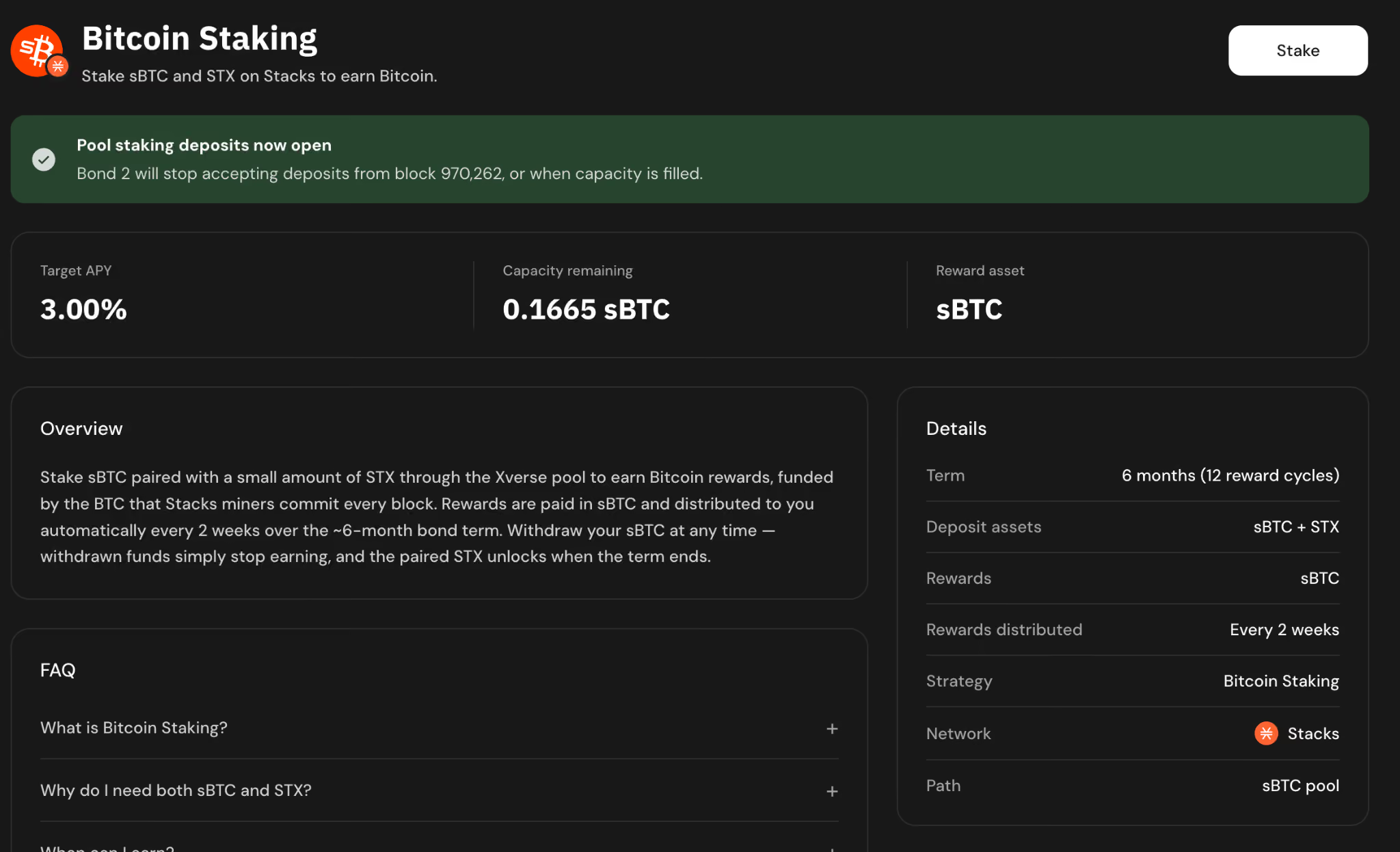
Users can participate through Xverse, Esbee by Fast Pool. The process generally involves:
1. Open the pool's Bitcoin Staking interface.
2. Connect a supported wallet.
3. Select the amount you want to stake.
4. Provide the assets required by the pool and confirm the transaction.
Xverse and Esbee by Fast Pool both use an sBTC and STX position for pooled Bitcoin Staking, with rewards paid in sBTC.
Because each pool determines its own terms, users should check the current capacity, minimum deposit, STX requirement and APY before depositing.
Option 2: Use Liquid Bitcoin Staking
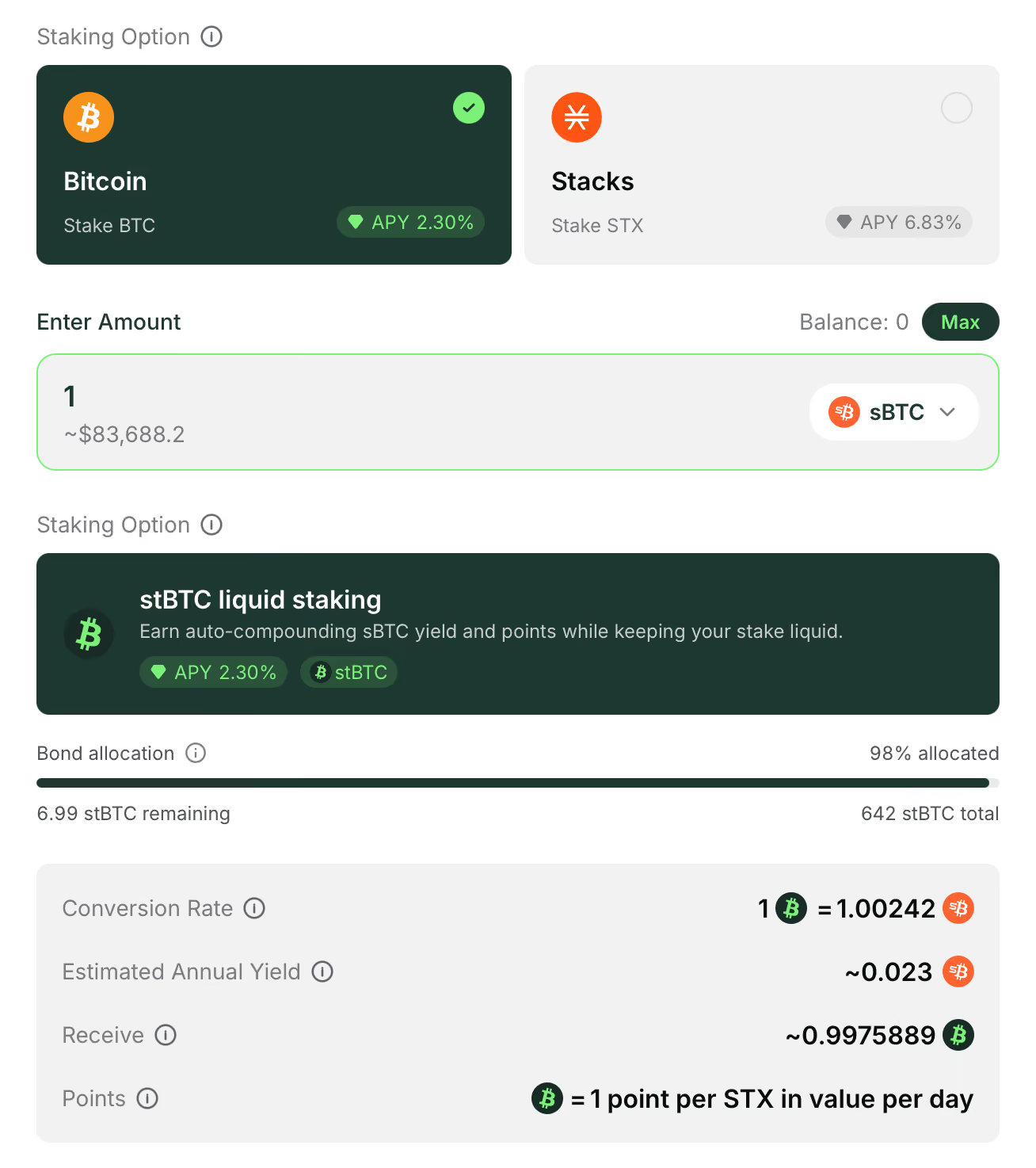
For liquid staking, users can access Bitcoin Staking through Stacking DAO. The process is:
1. Open Stacking DAO and connect a supported wallet.
2. Select Bitcoin Staking.
3. Deposit BTC or sBTC.
4. Receive stBTC representing the liquid Bitcoin Staking position.
Stacking DAO handles the underlying STX pairing and Bitcoin Staking position. The user holds stBTC while rewards accrue to the assets backing it.
The Stacking DAO interface currently lists a minimum of 0.00001 sBTC, although available capacity can change between bonding periods.
Open Stacking DAO Bitcoin Staking
What Should You Consider Before Choosing a Bitcoin Staking Option?
Pooled Bitcoin Staking has different risks from the direct self custodial route.
When participating through a pool, BTC moves onto Stacks as sBTC. sBTC is backed 1:1 by BTC and secured by a decentralized signer set, but this introduces additional trust assumptions compared with holding BTC directly under your own keys on Bitcoin L1.
Users also depend on the pool or protocol to manage the underlying Bitcoin Staking position correctly.
Liquid staking introduces an additional smart contract layer because stBTC represents the underlying Bitcoin Staking position.
Returns are also variable. Direct Bitcoin Staking currently targets around 3% annualized BTC APY, while pooled and liquid routes currently offer around 2.4–2.5% APY. Actual rates depend on the provider, fees and protocol conditions and are not guaranteed.
Finally, pool capacity can be limited. Available deposits may therefore change between Bitcoin Staking bonding periods.
Which Bitcoin Staking Option Is Best for Small BTC Holders?
There is no single best route for every BTC holder.
Xverse and Esbee by Fast Pool may be preferable if the goal is to join a pooled Bitcoin Staking position without using a liquid staking token.
Stacking DAO may be preferable if liquidity is important. Users receive stBTC, do not need to manage the STX pairing themselves, and can continue using their position across supported Stacks DeFi while it earns Bitcoin Staking rewards.
For smaller holders, the main decision is whether they want a standard pooled position or a liquid representation of that position.
To compare the current deposit requirements, capacity, mechanics and rates across available providers, explore the Bitcoin Staking options on Stacks.
FAQ
Can I stake less than 1 BTC?
Yes. You do not need to hold 1 BTC to use pooled or liquid Bitcoin Staking. Individual minimums depend on the provider. Stacking DAO, for example, currently lists a minimum stBTC staking deposit of 0.00001 sBTC.
How much can I earn staking a small amount of Bitcoin?
Direct Bitcoin Staking currently targets around 3% annualized APY in BTC, while pooled and liquid routes currently offer around 2.4–2.5% APY. For example, at a 2.5% annualized rate, a 0.01 BTC position would earn roughly 0.00025 BTC over one year if the rate remained unchanged. Actual rewards vary and are not guaranteed.
Do I need STX to stake a small amount of Bitcoin?
It depends on the route. Xverse and Esbee by Fast Pool use sBTC together with STX for pooled Bitcoin Staking. With Stacking DAO, users do not need to provide the STX pairing separately because the protocol manages it as part of the underlying position.
Is my Bitcoin locked when using pooled or liquid Bitcoin Staking?
Pooled positions follow the lock and withdrawal terms of the pool. With Stacking DAO, users receive liquid stBTC, which can be transferred or used across Stacks DeFi and redeemed for sBTC through available reserve liquidity or the standard withdrawal process.
What is the best Bitcoin Staking option for small BTC amounts?
Pooled staking through Xverse or Esbee can work well for users who want straightforward access to a shared Bitcoin Staking position. Liquid staking through Stacking DAO can be better suited to users who want to retain liquidity through stBTC and avoid managing the underlying STX pairing themselves.
Get more of Stacks
Get important updates about Stacks technology, projects, events, and more to your inbox.