How to Get Started with Bitcoin Staking
To start staking Bitcoin on Stacks, you need BTC and a participation route: direct, pooled, or liquid Bitcoin Staking.
Direct Bitcoin Staking lets BTC holders earn BTC denominated yield through Stacks by bonding BTC with STX, while keeping native BTC under their own keys on Bitcoin L1. Pooled staking uses sBTC and STX, while liquid staking through Stacking DAO lets users participate without providing the STX pairing themselves.
Bitcoin Staking lets BTC holders earn BTC denominated yield through Stacks. The right route depends mainly on position size, custody requirements, whether you want to provide STX yourself, and how much liquidity you need.
This guide explains how Bitcoin Staking works and how institutions and individual BTC holders can get started.
What Is Bitcoin Staking?
Bitcoin Staking on Stacks lets BTC holders earn BTC denominated yield by bonding Bitcoin with STX, while keeping the BTC self custodial on Bitcoin L1. The BTC is locked with a standard Bitcoin script rather than transferred to a custodian or bridge.
The yield comes from Stacks miners. Through Proof of Transfer, miners commit BTC for the right to produce Stacks blocks, and that BTC is distributed to staking participants. The yield therefore comes from miner activity, not token emissions or lending. Proof of Transfer has been live since January 2021 and has distributed more than 4,500 BTC to participants.
For direct Bitcoin Staking, BTC is paired with STX worth approximately 5% of the bonded BTC position. The STX provides staking capacity and remains locked for the bonding period, while all protocol bond yield accrues to the BTC side. Direct Bitcoin Staking currently targets roughly 3% APY paid in BTC.
Direct Bitcoin Staking has no protocol slashing. If rewards are missed or forfeited, the bonded BTC or STX is not confiscated by the protocol.
Pooled and liquid staking access the same underlying Proof of Transfer yield but use different custody, asset, and liquidity structures.
How Does Bitcoin Staking Work?
Proof of Transfer connects four main participants in the Stacks system: miners, signers, Bitcoin stakers, and STX stakers. Miners commit BTC, staked STX gives signers weight in consensus, and Bitcoin stakers earn BTC yield from the miner BTC flow.
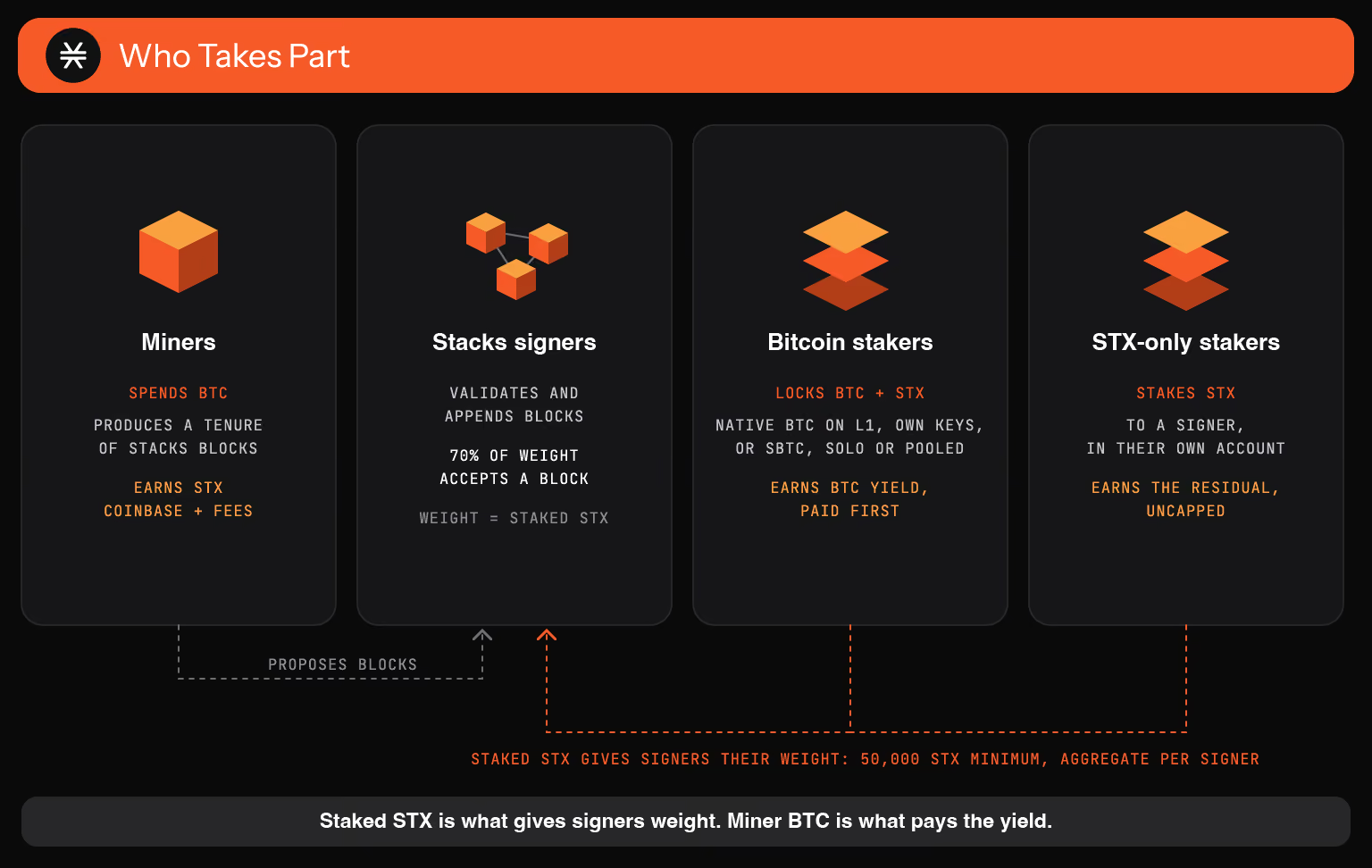
The direct Bitcoin Staking process can be broken into four steps.
1. Create a protocol bond
A direct protocol bond pairs BTC with STX.
The BTC is locked on Bitcoin L1 using OP_CHECKLOCKTIMEVERIFY, a standard Bitcoin timelock. The Bitcoin remains under the participant's keys rather than being bridged, wrapped, or transferred to a third party.
At the same time, STX worth approximately 5% of the BTC position is locked on Stacks. The STX determines the staking capacity available to the Bitcoin position.
2. Stacks miners commit BTC
Stacks miners commit BTC as they compete for the right to produce Stacks blocks and earn STX block rewards and transaction fees. That miner BTC is the economic source of Bitcoin Staking rewards.
3. Bitcoin Staking participants earn BTC
Active protocol bonds are paid from the BTC committed by miners. Direct Bitcoin Staking currently targets approximately 3% APY, with rewards paid in BTC roughly every week. The rate is a target rather than a guaranteed return and can vary with miner economics.
4. BTC unlocks at the end of the bond
A direct bond currently lasts approximately six months.When the bond ends, the Bitcoin timelock expires and the BTC becomes spendable again. The paired STX also unlocks.
BTC can also be unstaked early. The participant receives the BTC back but forfeits the remaining future yield, while the paired STX stays locked until the original bonding period ends.
There is no protocol slashing mechanism that reduces the bonded BTC or STX as a penalty.
What Do You Need to Start Staking Bitcoin?
The requirements depend on whether you choose direct, pooled, or liquid Bitcoin Staking: direct requires native BTC and STX, pooled requires sBTC and STX, while liquid staking through Stacking DAO handles the STX pairing for users.
During the current bootstrap phase, direct self custodial Bitcoin Staking is designed for anchor participants with 50+ BTC, with capacity allocated for each bonding period.
Pooled Bitcoin Staking removes the protocol level 50 BTC minimum. Individual pools determine their own capacity, requirements, and terms.
How Can Institutions Start Bitcoin Staking?
Institutions can start Bitcoin Staking by requesting access to a direct protocol bond, securing capacity for a bonding period, and preparing BTC and STX custody.
The current process is:
1. Request access: Direct participation operates through a managed approval process during the bootstrap phase.
2. Prepare and allocate BTC and STX: A direct bond requires both assets. The current path is designed for 50+ BTC positions, paired with STX worth approximately 5% of the BTC position.
3. Bond the assets: BTC is timelocked on Bitcoin L1 while the paired STX is locked on Stacks. Capacity for each bonding period is fixed and allocated to approved participants.
4. Receive BTC rewards: Rewards are distributed approximately weekly, with direct Bitcoin Staking currently targeting roughly 3% APY.
5. Unlock at maturity: After roughly six months, both assets unlock. BTC can be exited earlier by forfeiting future rewards, while STX remains locked for the original term.
Institutional custody and signing infrastructure
Bitcoin Staking is built to fit into established institutional custody and signing infrastructure, with support across providers including Fireblocks, Fordefi, Ledger + Leather, and Anchorage Digital. Institutions can use MPC infrastructure, hardware based self custody, and regulated bank custody depending on their setup.
The Genesis Bond launched on September 10, 2026. UTXO Management, 21Shares, and HashKey participated through the self custodial route, while Sypher Capital participated through liquid staking with Stacking DAO. In its first 14 days, the bond reached 230 BTC.
Bonding Period 2 opens October 10, 2026 with 500 BTC of capacity, more than double the Genesis Bond. Institutions and holders with 50+ BTC can request access for the upcoming period.
Request access for Bonding Period 2
How Can Individual BTC Holders Start Bitcoin Staking?
Individual BTC holders can currently access Bitcoin Staking through pooled or liquid staking routes without operating a direct 50+ BTC bond.
These routes use different custody models and participation requirements.
1) Pooled Bitcoin Staking
Pooled Bitcoin Staking aggregates individual positions into a protocol bond managed by a pool.
BTC moves onto Stacks as sBTC, a 1:1 Bitcoin backed asset secured by a decentralized signer set. Participants deposit sBTC together with the required STX, and the pool aggregates those positions and manages the underlying Bitcoin Staking bond.
With Xverse, users deposit sBTC together with unlocked STX worth approximately 5% of the sBTC position. The two assets are deposited into the pool, and rewards are paid in sBTC.
Fast Pool follows the same broad structure. Participants provide sBTC and the STX required for the underlying bond, while the pool manages the staking position.
Pool capacity, deposit windows, bond terms, rewards, and withdrawal mechanics can vary, so participants should check the current conditions of the specific pool before depositing.
Pooled staking lowers the entry barrier compared with operating a direct bond, but introduces the technical assumptions of sBTC and the selected pool.
2) Liquid Bitcoin Staking
Liquid Bitcoin Staking lets BTC holders participate while keeping their staking position transferable.
Stacking DAO's stBTC is a liquid Bitcoin Staking token. Users enter with sBTC, or native BTC through the current deposit route shown in the Stacking DAO app, and receive stBTC.
Bitcoin Staking rewards accrue in sBTC. As rewards accumulate, each stBTC represents an increasing amount of underlying sBTC. Because stBTC remains liquid, it can also be deployed across supported Stacks DeFi applications to earn additional yield on top of the underlying Bitcoin Staking yield.
Users do not need to supply the STX pairing separately. Stacking DAO handles the STX required for the underlying Bitcoin Staking positions on behalf of stBTC users.
Deposit capacity can vary between bond cycles. When deposits are available, users can use the current BTC or sBTC deposit route shown in the Stacking DAO app. When capacity is full or unavailable, users can join the stBTC waitlist.
Using stBTC introduces additional smart contract and liquidity risks, which can increase further when stBTC is deployed in DeFi.
Which Bitcoin Staking Option Should You Choose?
Choose direct Bitcoin Staking if you are an institution or larger BTC holder looking to keep native BTC under your own keys on Bitcoin L1. During the current bootstrap phase, direct participation is designed for approved 50+ BTC positions and requires the STX pairing alongside the Bitcoin bond. Direct staking currently targets approximately 3% APY paid in BTC.
Choose pooled Bitcoin Staking if you have a smaller position, are comfortable using sBTC, and want to provide the required STX yourself while a pool manages the underlying bond. This lowers the entry barrier but adds the technical assumptions of sBTC and the selected pool.
Choose liquid Bitcoin Staking if you want to keep the staking position transferable and do not want to provide the STX pairing yourself. Stacking DAO handles the STX requirement for the underlying Bitcoin Staking positions while you receive stBTC. stBTC can then remain usable across supported DeFi applications while earning BTC yield.
The main tradeoffs are custody, position size, STX requirements, liquidity, capacity, and additional smart contract exposure.
Start Bitcoin Staking on Stacks
Whether you want to participate through direct, pooled, or liquid Bitcoin Staking, the right path depends on your BTC position, custody requirements, STX requirements, and liquidity needs.
Explore the available Bitcoin Staking options on Stacks to compare the different participation routes.
For institutions and larger BTC holders looking to participate through a direct self custodial bond, request access to Bitcoin Staking.
Bitcoin Staking FAQ
1) Where does Bitcoin Staking yield come from?
Bitcoin Staking yield comes from BTC committed by Stacks miners through Proof of Transfer. Miners commit BTC to compete for the right to produce Stacks blocks, and that BTC is distributed to staking participants.
2) Do I need STX to stake Bitcoin?
It depends on the route. Direct Bitcoin Staking and current pooled routes require participants to provide STX alongside their Bitcoin position, generally worth around 5% of the BTC position. With Stacking DAO's liquid staking route, Stacking DAO handles the STX pairing on behalf of stBTC users.
3) How much Bitcoin do I need to start staking?
Direct Bitcoin Staking currently targets approved participants with 50+ BTC during the bootstrap phase. Pooled and liquid staking allow smaller positions to participate, subject to each provider's requirements, available capacity, and deposit terms.
4) Can I stake Bitcoin while keeping self custody?
Yes, through direct Bitcoin Staking. Native BTC remains under your keys on Bitcoin L1 and is locked using a standard Bitcoin timelock rather than being transferred to a custodian or bridge. Pooled and liquid staking instead use sBTC based custody structures.
5) How long is Bitcoin locked when staking?
A direct Bitcoin Staking bond currently lasts roughly six months. BTC can be unstaked early by forfeiting the remaining future rewards, but the paired STX remains locked until the original bonding period ends. Pooled and liquid staking have their own withdrawal terms.
6) What yield does Bitcoin Staking pay?
Direct Bitcoin Staking currently targets roughly 3% APY paid in BTC. The rate is variable and depends on miner economics rather than being guaranteed. Pooled and liquid staking yields can differ based on provider mechanics, fees, liquidity, and how rewards are distributed.
Get more of Stacks
Get important updates about Stacks technology, projects, events, and more to your inbox.