Self-Custodial Bitcoin Borrowing Deep Dive: Borrowing Stablecoins Against Bitcoin
Self-custodial Bitcoin borrowing is a design for borrowing stablecoins against BTC that stays on the Bitcoin L1, timelocked under the borrower's custody. Stacks Labs is exploring it as part of building Bitcoin capital markets. Bitcoin is the world's leading digital asset, and borrowing lets BTC that already earns through staking also serve as capital, without being sold or handed over, making the same Bitcoin more productive.
The design starts with staked BTC. Because staked BTC continues to earn while it collateralizes a loan, the staking yield offsets the cost of borrowing. Other self-custodial options leave the collateral idle, so the borrower pays the full rate.
Most Bitcoin sits idle because it has no native yield, credit or trading markets. Bitcoin staking brings the yield: 1,740 BTC has been staked across the first three Stacks bonds, a fraction of the 4M+ BTC held by ETFs, companies, exchanges and governments. Borrowing brings the credit.
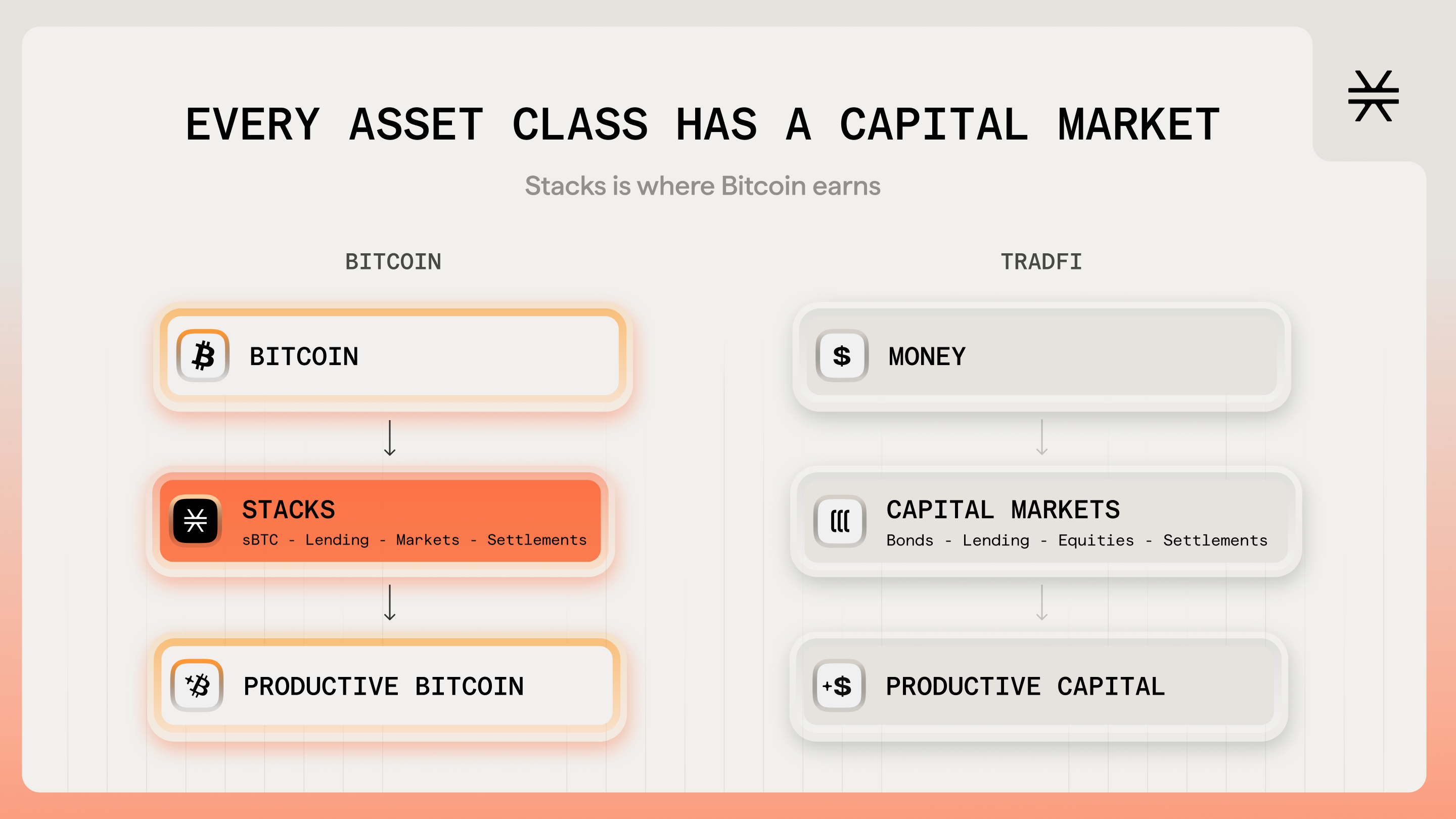
Today, holders who need liquidity usually sell their BTC or hand it over to borrow. Borrowing against staked BTC would complete the pairing traditional capital markets are built on: savings that earn, and that can be borrowed against.
Why Borrowing Against Bitcoin Usually Means Giving Up Custody
Under existing models, a borrower transfers BTC to a lender or custodian, or wraps it into a token on another chain. While pledged, the BTC typically earns nothing and may be rehypothecated by whoever holds it.
That structure concentrates custody and counterparty risk. In the last few years, several of the largest crypto lenders failed while holding client Bitcoin. For institutions, these risks remain the main barrier to borrowing against BTC.
How the Design Works
Three layers
The design splits a loan across three layers, each doing one job.
Bitcoin L1 holds the collateral
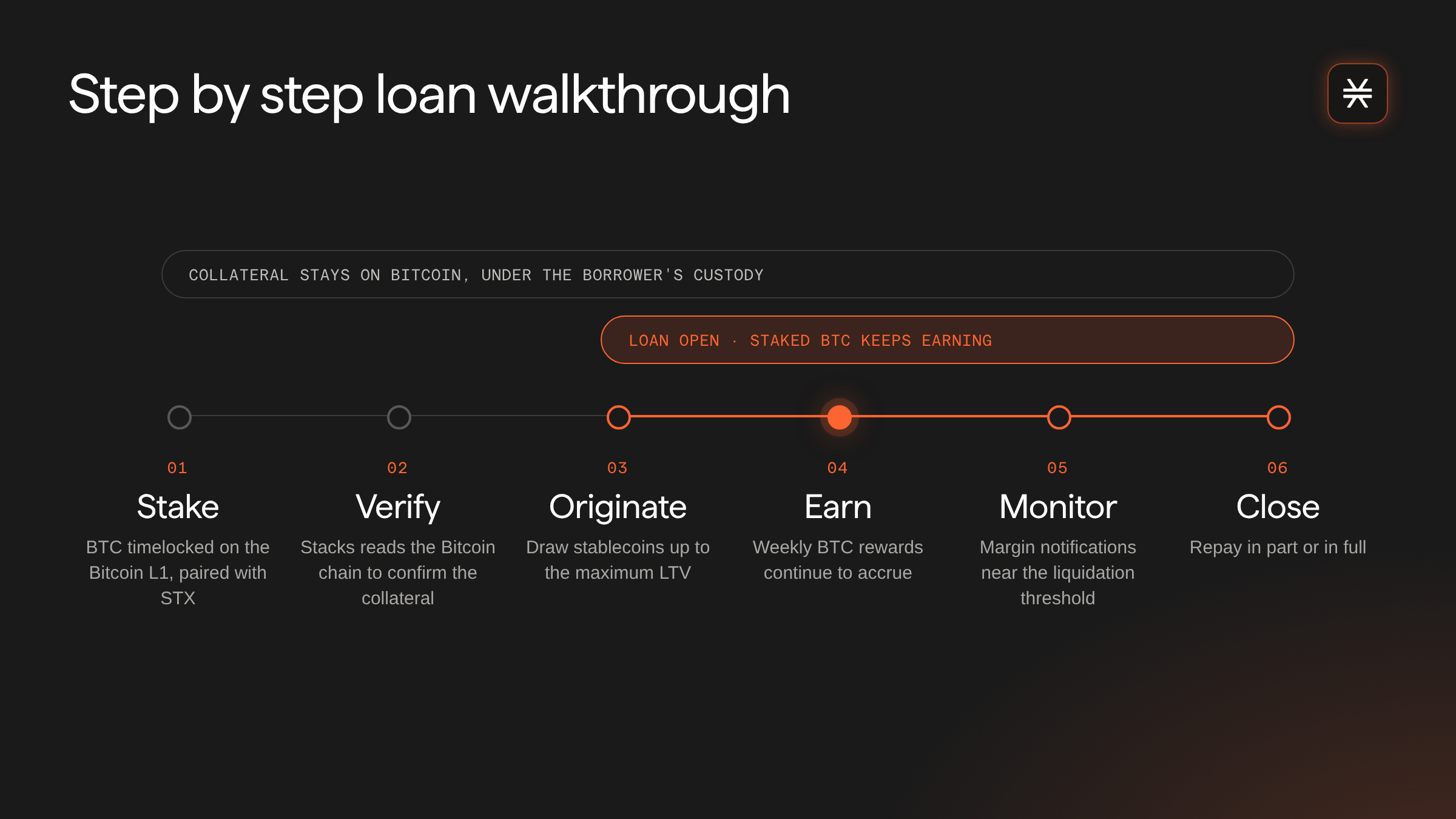
The BTC is locked with standard Bitcoin script (OP_CHECKLOCKTIMEVERIFY), the same timelock used in self-custodial Bitcoin staking today. It is not bridged, wrapped or converted to sBTC, and it stays under the borrower's custody.
Stacks records and enforces the loan
Stacks reads Bitcoin's state directly, so contracts on Stacks can verify the timelocked collateral on the L1 for the life of the loan. Stacks is exploring issuing the loan through its Proof of Transfer (PoX) consensus framework, against the staked position.
Lending markets on Stacks supply the stablecoins
Rather than build a new lending engine, the design draws on lending markets already live on Stacks, with USDCx, the Circle-backed stablecoin on Stacks, as the core dollar asset.
Collateral stays on the Bitcoin L1
The borrower's BTC remains on the Bitcoin L1 in a timelock under the borrower's custody for the life of the loan. No lender or platform takes possession of it, and it cannot be rehypothecated. A lender's claim on the collateral arises only if the loan reaches its liquidation threshold.
Origination
Against the timelocked BTC, the borrower draws stablecoins, available on Stacks at origination. The loan terms, including the interest rate, maximum loan-to-value (LTV) and liquidation threshold, are set at origination and do not change for the life of the loan.
Repayment
The borrower can repay in part or in full at any time, and the collateral is released on full repayment. The loan and its terms are recorded on Stacks, where they are enforced automatically. No company, lender or platform can alter them after origination.
Margin and liquidation
If the BTC price falls and the LTV rises toward the liquidation threshold, the borrower receives margin notifications and can restore the position by repaying part of the loan. If the threshold is reached, only the BTC needed to repay the outstanding loan is liquidated to the lender. The remaining collateral stays with the borrower.
Areas of active research
Stacks Labs will share details on each as it is settled:
- Liquidation: how collateral moves to a lender from the borrower's timelock, only once the liquidation threshold is reached.
- Loan and bond terms: what happens if a loan outlasts its bond.
- Price data: which feed measures LTV, and how it is secured.
- Rates and lenders: how rates, maximum LTV and liquidation thresholds are set, and who supplies the stablecoins.
- Network readiness: the 2027 consensus upgrade, deeper USDCx liquidity and higher Stacks throughput.
Starting With Staked Bitcoin
The first use case is borrowing against BTC in Bitcoin staking. Today, a holder who needs liquidity against staked BTC must exit staking and forgo the yield.
Self-custodial Bitcoin staking is whitelisted during the bootstrap phase, so borrowing in this design would begin with those participants. In 2027, an open auction through PoX-6 will let anyone stake BTC in the self-custodial path.
Net cost of carry
Staked BTC earns a 3% target annual yield per bond, set before the bond opens and fixed for its term. The yield is paid in BTC by Stacks miners through Proof of Transfer and continues to accrue while the loan is outstanding.
The borrower's net cost of carry is the loan rate less the staking yield. Where the loan rate is below the staking yield, the yield can cover the interest in full. Because the yield accrues in BTC and the loan is denominated in stablecoins, the size of that offset moves with the BTC price.
Illustrative example
The figures below are hypothetical and are not proposed loan terms.
A borrower stakes 50 BTC at the target yield and borrows $2,000,000 in stablecoins at a hypothetical 5% annual rate, with BTC at $100,000, a 40% LTV. Over one year, interest totals $100,000 and the staked BTC earns 1.5 BTC.
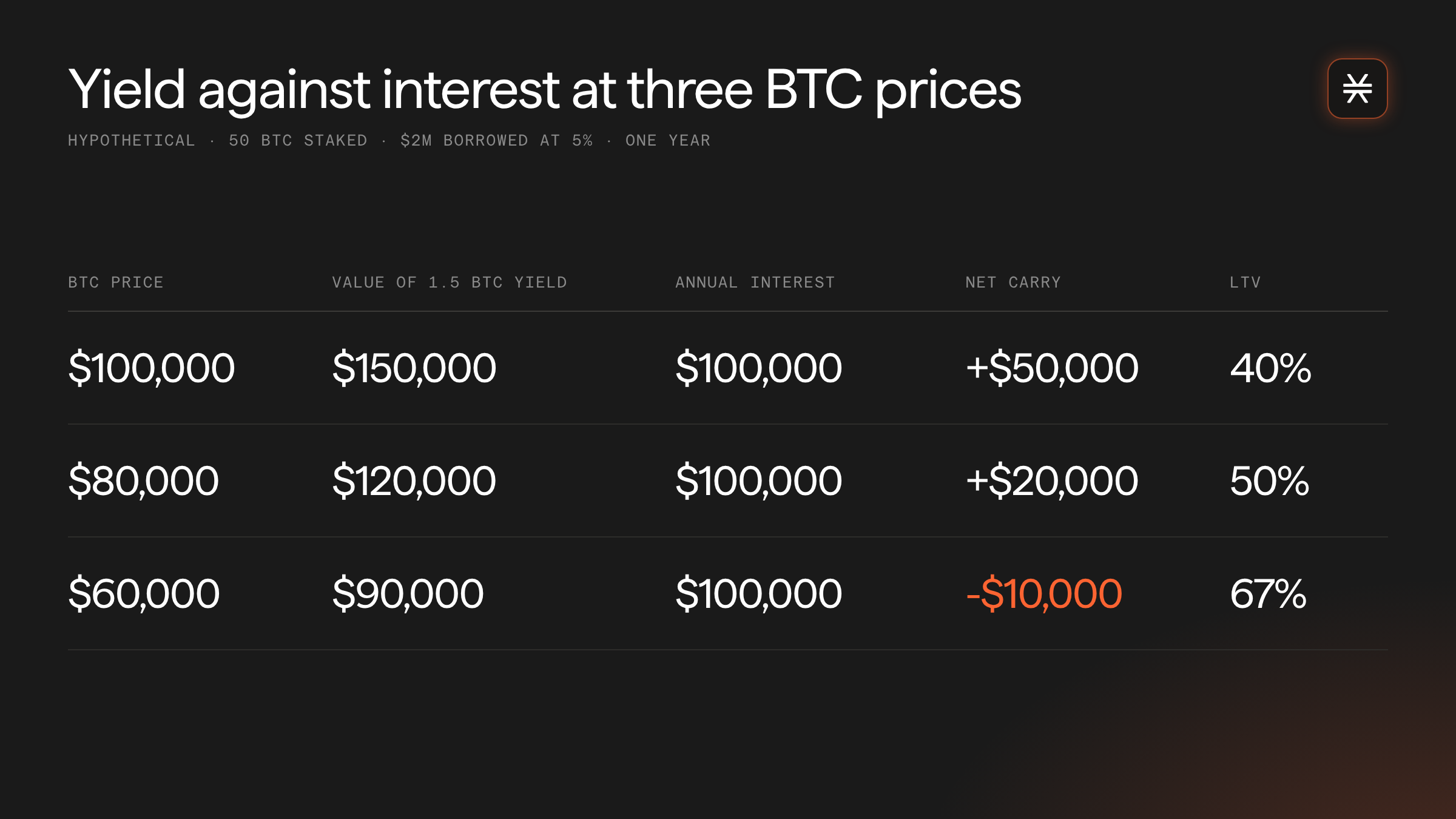
As the BTC price falls, the yield covers less of the interest and the LTV rises, which is where margin notifications and the liquidation threshold apply.
The closest traditional analog is a repurchase agreement (repo), in which a bondholder borrows cash against a bond that continues to pay its coupon. The comparison is illustrative rather than one-to-one.
Uses of Borrowed Stablecoins
Borrowed stablecoins are available on Stacks while the BTC collateral remains staked. A borrower can use them as working capital to meet operating expenses or obligations in dollars without selling BTC, hold them as treasury liquidity while keeping full BTC exposure, or deploy them in trading apps on Stacks.
Where STX Fits
In Bitcoin staking, each staked BTC is paired with STX, locked at a current parameter of 5% of the BTC value. STX is the staking capacity that underpins Bitcoin capital markets on Stacks.
In the current design, a loan locks no additional STX, so the same capacity supports both staking and borrowing. A staking position that can also be borrowed against is more useful to its holder, and with an open auction for staking capacity being researched for PoX-6, that utility would be reflected in STX bids.
What Comes Next
Self-custodial Bitcoin borrowing is one of several Research & Development tracks at Stacks Labs. Bitcoin staking demonstrated that BTC can earn while it stays on the Bitcoin L1 under the holder's custody. Borrowing extends the same capital to credit, without a sale or a transfer of custody.
Savings that earn and can be borrowed against are the basis of traditional capital markets, and staking and borrowing together would bring that pairing to Bitcoin. Stacks Labs will share further detail as the research progresses.
Borrowing in this design would begin with participants in self-custodial Bitcoin staking. Institutions that want to stake BTC today, or discuss their borrowing requirements as the research progresses, can contact the Stacks institutional team through the institutional Bitcoin staking page.
Bitcoin staking proved that BTC can earn without leaving its holder's custody, and self-custodial Bitcoin borrowing explores how that same Bitcoin can also back credit, deepening the productivity of Bitcoin capital as Stacks builds the markets the world's leading digital asset deserves.
Stacks is where Bitcoin earns.
Get more of Stacks
Get important updates about Stacks technology, projects, events, and more to your inbox.